Free NewsletterPro Login
S&P 500 6,287 +0.42%
DOW 44,521 -0.18%
NASDAQ 21,103 +0.71%
S&P 500 +12.4%
Briefs Finance Fund +24.8%
JOIN THE FUND →

Iran Just Started Cutting Oil Production. Tehran Says It Has A Playbook For This.

Published May 4, 2026
[tts_player]
Share:
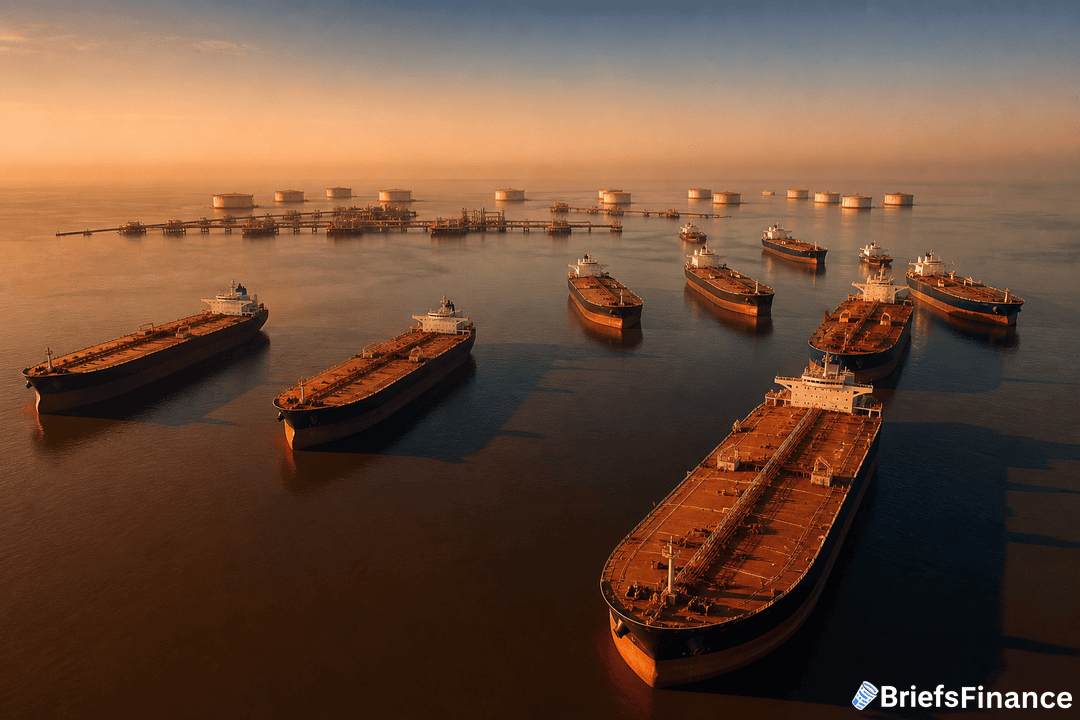
Aerial view of multiple oil tankers anchored near large storage tanks in a calm body of water at sunset, with a BriefsFinance watermark.
Summary:
  • Iran has begun cutting crude output to stay ahead of full storage tanks as the U.S. blockade strands tankers in the Persian Gulf.
  • Officials say the country has roughly a month of storage left at current production levels.
  • Iran can lean on 65 to 75 million barrels of floating storage, much of it on aging "dark" tankers in the Gulf.

The U.S. blockade was supposed to crush Iran's oil trade in days.

It hasn't.

Iran has started cutting crude output, and Tehran says it has done this before.

The Storage Squeeze

The blockade went into effect April 13, and exports have collapsed since then.

Tankers have been piling up off Kharg Island, Iran's main export hub.

About 18 ships that have hauled Iranian oil before are now parked in the Gulf, with room for up to 35 million barrels of crude, per data firm Kpler.

A senior Iranian official said the country has begun cutting output, and the cuts could touch as much as 30% of Iran's oil fields.

JPMorgan Chase and Kpler peg Iran's storage runway at about a month.

Wood Mackenzie sees roughly three weeks.

In all, Iran has 65 to 75 million barrels of floating storage to lean on, per Vortexa.

Much of that sits on older "dark" tankers inside the Gulf, ships that operate outside global shipping rules.

The blockade has frozen what was a 3.2 million barrel-a-day operation just last month.

Exports were holding near pre-war levels until the U.S. moved in.

The Playbook

Cutting output is risky.

Wells need steady underground pressure to stay healthy.

A sloppy shutdown can ruin them for good.

The White House is betting some of those wells won't come back.

Tehran says they will.

Iran spent years under the first Trump term learning to shut wells down and bring them back.

That muscle memory is what it's leaning on now.

"We have enough expertise and experience," said Hamid Hosseini, a spokesman for Iran's oil exporters group. "We're not worried."

Iran has also kept a small flow moving overland.

About 250,000 to 300,000 barrels a day are going to Turkey, Pakistan, Afghanistan, and Uzbekistan, per Hosseini.

Those volumes don't come close to replacing what once shipped by sea.

But they do keep some money flowing in while the blockade holds.

Whose Pain Lasts Longer

The flip side is the price tag.

Treasury Secretary Scott Bessent wrote on X this week that Kharg Island is "soon nearing capacity," pegging Iran's lost oil revenue at $170 million a day.

Iran's money also hit a record low against the dollar this week.

But the blockade is costing the U.S. too.

Oil prices hit a four-year high this week.

That feeds straight into gas pumps, jet fuel, and everything else that moves through U.S. supply chains.

"Washington is operating on a status-quo assumption that Iran will sit idly by and absorb this pressure and move toward collapse on a predictable timeline," said Brett Erickson at Obsidian Risk Advisors.

"That fundamentally misunderstands how regimes behave under sustained economic warfare. They do not fold, they adapt."

The U.S. Treasury also hit dozens of people this week tied to Iran's "shadow banking" network.

Among the targets were small Chinese refineries that have long been a key buyer of cheap Iranian crude.

What To Watch

Trump predicted last Sunday that Iran's oil setup would "explode" within three days.

That deadline came and went.

Tehran has done this before. Washington hasn't.
Disclosure

Recent News

1 2 3 28

Get Market Briefs delivered to your inbox every morning for free!

No fluff. No noise. No politics. Just finance news you can read in 5 minutes.

Blogs

June 25, 2026
How Stocks Work: A Simple Guide for Beginners
  • A stock is a slice of ownership in a company - buy one, and you own a piece of the business.
  • You make money two ways: the share price rising over time, and dividends paid to shareholders.
  • The simplest path for most beginners is buying into the whole market through a low-cost index fund.
Read More
June 25, 2026
Stop Loss vs Stop Limit: What's the Difference?
  • A stop loss order sells your stock once it hits a trigger price, prioritizing getting you out.
  • A stop limit order only sells within a price range you set, prioritizing price over a guaranteed exit.
  • The trade-off: a stop loss almost always executes; a stop limit might not if the price moves too fast.
Read More
June 25, 2026
Energy Stocks: A Simple Guide for Investors
  • Energy stocks are companies that produce and supply the power the world runs on, from oil and gas to newer sources.
  • They make up one of the 11 sectors of the market and tend to move with energy prices and big-picture shifts.
  • Like any sector, the key is diversification and understanding the forces driving demand.
Read More
June 18, 2026
What Is a Stop Loss Order? A Simple Guide
  • A stop loss order automatically sells a stock once it falls to a price you set.
  • It's a tool to cap losses or lock in gains without watching the market all day.
  • It works best for active strategies, and can backfire if used carelessly on long-term holdings.
Read More
June 18, 2026
Best S&P 500 Index Fund: How to Choose One
  • The best S&P 500 index fund for most investors is simply the cheapest, most established one that tracks the index well.
  • Funds like VOO, IVV, and SPY all hold the same 500 companies, so the biggest difference is the fee.
  • Pick one, automate your buys, and let time do the heavy lifting.
Read More
June 17, 2026
What Are Penny Stocks? Risks and Rewards Explained
  • Penny stocks are very low-priced shares of very small companies, often trading for just a few dollars or less.
  • They promise huge gains but carry huge risks: low liquidity, high failure rates, and wild price swings.
  • Most investors are better served by quality companies and funds than by chasing cheap shares.
Read More
June 17, 2026
Best Stocks for Beginners With Little Money
  • The best stocks for beginners with little money usually aren't individual stocks at all - they're low-cost index funds.
  • You can start with $100 or less and use small, regular investments to build wealth over time.
  • Focus on diversification and consistency, not on picking the next big winner.
Read More
June 16, 2026
Tech Stocks: A Simple Guide for New Investors
  • Tech stocks are companies in the information technology and related sectors, from software to chips to the internet giants.
  • They've driven much of the market's growth, but they can be volatile and richly valued.
  • The smart approach is to understand what you own and not let one sector run your whole portfolio.
Read More
June 16, 2026
What Is a Joint Stock Company? A Simple Guide
  • A joint stock company is a business owned by many people, each holding shares of stock that represent a slice of ownership.
  • It's the basic idea behind every public company you can buy on the stock market today.
  • Owning a share makes you a part-owner, entitled to a piece of the profits and growth.
Read More
June 16, 2026
Capital Gains Tax in California: A Simple Guide
  • Capital gains tax is what you owe when you sell an investment for more than you paid for it.
  • How long you held it matters: long-term gains are taxed more gently than short-term gains at the federal level.
  • Smart investors lower the bill with tools like tax-loss harvesting and holding for the long run.
Read More
1 2 3 23
Share via
Copy link











