Free NewsletterPro Login
Free Live Investors Workshop
Seats limited
Tue, Sep 29.
The dollar is losing value.
Here’s how investors can still profit.
Hosted By
Jaspreet Singh
Founder, Briefs Finance
X

Warning: Undefined variable $stocks in /var/www/briefs.co/htdocs/wp-content/plugins/oxygen/component-framework/components/classes/code-block.class.php(133) : eval()'d code on line 448

Warning: foreach() argument must be of type array|object, null given in /var/www/briefs.co/htdocs/wp-content/plugins/oxygen/component-framework/components/classes/code-block.class.php(133) : eval()'d code on line 448

Warning: Undefined variable $funds in /var/www/briefs.co/htdocs/wp-content/plugins/oxygen/component-framework/components/classes/code-block.class.php(133) : eval()'d code on line 472

Warning: foreach() argument must be of type array|object, null given in /var/www/briefs.co/htdocs/wp-content/plugins/oxygen/component-framework/components/classes/code-block.class.php(133) : eval()'d code on line 472
/* the link was here */

Barrick Stock Slide Deepens After $1.95 Billion Newmont Agreement

Published Aug 10, 2026
Share:
Barrick Stock Slide Deepens After $1.95 Billion Newmont Agreement
Summary:
  • Barrick shares fell as much as 9.7% Monday after Newmont agreed to pay $1.95 billion in cash and settle their dispute over the Nevada joint venture.
  • The entire package is worth about $4 billion, but analysts view that as a modest price for an asset of this quality.
  • Barrick still plans a New York IPO for its North American business by the end of this year, with major shareholders opposed.

A Deal Investors Did Not Love

Barrick's bad day started with a deal that was supposed to clear the way for its big stock market debut. Barrick plans to list its North American business in New York through an initial public offering, or IPO.

Investors wanted a bigger number, and they said so with their selling.

That gave Barrick shares their biggest drop since March.

The deal also gives Newmont a 38.5% stake in Barrick's Fourmile project. Mark Hill, the CEO of Barrick's planned North American business, says that $4 billion figure already nets out Newmont's payment, Barrick's cost for the Newmont properties it receives, and fees to settle litigation over their Nevada joint venture.

That explanation did not calm everyone. Bloomberg Intelligence analysts Grant Sporre and Emmanuel Munjeri wrote that Newmont appears to have gotten the better terms, saying the $4 billion figure looks thin for a project of Fourmile's quality even though the accord removes a major obstacle to the North American IPO and repairs relations with Newmont. They also calculated the implied value of the gold in the ground at about $325 per ounce, a price that arguably favors Newmont.

The Fight Behind the Deal

This deal ends a messy argument. Newmont had earlier sent Barrick a notice of default over alleged mismanagement at their shared Nevada operation.

Get the free Always Be Buying eBook and learn the simple system for building wealth on any income

That dispute was hanging over the IPO, and this agreement takes it off the table.

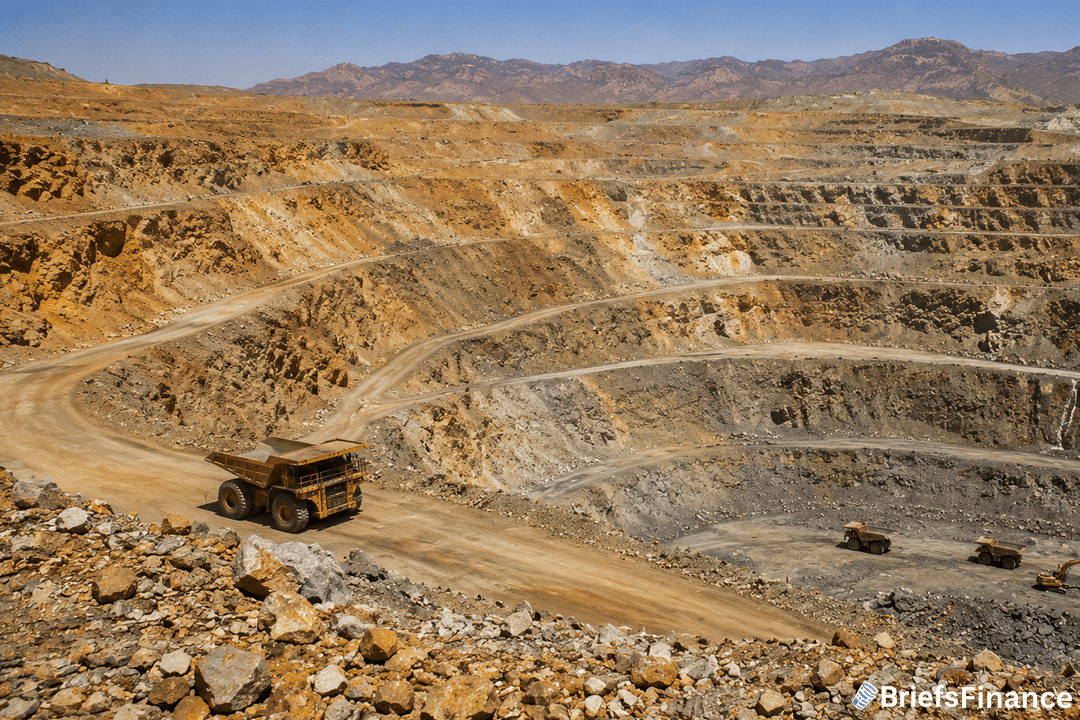
Barrick, the world's third-largest gold producer, wants to spin its North American mines into a new publicly traded company. Barrick has targeted the end of this year for that listing.

But several major shareholders have pushed back against the plan, so the listing still has opposition.

Fourmile, the project at the center of the deal, has serious upside. A preliminary assessment from September says it could produce up to 750,000 ounces of gold per year.

Alexander Hacking at Citigroup says the market's general view is that Fourmile is worth roughly $10 billion to $20 billion. With a range that wide, it is easy to see why a $4 billion deal felt light.

The Business Behind the Headlines

Forget the legal drama for a second. Barrick's core numbers came in okay.

In the second quarter, adjusted profit per share, known as EPS, hit 82 cents, matching analyst estimates. Gold output rose 11% to 796,000 ounces compared with the previous quarter.

The company also maintained its full-year outlook of 2.9 million to 3.25 million ounces of gold and copper output between 190,000 and 220,000 tons. Free cash flow, the cash left after keeping operations running, was $515 million in the latest quarter, compared with $1.58 billion in the prior one.

That drop is separate from the Newmont deal, and it could matter just as much.

What This Means for Your Portfolio

Monday's move shows how quickly the mood can change.

What matters for your portfolio is the gap between the investor consensus of roughly $10 billion to $20 billion for the asset and what another major gold miner is willing to pay. In gold mining, the metal in the ground only helps if the price attached to it makes sense.

Download the free Always Be Buying eBook and start putting your money to work today
Disclosure

Recent News

1 2 3 … 86

Get Market Briefs delivered to your inbox every morning for free!

No fluff. No noise. No politics. Just finance news you can read in 5 minutes.

Blogs

September 25, 2026
BRIEFS EXCLUSIVE: 43% Of Respondents Say Bills Outran Their Income Over Past Two Years
  • 43% of the 494 Market Briefs readers surveyed said their bills grew faster than their income over the past two years, even though 79% could cover a surprise $5,000 expense tomorrow.
  • Half of readers own gold or crypto, the two classic bets against a weaker dollar, and only 13% bought nothing at all in the last 12 months.
  • The median reader says it takes $150,000 a year to feel financially secure, about $62,000 above the U.S. median household income.
Read More
September 25, 2026
The Economy Is Booming. So Why Did Stocks and Bonds Fall Together?
  • S&P Global says the US economy is growing at its fastest rate since 2021, with corporate profits up 28.9% in a year, almost four times the historical average.
  • Stocks and bonds fell at the same time, which is not how the two markets normally behave, because Treasury yields above 5% now compete with stocks for investors' money.
  • Jaspreet Singh lays out three ways to invest through a shift like this: always be buying, buy the crash, or follow the money before it hits the headlines.
Read More
September 24, 2026
The 2026 Economic Reset Is Starting: Are We in a Recession, or Is the Pain Still Ahead?
  • The Federal Reserve has flipped from stimulating the economy to fighting inflation with higher interest rates, while the White House still wants growth at almost any cost.
  • The national debt tops $40 trillion, has outgrown the entire U.S. economy, and its interest payments are now the government's fastest-growing expense.
  • Higher rates bring pain for private equity, private credit, and speculative assets, but they open opportunities for investors holding cash, treasuries, and value assets.
Read More
September 23, 2026
Are We in a Recession? Without AI, America Might Already Be in One - and Washington Knows It
  • The White House attributes about three quarters of U.S. economic growth to AI, and many believe the economy would already be in a recession without it.
  • Washington has three reasons it cannot let the AI boom slow down: staying the world's superpower, outgrowing $40 trillion in national debt, and protecting a government stock portfolio worth billions.
  • Every market goes through booms and busts, and investors who understand the cycle get to buy the downturn instead of panic-selling with the crowd.
Read More
September 22, 2026
Will Interest Rates Go Down in 2026? Where the Money Moves Either Way
  • The Fed is leaning toward higher rates to fight 4% inflation, while the White House and a cracking job market push the other way.
  • If rates rise, money has tended to move toward short-term Treasuries, floating-rate loans, energy, banks and dividend payers.
  • If rates fall, it has tended to move toward gold, silver and Bitcoin, real estate, small caps, the S&P 500 and speculative bets.
Read More
September 21, 2026
How the Federal Reserve Makes Money - and Why It Just Posted Its Biggest Loss Ever
  • For 109 years the Federal Reserve created money, lent it to the U.S. government and handed the interest it collected back to Washington - almost $1 trillion in the decade starting in 2011.
  • Pandemic-era lending locked the Fed into earning about 2% on trillions of dollars while it now pays banks around 4%, producing a record loss of hundreds of billions in 2026.
  • The Fed covers its losses by creating money and the government covers its lost revenue by borrowing, and both feed the inflation that eats at the dollars in your account.
Read More
September 18, 2026
Kevin Warsh Just Defied Trump: What the Fed Rate Hike Means for Your Money
  • The Fed raised rates for the first time since 2023 in a unanimous vote led by Kevin Warsh, the chairman President Trump appointed to cut them.
  • Higher rates make the $40 trillion national debt, business loan resets and mortgages more expensive, but they strengthen the dollar and pay investors holding cash.
  • The war with Iran is pushing up oil, grocery and chip prices, another hike is likely in 2026, and recession talk is about to get louder.
Read More
September 17, 2026
Why America Bailed Out the Yen: The Japan Carry Trade, the Dollar and Your Mortgage Rate
  • In July 2026 the US sent money to steady the yen because Japan is the largest foreign owner of US debt, and Washington needs Japan to keep lending.
  • For decades the Japan carry trade let Wall Street borrow yen at essentially 0% and pour it into US stocks, real estate and Treasuries, and rising Japanese rates are shutting that off.
  • A weaker yen means fewer buyers for the dollar and for US debt, which pushes Treasury rates up and drags mortgage, car loan and credit card rates up with them.
Read More
September 16, 2026
Treasury Yields Are Spiking Because Lenders Are Backing Away From U.S. Debt
  • The U.S. is paying its highest 30-year borrowing rate in about two decades because its biggest lenders, the Fed, foreign governments, and banks, are all pulling back from Treasuries.
  • Every mortgage, car loan, credit card, and business loan is priced off the 10-year Treasury yield, so when Washington pays more to borrow, so do you.
  • With about $40 trillion of debt against a $32 trillion economy, the country either outgrows its debt or slides into a doom loop, and investors need a plan for both.
Read More
September 15, 2026
Fiat Currency Runs on Trust, and the World Just Stopped Trusting the Dollar
  • Gold has overtaken US treasuries as the world's top reserve asset, and central banks are now buying less US debt and more gold.
  • The US dollar is a fiat currency, meaning it's backed by a promise rather than gold, so it loses value when fewer countries want to hold it.
  • Whether the US economy or its national debt grows faster from here decides which assets stand to benefit next.
Read More
1 2 3 … 27
Share via
Copy link













