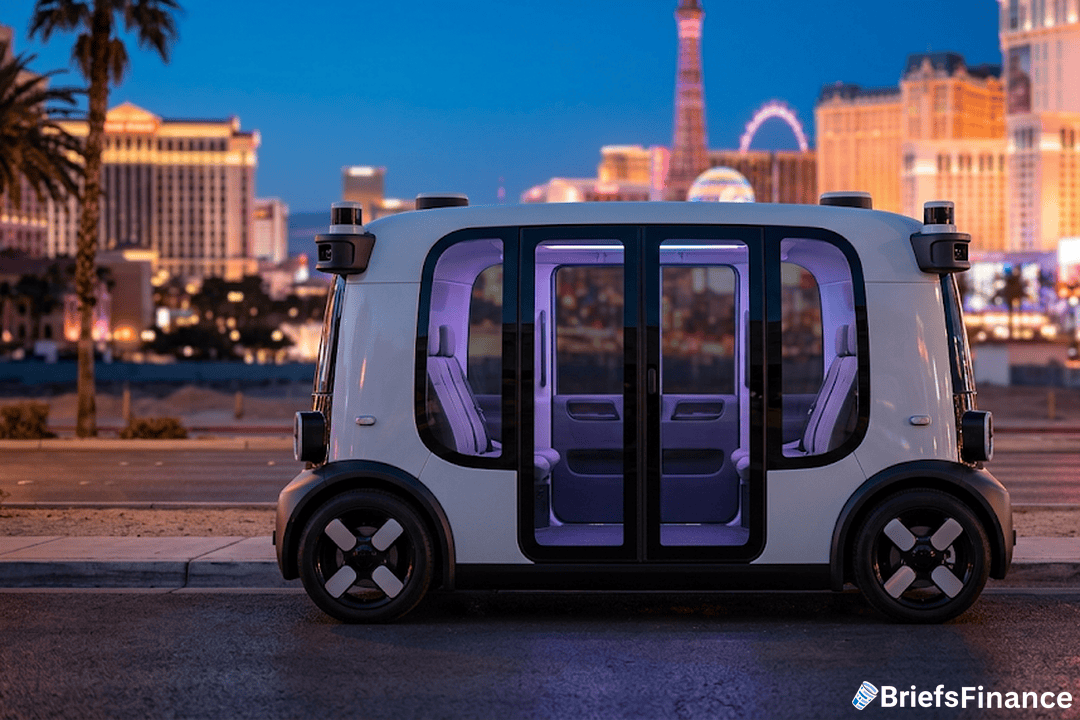
A Boxy Shuttle That Drives Itself Now Wants to Get Paid
Amazon's self-driving car company is moving from free samples to the real thing. Starting Aug. 10, Zoox will charge for rides in Las Vegas, marking the company's first paid robotaxi service anywhere.
It is a big step for a vehicle that looks like an appliance on wheels. Zoox's shuttles have no steering wheel and no brake controls.
Up to four passengers sit facing each other, and the car can drive in either direction without turning around. That makes the shuttle different from the modified cars used by other driverless car operators, which still look like ordinary vehicles with a lot of extra gear.
Until now, Zoox gave rides away in parts of Las Vegas and San Francisco, a free phase that only began within the past year. In July, federal regulators gave the company a temporary waiver from rules requiring human controls, opening the door for paid rides.
The Price and the Promise
Pricing is the part that will get most riders' attention. Zoox has not said what the base fare will be.
The company says the final price is built from a starting charge, the miles traveled, and the time spent, and some trips, like airport rides, may carry extra fees.
The goal is to land in the comfort tier of ride-hailing, the level above UberX. For riders, that means a robotaxi that does not undercut Uber on price right away.
Get the free Always Be Buying eBook and learn the simple system for building wealth on any income
A higher price comes with higher expectations, and a driverless shuttle has to deliver on that. CEO Aicha Evans knows the shift in pressure.
"However hard it was to build the technology up to get up to this point, there's a new hard that's coming, which is paid operations, where with the customer, there's an expectation," she said in an interview.
She describes the goal as "stellar, lovable commercial service." Her blunt version: "It's different when it's free vs. when the customer is going to pay."
The Race Against Waymo
Zoox is not entering an empty market. The company says the Las Vegas expansion is part of a push to compete with Waymo, the Alphabet-owned robotaxi leader that already operates in several cities.
Zoox has momentum in its favor, having carried nearly one million riders in Las Vegas, San Francisco, Austin, and Miami since the free service began.
That gives it a base of people who have felt the car move, turned in a seat that faces another passenger, and watched the car drive itself.
To charge for rides outside Las Vegas, Zoox still needs state and local approvals and says it is talking with several state agencies. Some places are pushing back.
In February, New York's governor, Kathy Hochul, scrapped a plan that would have allowed commercial robotaxis in parts of the state. In March, New York City chose not to renew Waymo's permit, ending a limited test there.
The resistance is a reminder that not every city will move as fast as Las Vegas.
What It Means for Your Money
For investors, Las Vegas is the place where the robotaxi story becomes a real business. If Zoox can charge comfort-level prices and still fill its shuttles, it proves that driverless rides can move from curiosity to commerce.
The launch has something for investors and riders alike. Amazon is betting that Zoox can be a serious rival to Waymo, and every paid ride is a small vote on whether that bet works.
For riders, the launch sets a price marker. If Zoox matches Uber Comfort roughly dollar for dollar, the value comes down to a simple question: would you trust a four-seat box with no steering wheel to get you across the Strip?
That question is more than a test of technology.
The answer may decide how quickly driverless cars move from a Las Vegas novelty to a normal way to get around.
Download the free Always Be Buying eBook and start putting your money to work today