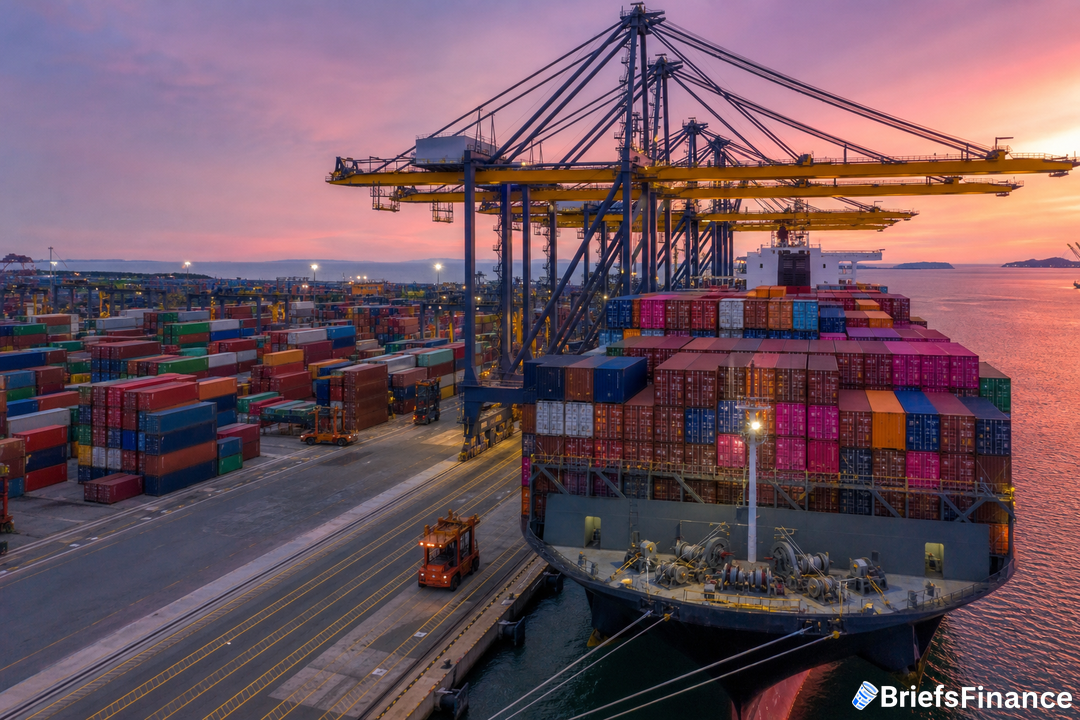
AI is carrying the goods side
Trade in physical goods is proving sturdier than expected, according to a WTO report released Thursday. The forum now sees volumes rising 3.9% this year rather than the 1.9% increase it penciled in back in March.
The real kicker has been AI-related kit. During the first half of 2026, AI-enabling products contributed 47% of the value underpinning that increase in goods trade. After moving in lockstep with other merchandise until 2024, shipments of AI-enabling goods jumped 16% that year, nearly doubled in 2025 versus 2024, and then surged 67% in the first half of 2026. As a result, their portion of world goods trade reached 14.8%, roughly twice the average from 2016 to 2023.
The gains are clustered. In 2025, the ten largest traders in AI-enabling goods accounted for roughly 85% of global exports and 80% of imports, according to the WTO.
Services feel the fuel pinch
The WTO trimmed its services outlook to 3.3% growth this year from 4.8% projected six months earlier, with higher fuel costs crimping travel. The report flagged that elevated commodity prices could linger because of bottlenecks that are constraining flows of fuels and fertilizers.
At the same time, the WTO noted, "Surging import demand related to an investment boom in artificial intelligence has overcome headwinds from the ongoing conflict in the Middle East."
Trade forecasts are a reasonable proxy for global growth expectations. Market Briefs covers them free every weekday.
Politics, fragmentation, and the bigger picture
Against that backdrop, the WTO says the broader pattern of bloc-style trade fragmentation has cooled: "The broader pattern of bloc-based trade fragmentation has not intensified at the same pace as in recent years." In its words, "geopolitical tensions continue to affect trade patterns but the divergence between geopolitical blocs is no longer widening."
The report also points to evidence that the fragmentation gap between geopolitically aligned partners has narrowed, even as the US and China diversify. A figure in the study is indexed at 100 in January 2022 and credited to Blanga-Gubbay and Rubínová (2024).
WTO Director-General Ngozi Okonjo-Iweala added the human angle: "An integrated world economy and a rules-based trading system provide economies flexibility to keep essential products flowing to businesses and households that need them," while cautioning, "Nevertheless, some have felt the shock more than others, and not everyone can access emerging opportunities like AI."
What to watch from here
Looking forward, the WTO projects goods trade growth of 4.1% in 2027 and services at 6.4%. Taken together, total global trade is set to rise 3.7% this year and 4.7% next year. As the report puts it, "While high commodity prices may persist as a result of bottlenecks constraining flows of fuels and fertilizers, continued AI investment and the broader digitization of the global economy are expected to keep merchandise trade growth above the rate of world GDP growth in 2027."
For your wallet, the takeaway is straightforward: AI-linked supply chains are powering the goods side, services are feeling pressure from fuel costs, and the benefits are clustering among a handful of major traders. If your money is tied to travel-heavy businesses or to companies dependent on energy and fertilizer supply routes, the near-term picture may look different than for firms riding the AI buildout.
If AI is genuinely lifting trade, that shows up in these numbers first. Join Market Briefs free and follow the data.