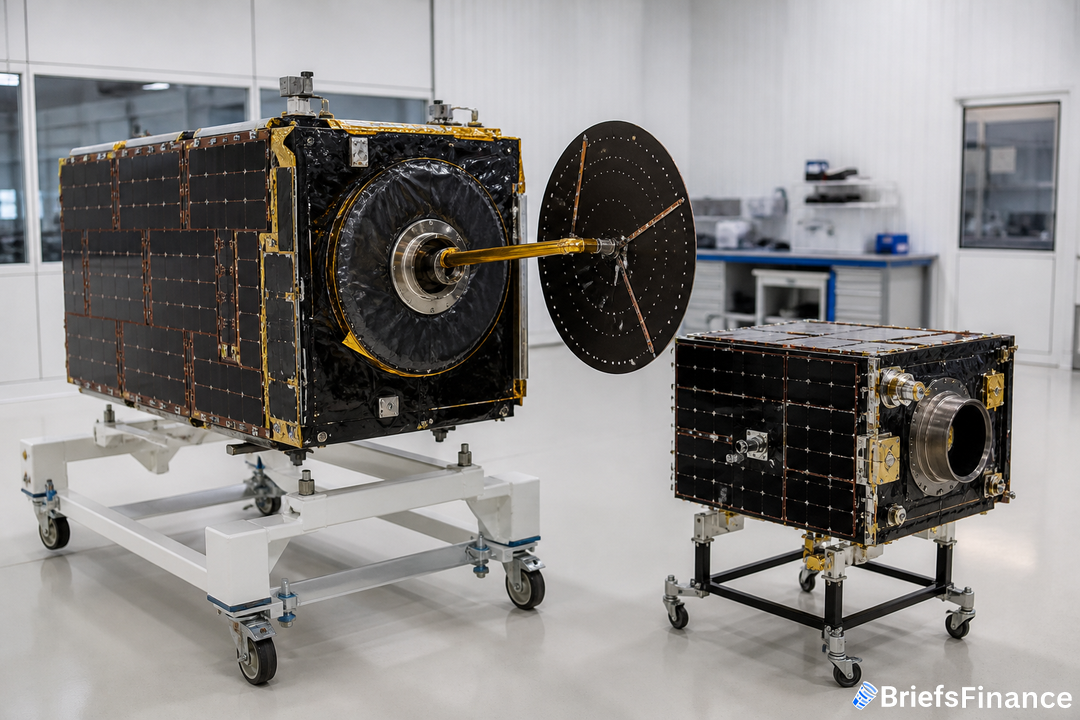
What Fortastra is building and why it matters
Fortastra is designing nimble satellites to help shield the orbital infrastructure used by the US and its allies, a concept it frames as "bodyguards in space" for both commercial and defense systems. The raise comes after last month's revelation that the US has a space-based weapon intended to deter Russia, China and other would-be adversaries, amid growing concern that guidance, communications and other systems are at risk.
"There's an acknowledgment that space, while it was a fairly peaceful domain at one point, is actually fairly contested," Chief Executive Officer and founder Mike Smayda said. He added that there are "hundreds of billions, if not trillions, of dollars' worth of value in space. And generally things that go to space are launched unprotected."
Hardware progress and the plan to scale
Two Fortastra prototypes, called Watchdog V0, lifted off Oct. 1 on Space Exploration Technologies Corp.'s Transporter-18 from Vandenberg Space Force Base; they were the startup's first spacecraft to reach space. According to Smayda, the new funding will enable Fortastra - currently a team of only 18 employees - to accelerate manufacturing. He declined to disclose a valuation for the round.
Smayda said the ambition is to move past a "bodyguard-type framework" toward "more zone defense, where we're building a lot of these and they're massively proliferated across different orbits and orbital regimes," adding, "We're talking hundreds, if not thousands, of more satellites." He did not detail potential defensive capabilities, but compared the concept to a bodyguard responding when "someone pulls a knife": intercept, assess, deter, and, if needed, "handle it."
Defense technology funding is reshaping what counts as critical infrastructure. Market Briefs covers that shift free every weekday.
Who backed the round and the SoCal backdrop
First In, a venture fund focused on security tech and advanced manufacturing, led the $30 million raise. Other investors include Upfront Ventures, Space Capital, Rsquared, Side Door Ventures and ATX Venture Partners. In December, the company said it had secured an initial $8 million raise, with Upfront as lead and Generational Partners, Forward Deployed Venture Capital, Wave Function Ventures, and Bloomberg Beta participating - a venture firm financed by Bloomberg LP, the parent of Bloomberg News.
Southern California's aerospace scene is resurgent on the back of growing government and commercial spending and a deep pool of engineering talent that dates to World War II. Anduril Industries Inc., Rocket Lab Corp. and Relativity Space Inc. all sprang up in the region over the past decade. Many former SpaceX employees stayed in California after Elon Musk relocated the company to Texas, launching new ventures that benefit from local manufacturing know-how and Silicon Valley capital nearby.
Venture data backs it up. PitchBook estimates that US venture investment in space and defense startups has reached $32.6 billion year-to-date, rising from $16.8 billion across all of 2025. More than $13 billion, about 40%, has gone to Southern California. Note: 2026 figures are as of Oct. 6.
The founder's chops and what it could mean for your money
Smayda spent five years at SpaceX in Hawthorne, California, working on entry, descent and landing capabilities for Falcon 9 and Falcon Heavy. In 2018, he co-founded the hypersonic aircraft company Hermeus, serving as chief product officer. Fortastra itself opened last year in Torrance, just outside Los Angeles.
The upshot for your wallet: Washington's interest in space security is growing, Southern California is capturing a big chunk of the capital, and Fortastra is pitching a model built for scale. If its prototypes evolve into a proliferated "zone defense" network, that ties directly to national security spending cycles and the kind of durable demand that can support young companies over time.
Orbital assets are becoming a genuine security and investment question. Join Market Briefs free and follow the sector.