Free NewsletterPro Login

Warning: Undefined variable $stocks in /var/www/briefs.co/htdocs/wp-content/plugins/oxygen/component-framework/components/classes/code-block.class.php(133) : eval()'d code on line 448

Warning: foreach() argument must be of type array|object, null given in /var/www/briefs.co/htdocs/wp-content/plugins/oxygen/component-framework/components/classes/code-block.class.php(133) : eval()'d code on line 448

Warning: Undefined variable $funds in /var/www/briefs.co/htdocs/wp-content/plugins/oxygen/component-framework/components/classes/code-block.class.php(133) : eval()'d code on line 472

Warning: foreach() argument must be of type array|object, null given in /var/www/briefs.co/htdocs/wp-content/plugins/oxygen/component-framework/components/classes/code-block.class.php(133) : eval()'d code on line 472
/* the link was here */

Authorities tighten e-bike rules as crashes surge and communities push back

Published Oct 8, 2026
Share:
Summary:
  • Riders on e-bikes and e-motos have swarmed streets in Bend, Oregon, and Orlando, Florida, while two teens were spotted motoring through a Walmart in Orange County, California.
  • The U.S. logged more than 155,000 emergency-room visits and over 300 deaths tied to e-bikes since 2017, while California's crash injuries jumped from 2 in 2020 to 1,566 in 2024.
  • Cities and states are responding with age limits, licensing and insurance requirements, buybacks, and in some cases criminal charges against parents.

What officials are seeing on the streets

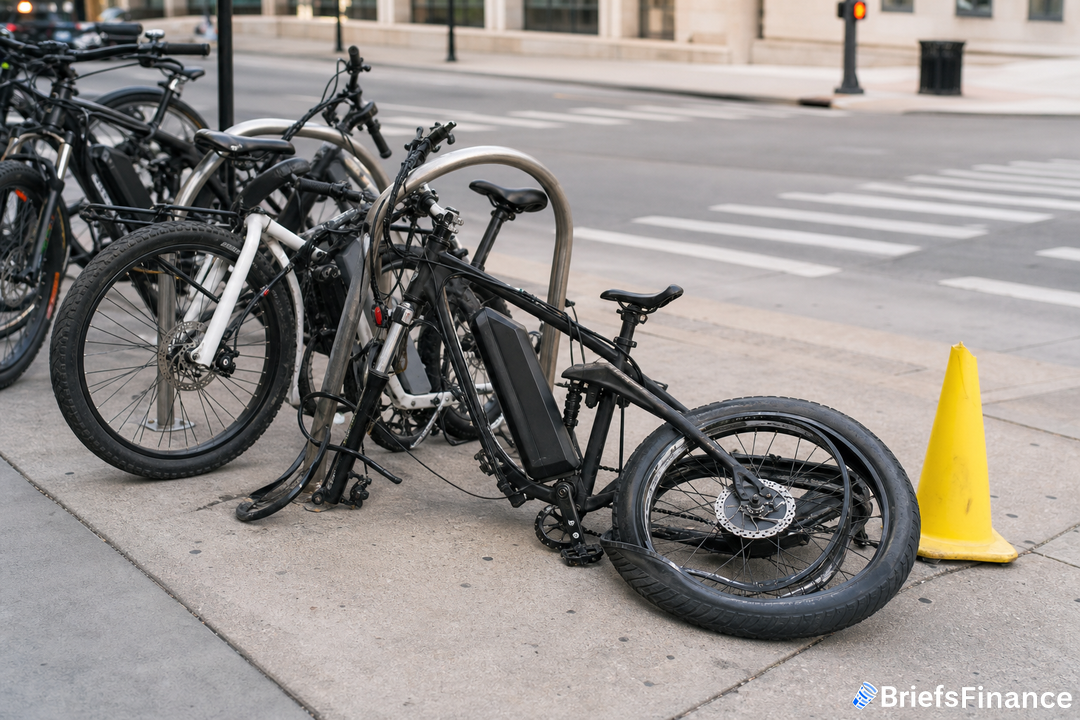
If it feels like e-bikes are everywhere, you are not imagining it. Police were called when dozens of electric bikes and e-motos flooded Bend, Oregon, one afternoon. Two teenagers were seen cruising inside a Walmart in Orange County, California. And in Orlando, security cameras recorded hundreds of riders blocking traffic.

These machines now span a range of classes, from pedal-assist setups to Class 3 bikes that can reach 28 miles an hour. When bikes are modified for extra speed, or when riders use high-torque e-motos and mini bikes, the vehicles are typically treated as motorized machines similar to motorcycles and are generally off-limits to those under 16 without proper licensing.

Injuries, deaths and hospital trends

The rise has a cost. The U.S. Consumer Product Safety Commission counts more than 155,000 ER visits linked to e-bikes from 2017 through 2024, along with over 300 deaths. A University of California, San Diego study of state records shows injuries from e-bike collisions in California climbed from 2 in 2020 to 1,566 in 2024.

Children's hospitals are seeing the shift up close. Rady Children's Health in Orange County has treated 156 pediatric patients from e-bike crashes so far this year, after seeing just one such patient in 2021. "Our orthopedic surgeons have seen types of fractures that they haven't seen before," said Laura Goodman, who oversees trauma services at Rady Children's Health in Orange County. She is calling for expanded education on e-device safety and on helmets certified for e-bike use.

The hardware itself is getting hotter. According to a 2025 San Jose State University study, roughly 90% of e-devices parked at schools in Northern California seemed noncompliant with legal e-bike standards, and some exhibited up to eight times the typical power.

Safety regulation reshapes an entire product category's economics. Market Briefs covers that intersection free every morning.

Laws, buybacks and enforcement

Officials are moving fast to build guardrails. In July, New Jersey began implementing what it calls the toughest e-bike law in the country, barring anyone under 15. Bloomfield Township, Michigan, voted in September for a six-month ban on kids under 16 riding e-bikes. And starting in January, Illinois will require e-bikes that exceed 28 mph to be titled and licensed, with registration and insurance, and ridden by someone who holds a driver's license.

New York City, powered by a large delivery workforce, is weighing 23 separate bills to rein in the devices. At a recent City Council hearing, testimony stretched for hours while residents objected to delivery riders on e-bikes and e-motos speeding along streets and sidewalks.

Orange County, California, took a page from gun programs and ran a buyback. In September, the district attorney's office distributed gift cards valued at up to $1,000 to people who turned in e-bikes, e-scooters, and e-motorcycles. Hundreds showed up, and many continued to hand over devices even after the gift cards were depleted two hours into the event. Photos from the Orange County District Attorney's Office show stacks of collected devices at Angel Stadium on Sunday, Sept. 13, 2026.

The office of Orange County District Attorney Todd Spitzer has brought criminal charges against parents in separate cases, including a father whose 12-year-old was critically injured riding an unlawfully modified e-bike and a mother whose 14-year-old, riding an e-motorcycle illegally, struck and killed an 81-year-old veteran. Authorities have similarly pursued cases against parents in states including Arizona and Oregon.

Families, grief and the debate over limits

For some families, the risks are no longer abstract. Allister Carlos lost his 15-year-old son, Ethan, in an e-bike crash in La Habra, California, last year. He created the Ethan Carlos Foundation in his memory. "These machines are really dangerous," he said. "It's the next wave of epidemic, up there with guns and school shootings."

Carlos said e-bikes weren't allowed in his home, and he didn't know Ethan and a friend had gone out on a vehicle that isn't legal for street use by riders under 16. While Ethan rode on the back of his friend's Class 3 e-bike, a car struck them from behind, killing both boys. "We didn't know that they had a powerful motorbike like that, and the parents made the decision for us," Carlos said. "They just sent off our son with no helmet, no protection at night." At the Orange County buyback where he shared his son's story, he broke down, thinking how getting these machines off the road could prevent future tragedies.

Parents are also trying to find a middle lane. In Southport, Connecticut, healthcare professional and experienced motorcyclist Katherine Echo Kim purchased an e-bike for Miles after her son turned 13, but only following extensive research. They took an online course together, she set up a cone-marked practice track in a parking lot to teach steering, and she and her husband followed him early on to check his road skills.

Still, she worries about kids riding without helmets and ignoring traffic rules. "Some of these kids have absolutely no training about e-bikes," she said.

Surging demand helps explain the pressure. U.S. e-bike imports surpassed 1 million in 2022 and topped 2 million last year, according to an analysis by eCycleElectric, with industry data from the Light Electric Vehicle Association and eCycleElectric Consultants.

The public leans toward safeguards, not blanket bans. The University of Michigan's CS Mott Children's Hospital surveyed parents of kids 11 to 18 and found most supported safety regulations like helmet requirements and training, while only 11% backed an outright ban. Christine Berube, a mom in suburban Maryland, said she ultimately opted for a Class 2 bike with a top speed around 20 miles per hour for her son. "It gives him that ability to hop on and go to Chipotle and meet a friend," she said.

What this means for your money and your day

If you or your kid rides, expect tougher rules to change the calculus: age minimums, licensing and insurance for faster models, and even local moratoriums. That can shape where these bikes can legally go, what they cost to operate, and whether households feel comfortable buying in. Hospitals, schools and city halls are signaling this is a long-term shift, not a summer fad. For your budget, that means factoring in compliance costs and the right safety gear for any e-bike purchase, and for your neighborhood, it means paying attention as local policies evolve.

Where rules land determines which companies can still compete. Get the free Market Briefs daily newsletter and follow it.

Disclosure

Recent News

1 2 3 … 96

Get Market Briefs delivered to your inbox every morning for free!

No fluff. No noise. No politics. Just finance news you can read in 5 minutes.

Blogs

October 5, 2026
What Is the Briefs Connector? A Simple Guide
  • The Briefs Connector lets your favorite AI read Briefs research, like Pro reports and the Briefs Score.
  • Without it, an AI asked about investing can give answers that sound right but aren't backed by that research.
  • It explains the research, but it won't tell you what to buy or sell.
Read More
October 5, 2026
Is a Recession Coming? What the Last Five Rate Hiking Cycles Say
  • The Fed has started raising rates again, and in the last five hiking cycles going back to 1994, a recession never started while the hikes were underway.
  • The pain showed up where there was a bubble to pop - housing in 2008, dot-coms in 2000, the pandemic money-printing boom in 2022 - and usually after the hikes ended.
  • Private equity and private credit are feeling this cycle first, and how far the pain spreads depends on how high rates go and how long they stay there.
Read More
October 2, 2026
Fed Interest Rates May Rise Again in 2026 - and the Newest Culprit Is AI
  • Fed Governor Barr told a meeting our head of investing research attended that higher rates are likely in 2026, lower inflation may not come soon, and AI is now pushing prices up.
  • The same week, President Trump asked the biggest AI companies to police themselves under an accord that's morally but not legally binding, because the White House sees AI as a race with China.
  • Higher rates put downward pressure on asset prices and squeeze borrowers, but the way through hasn't changed: own investments, buy on a schedule, and treat downturns as discounts.
Read More
October 1, 2026
Housing Market 2026: Why Office Buildings Are Cracking Before Houses Do
  • Office buildings are selling for 80% to 95% off because their five-year loans are resetting at much higher rates while half-empty floors have gutted the income those buildings are valued on.
  • Housing is under pressure, not cracking: a $400,000 mortgage costs $975 more a month than at 3%, but six of every seven mortgages are still under 6% and those owners are staying put.
  • Whether pressure turns into cracks is a race between unaffordability and the economy, and either way Jaspreet's rule is to treat your house as a liability and buy only what you can afford.
Read More
September 30, 2026
Dividend Investing vs. Growth Investing: Why the Slower Portfolio Can End Up Bigger
  • "What stock should I buy?" is the wrong first question. Growth, income, or wealth preservation comes first, and the goal changes which stocks even make sense.
  • At $500 a month for 30 years, 13% growth builds about $1.75 million. 10% growth plus a reinvested 4% dividend builds a little more than $2.2 million and pays a little more than $80,000 a year.
  • Income investors have US dividend ETFs, REITs, and international dividend funds to study. Growth investors have the Nasdaq 100, AI and chip funds, and small caps. None of it is a recommendation.
Read More
September 29, 2026
Why Is Gold Going Down? A 5.2% Treasury Yield Just Took Its Job
  • President Trump rejected Iran's deal to reopen the Strait of Hormuz, oil prices jumped back up, and gold fell instead of rising.
  • Treasury yields hit their highest level in more than 20 years, so investors sold gold and bought Treasuries that pay interest.
  • Higher Treasury yields make the national debt, mortgages, car loans, and credit cards more expensive, with the Fed's next rate decision due October 28.
Read More
September 28, 2026
The Strategic Bitcoin Reserve: Why the Government Wants Bitcoin to Explode
  • The US government holds about 328,000 Bitcoin, worth roughly $25 billion, and since a 2025 executive order it keeps seized coins instead of selling them.
  • Washington wants a bigger pile of assets so its $40 trillion national debt looks smaller next to them, which lets it keep borrowing and spending.
  • Bitcoin's wild price swings, and a government holding a coin built to escape governments, are the two risks investors need to watch.
Read More
September 25, 2026
BRIEFS EXCLUSIVE: 43% Of Respondents Say Bills Outran Their Income Over Past Two Years
  • 43% of the 494 Market Briefs readers surveyed said their bills grew faster than their income over the past two years, even though 79% could cover a surprise $5,000 expense tomorrow.
  • Half of readers own gold or crypto, the two classic bets against a weaker dollar, and only 13% bought nothing at all in the last 12 months.
  • The median reader says it takes $150,000 a year to feel financially secure, about $62,000 above the U.S. median household income.
Read More
September 25, 2026
The Economy Is Booming. So Why Did Stocks and Bonds Fall Together?
  • S&P Global says the US economy is growing at its fastest rate since 2021, with corporate profits up 28.9% in a year, almost four times the historical average.
  • Stocks and bonds fell at the same time, which is not how the two markets normally behave, because Treasury yields above 5% now compete with stocks for investors' money.
  • Jaspreet Singh lays out three ways to invest through a shift like this: always be buying, buy the crash, or follow the money before it hits the headlines.
Read More
September 24, 2026
The 2026 Economic Reset Is Starting: Are We in a Recession, or Is the Pain Still Ahead?
  • The Federal Reserve has flipped from stimulating the economy to fighting inflation with higher interest rates, while the White House still wants growth at almost any cost.
  • The national debt tops $40 trillion, has outgrown the entire U.S. economy, and its interest payments are now the government's fastest-growing expense.
  • Higher rates bring pain for private equity, private credit, and speculative assets, but they open opportunities for investors holding cash, treasuries, and value assets.
Read More
1 2 3 … 28
Share via
Copy link










