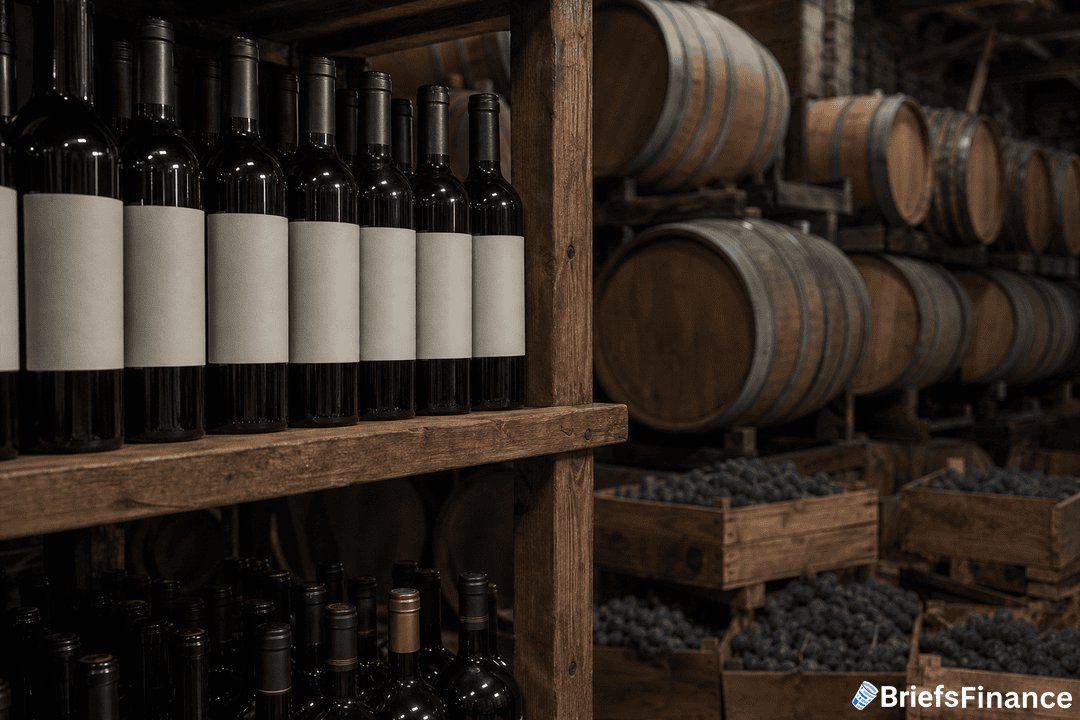
A flood of high-end wine hitting discount labels
California's supply pileup is turning into a win for value hunters. Industry buyers say a lot of the excess is genuinely good, and it is increasingly appearing at big chains like Costco, Kroger and Aldi as private or exclusive labels. It is even showing up in scores. "We went from having no wines with 90-plus scores in our portfolio from respectable reviewers to 20 in the last two months," said Curtis Mann, who oversees wine, beer and spirits as a vice president at Kroger.
The price gaps can be dramatic. Buyers say a bottle that would command $150 under a winery's own brand can reappear below $30 with a retailer's label. Taylor Case, president of Navigator Wine Collection, recounted a recent tasting of a Napa Valley cabernet that he is aware carries a $149 retail price.
Navigator plans to sell it for $29.99. "I'm shocked at what we do sometimes," he said. "I would not want to be a grower right now." He added, "There's a ton of wine that's still on the market." Navigator sells private-label lines including Gearbox, Motif and Decoded.
At Grocery Outlet Inc., Steve Beckner, who buys direct imports and private-label wine, said in nearly 30 years he has not seen anything like this. "I'm trying to find the words to describe it," he said. "The quality has gone up exponentially." He cited a case where a Napa Valley cabernet sauvignon that might be tagged at $45 to $85 with the winemaker's branding shows up at $9.99 as Second Cheapest Wine, the chain's house label. Grocery Outlet operates over 500 locations across 16 states.
How big this surplus looks in practice
The bulk offers have ballooned. When Beckner started at Grocery Outlet in 2018, he said sellers typically offered around 1,000 to 3,000 cases per deal. Now he is seeing pitches for 20,000 to 200,000 cases. That scale is how expensive juice ends up in bargain bottles.
To shed surplus, wineries may run closeouts under their own brands or offload bulk wine to third parties who bottle it, such as supermarket chains and outlets like Total Wine & More. If inventory remains, it might be warehoused, mixed into future releases, or even dumped. Store brands often keep origins quiet. As Beckner put it, if a producer with a $100 cabernet has to divert some wine that did not make the flagship and it winds up in a $9.99 bottle, they want discretion.
Shoppers can see the shift in price tags. Costco said it recently dropped the price of Kirkland Signature Stags Leap Cabernet Sauvignon to $19.99 from $22.99. Andrew Cullen, who reviews wines sold at Costco from Atlanta, said, "You're getting access to maybe some of the best winemakers in the world for 20 bucks a bottle." His verdict: "This is insane."
Rob McMillan, executive vice president of Silicon Valley Bank's wine division, said in a videocast for the bank's 2026 State of the US Wine Industry report, "The one thing that is growing is private label" at retailers such as Costco, Kroger and Aldi. He added, "Those kind of businesses, they're all selling wine. They're doing something right." The report also described what some producers are doing as "a positive form of discounting that attracts new value-seeking consumers, protects existing brand value and helps drain the ocean of bulk wine."
Oversupply in any commodity eventually reaches the shelf price. Market Briefs covers the consumer economy free every morning.
Why the surplus exists and how producers are responding
Several forces are slowing drinking in California and other U.S. regions, including people cutting back on alcohol, GLP-1 weight loss drugs and inflation. Even after "drastic, necessary actions" to fix the imbalance, "the residual overproduction from prior years still must be worked through," according to Turrentine Brokerage's August 2026 wine market report. In other words, the consumer-friendly glut still has room to run.
Winemakers are adjusting. Kerith Overstreet, founder of Bruliam Wines in Windsor, California, said she deliberately produced less this year. She noted that recent volatile weather pushed yields lower across the region, and at Bruliam's Russian River Valley vineyard they are down 30% from a 2024 high.
She called the lower yields "a divine market correction" and said the business is "definitely cyclical." To accelerate the correction, winemakers might remove vines, convert land to different crops, or just reduce production. Looking ahead, Case expects the market to come back into balance. "It's still going to take another 12 to 24 months to completely clear up," he said.
"Supply and demand always find each other."
What this means for your wallet
Right now is a sweet spot for value. Peter Baedeker, owner of Baedeker Wine in Santa Barbara, called it "probably one of the best times I've seen in my near 30-year history in the industry for the consumer." Private labels are serving up weekday deals, though the story behind a bottle still matters for gifts. Steph Marr, a director at a Boston advertising tech company, said she is happy to buy a store brand for everyday drinking, but when it is a present, "I want it to feel like a special thing."
For your budget, that means high-quality wine is temporarily cheaper at places you already shop, while steps to reduce supply could tighten things over time. The window may not stay this wide open.
A glut is good news for buyers and painful for producers. Get the free Market Briefs daily newsletter and follow it.