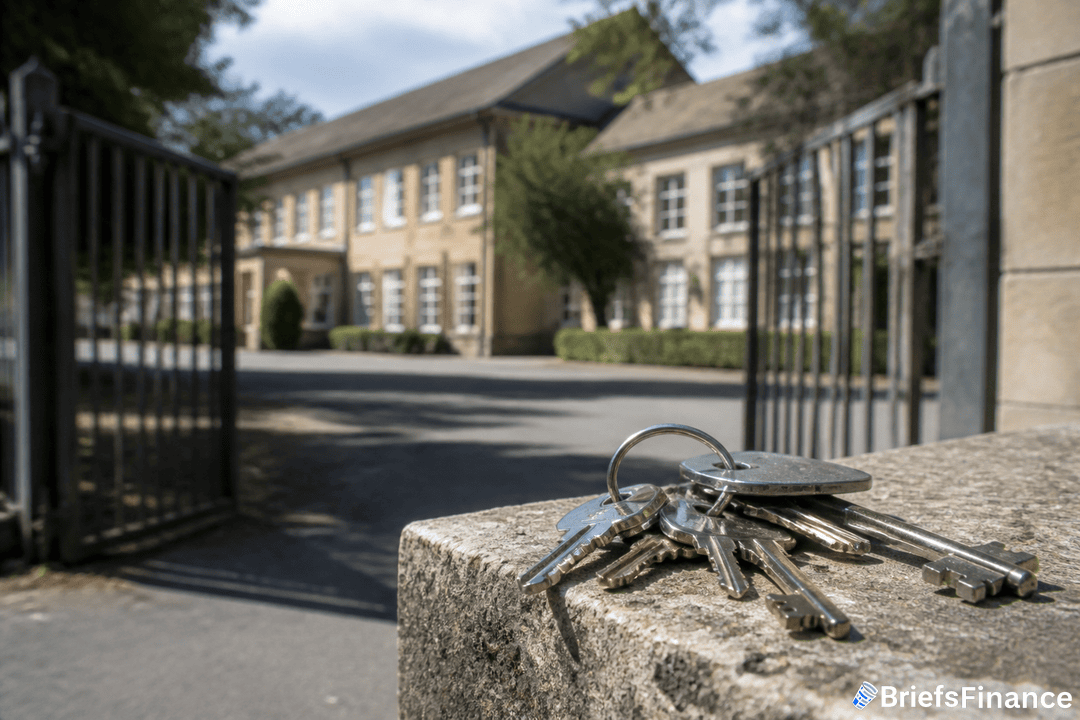
People familiar say UAE-based Alephya, majority-owned by TA Associates, is in advanced talks to buy a controlling stake in Ajialuna Educational Co.
Discussions focus on Sulaiman Alrajhi Holding's stake, with some estimating the Riyadh firm could be valued at up to $500 million.
State-backed investors across MENA have deployed $102 billion so far this year and are pacing toward a second-best year, even as the US-Iran war enters month eight, per Global SWF.
What's on the table
People with direct knowledge say Alephya is in late-stage discussions to take control of Ajialuna, although nothing has been finalized. Across Saudi Arabia, Ajialuna runs 10 private and international campuses, educating more than 17,000 students from kindergarten to high school. Some of the people involved put a potential valuation at up to $500 million.
Alephya runs 15 schools across the Gulf Cooperation Council and, per its website, serves more than 20,000 students. In 2024, TA Associates took majority ownership of the Dubai-based operator.
Who kicked the tires, and who is talking
Bloomberg News reported last year that GEMS Education - the Dubai company supported by Brookfield Asset Management - had expressed interest in Ajialuna. Requests for comment to Alephya, Ajialuna and Sulaiman Alrajhi went unanswered. Both TA Associates and GEMS Education said they had no comment.
If you track money and influence in the region, the Mideast Money newsletter offers a weekly read on how those forces intersect.
Cross-border talks come after a stretch of strain between the UAE and Saudi Arabia that had Wall Street wondering about potential friction in capital flows between the two closely linked economies. A warming in ties surfaced in September, marked by a meeting between UAE Vice President Sheikh Mansour bin Zayed Al Nahyan and Saudi Crown Prince Mohammed bin Salman - the first public trip to the kingdom this year by a senior Emirati official.
Despite the turmoil, deal flow is still moving. According to Global SWF, sovereign-backed investors across the Middle East and North Africa have put $102 billion to work this year and are tracking toward their second-best year. Meanwhile, Saudi Arabian cities and energy facilities have been regularly targeted by the Houthis in recent weeks, and on Sunday the coalition led by Saudi Arabia in Yemen began an operation to retake areas held by the Houthis.
Clashes have since intensified near the Bab el-Mandeb strait, a route that can stand in for the vital Hormuz waterway. The fighting adds another front to the broader conflict with Iran, even as the Trump administration has shown reluctance to step deeper into the Saudi campaign against the Houthis.
The education angle investors care about
Schools are viewed as a defensive bet in the Gulf, especially in Saudi Arabia, home to about 35 million people, roughly 20 million of whom are citizens. The kingdom is courting more expatriates under Vision 2030. After foreign ownership rules were relaxed in 2017, both international and regional school brands spread nationwide, and the number of Saudi students attending international schools has been rising as the government works to boost access and narrow skills gaps.
Even in expat-heavy Dubai, enrollment has held up. GEMS and Taaleem Holdings PSC reported resilient numbers in September, after the UAE thwarted thousands of projectiles from Iran early in the conflict. For investors, steady demand plus deep pools of state-backed capital help explain why bidders are circling education assets.
Anthropic has gone public at a valuation of about $1.5 trillion, while Amazon went public in 1997 at around $440 million. Anthropic has about $33 billion in revenue this year and no profit, and investors are paying more than 40 times its sales, against about 3 times for Amazon. Briefs Finance CEO Jaspreet Singh says nobody knows what comes next, and that long-term investors use downturns to buy instead of panic selling.
Tech stocks are selling off because investors don't know who will lead Nvidia, the company that has been funding the AI industry and selling it chips.
Inflation has the Federal Reserve planning to raise interest rates, with a hike expected in December, and that puts pressure on homebuyers, private equity and the $40 trillion national debt.
Briefs Finance CEO Jaspreet Singh says nobody has a crystal ball, so his rules are to buy when markets are low, hold long term and invest only what you're willing to lose.
The national debt is above $40 trillion, and the Federal Reserve has gone from sending Washington its profits to losing money.
President Trump's four-part plan leans on shorter-term debt, stablecoin companies buying Treasuries, a bigger balance sheet and government stakes in private companies.
The goal is to outgrow the debt, not pay it off, so Jaspreet Singh points investors to the seven industries where Washington wants growth.
The Fed makes its next rate decision on December 9 and is now talking about jumbo interest rate hikes of 0.5%, though one in December looks unlikely.
Washington will pay a record $1.05 trillion in interest this year on $40 trillion of debt, and that debt resets at higher rates as the Fed hikes.
Jaspreet Singh's five moves are to pay down variable-rate debt, earn interest on your savings, know which stocks feel the pressure, look at value and hedge.
Margin debt, the money investors borrow to buy stocks, is at a record of around 4.6% of GDP, up from 3.9% in 2021.
ETF money has more than tripled in five years to 7% of GDP, while corporate buybacks and 401(k) money sit below their earlier peaks.
Margin calls and panic selling can make the next downturn deeper, so Jaspreet Singh keeps buying broad market funds and says most investors should skip margin debt.
Jensen Huang is out at Nvidia over affairs with multiple people, and the company he founded has been the bank of American AI, with about $30 billion into OpenAI and $10 billion into Anthropic.
A hotter-than-expected inflation report has Fed officials talking about a possible 0.5% hike in December, and gold, silver, and bitcoin fell on the news.
President Trump said the US may not need a deal with Iran, keeping oil prices and inflation risk high. Jaspreet Singh breaks down what it all means for AI stocks and your portfolio.
Stocks are booming at the fastest pace in years, jobless claims just hit a 57-year low, and most investors still feel like nobody is hiring.
The Fed is protecting the dollar over the economy, oil swings on every Iran headline, and a few AI companies are carrying an S&P 500 where four of five stocks sit in a correction.
Jaspreet Singh explains why circular financing between Nvidia, OpenAI, Anthropic, and SpaceX rhymes with 2008's house of cards, and how his three investing pillars handle a stock market bubble.
The Fed has raised rates, cut them, then raised them again only twice in the last 60 years, and both times the economy fell into a recession and stocks crashed.
The same stop-and-go cycle is playing out now, with one big difference: US debt is 125% of GDP today versus about 30% in 1980.
In the 1970s gold rose roughly 24x, real estate 157%, stocks lagged, and cash lost half its value. Jaspreet Singh lays out five assets to consider before the next flip.
The IRS 2027 tax plan keeps the same seven rates but widens every bracket and lifts the married-filing-jointly standard deduction to $33,200.
The 0% long-term capital gains bracket rises to $102,100, so a household living on $135,300 of investment income could owe $0 in federal income tax.
C corporations still pay 21%, small businesses keep the 20% QBI deduction, and the 401(k) limit climbs to $25,500 with an $8,500 catch-up for investors over 50.
Make sure to check your inbox for the first email.
Before you go
We’re hosting our first ever livestream on how investors can use ChatGPT & Claude to invest like a pro. It’s on 11/17 and is hosted by our CEO Jaspreet Singh.