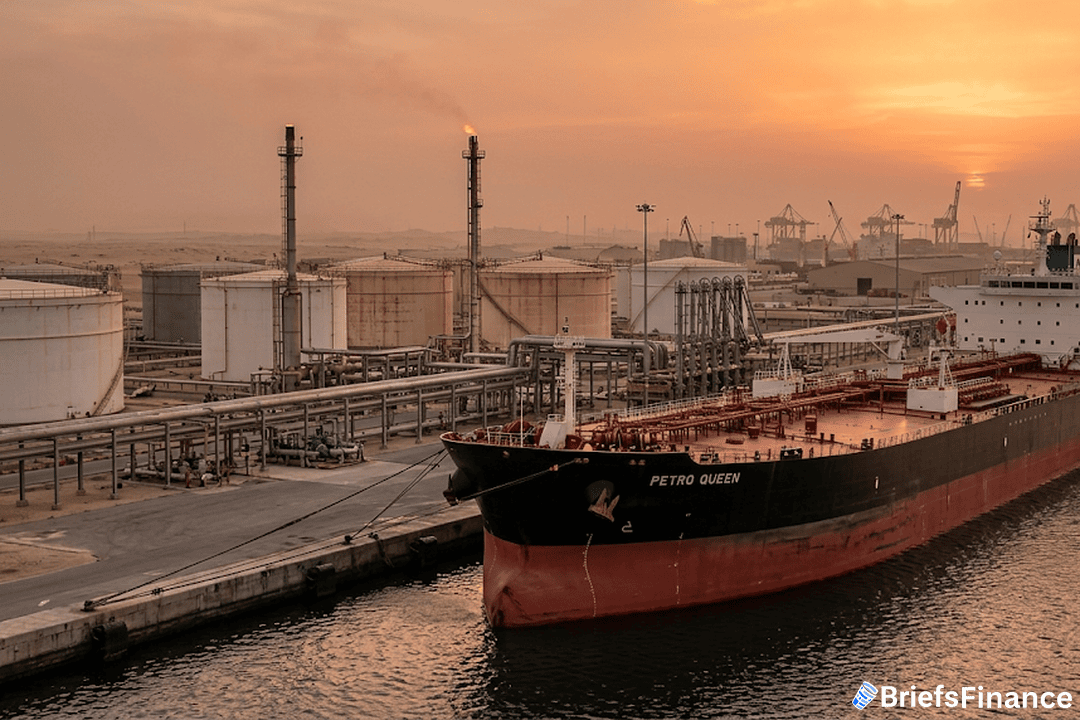
For weeks, the world's most important oil shipping lane has looked strangely quiet. Saudi Arabia's main Persian Gulf ports appeared nearly empty, with tankers nowhere to be seen. But a new satellite image suggests the silence was more about poor visibility than a real slowdown.
The Tanker That Shouldn't Have Been There
The image came from the European Union's Sentinel 2 satellite, which caught a very large crude carrier, known as a VLCC, parked at Ju'aymah's single-point mooring. That is part of the Ras Tanura complex, one of the biggest oil export hubs on Earth. A VLCC holds roughly 2 million barrels, so this was not a small event.
The sighting matters because it breaks a stretch of quiet. Saudi Arabia told OPEC it raised July output by just over 1 million barrels a day, so the oil is clearly flowing somewhere. The question was where.
Part of the answer is that the kingdom has been rerouting. A temporary U.S.-Iran accord allowed tankers to pass through the Strait of Hormuz once more, which should have raised traffic at Gulf ports. But the ships have not been easy to spot, and the satellites watching them keep blinking.
The Camera Blinks, and Ships Slip Through
Here is the tracking problem. Over the 26 days ending Aug. 11, the Sentinel 1 and 2 satellites captured clear images just over half the time. In three of those gaps, a VLCC could have taken on its entire cargo and departed unseen.
Get the free Always Be Buying eBook and learn the simple system for building wealth on any income
So the quiet may be an illusion. A second tanker appeared at Ras Tanura's offshore loading point, roughly 20 miles below Ju'aymah. Its size suggested a Suezmax vessel, which carries about 1 million barrels. That was the second such sighting this month, following an Aframax, a smaller ship, a week earlier.
Meanwhile, the Red Sea port of Yanbu has become the kingdom's workaround. Tuesday images showed two Aframax ships at Yanbu North and one VLCC at Yanbu South, with combined capacity of about 3.4 million barrels. Larger tankers usually need more than a day to load, so those ships were likely still working when the photo was taken.
Prior to the Houthi threats, the two Yanbu terminals typically had six of their seven berths occupied. Now the port is running quieter, but the oil is still leaving. Most Yanbu exports travel toward the Suez Canal and the Sumed pipeline, which lie to the north.
According to Vortexa, roughly 2.2 million barrels per day departed the Sidi Kerir terminal on the Mediterranean last week. That is the highest volume since at least 2016.
What This Means for Your Portfolio
The practical takeaway is that Saudi oil exports are not collapsing. They are just harder to count.
For investors, the lesson is about trusting the headlines. A few weeks of empty satellite images made it look like Saudi Arabia had pulled back from the market. The reality is that shipping routes changed, and the tracking tools could not keep up.
That matters for oil prices, which react to supply fears. If traders believe exports are drying up, prices climb. When the truth surfaces, prices adjust. The gap between what the satellites show and what the tankers are actually doing is exactly the kind of uncertainty that moves your energy holdings.
The other thing to watch is the Red Sea. If the security situation worsens, Saudi Arabia could face real trouble moving its oil, not just trouble tracking it. For now, the barrels are flowing, even if the cameras cannot always prove it.
Download the free Always Be Buying eBook and start putting your money to work today