Contract Overview
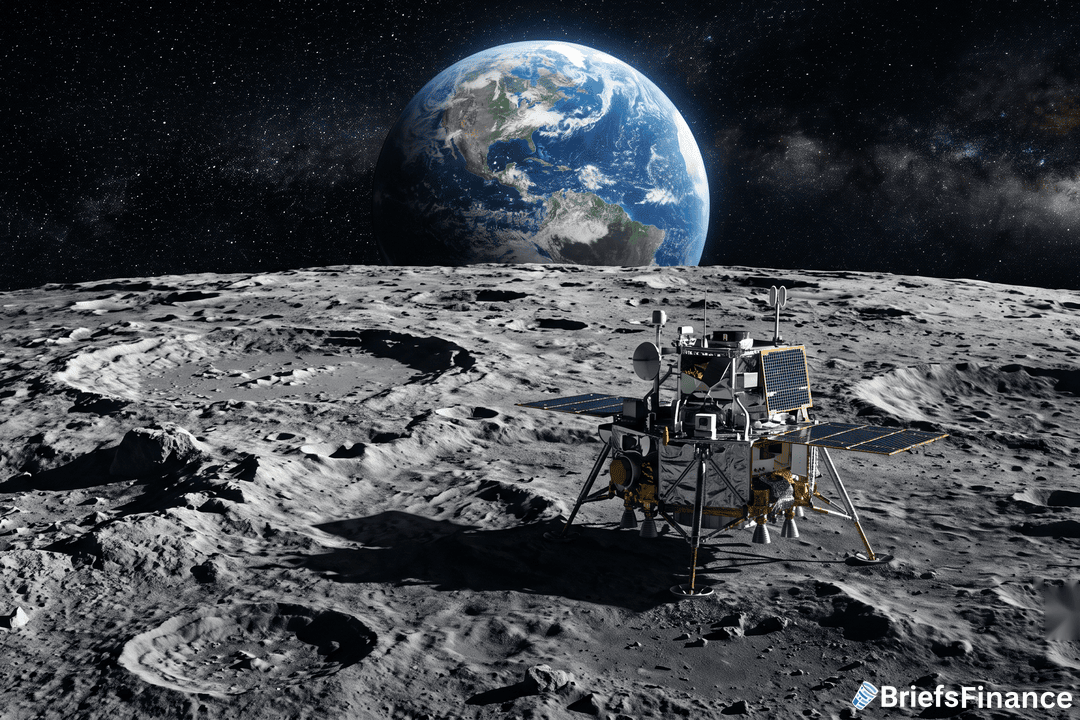
The space agency has chosen three additional private firms to deliver robotic landers to the moon, supporting its goal of building a lunar outpost by 2030.
Additionally, NASA is considering sending a test version of its Mars rovers to the moon - a vehicle it calls Promise, an acronym for a rover designed to observe, map, and explore the lunar polar regions in situ.
"We've got the hardware and this is exactly what we should be trying to do, to put wins on the board, getting a capability like Promise to the surface of the moon," NASA Administrator Jared Isaacman remarked at a press briefing.
Astrobotic plans to launch an improved version of its Peregrine lander, which failed in 2024, to the moon later this year or in early 2027.
Get your free investing masterclass bonus when you join Market Briefs, our free daily newsletter
"They're applying a lot of the lessons learned from the previous Peregrine build out, and we expect to see a spacecraft that has those additional capabilities," stated Carlos García-Galán, who serves as NASA's moon base program manager.
Voyager Technologies Inc. finalized a deal in early June to buy Astrobotic for up to approximately $300 million.
In 2024, Intuitive Machines achieved the first intact commercial spacecraft landing on the moon, though its lander tipped over upon descent, restricting the mission. A subsequent attempt in March 2025 similarly ended with a flawed landing. During the same month, Firefly Aerospace successfully completed its first robotic moon landing.
Background and Recent Developments
In March, Isaacman outlined NASA's intention to spend over $20 billion in the coming seven years to construct a lunar base for astronaut habitation and work. The deployment will encompass landers, rovers, drones, power generators, and additional necessary equipment. These new contracts further NASA's Commercial Lunar Payload Services strategy of leveraging private industry to deliver scientific payloads and tech demos ahead of crewed missions.
This initiative is part of NASA's Artemis program, focused on returning humans to the moon. The Artemis II mission in April sent four astronauts on a lunar orbit to evaluate equipment intended for a crewed landing possibly by 2028.
The contracts also reflect growing confidence in private-sector capabilities after a series of mixed results. While Intuitive Machines experienced partial failures, Firefly's successful landing in March 2025 demonstrated that commercial partners can now reliably reach the lunar surface. Astrobotic, despite its earlier setback, has redesigned key propulsion systems and intends to prove its revised Peregrine lander is ready for the task. NASA's broader vision includes not only landers but also rovers like Promise, which would serve as a test platform for technologies later used on Mars.
These awards continue NASA's strategy of relying on commercial partners for lunar delivery services, a model that has yielded both successes and failures but is deemed essential for sustainable exploration. The agency's CLPS program has already contracted multiple missions, and the mixed track record underscores the technical difficulty of landing on the moon. Nonetheless, NASA remains committed to using private industry to build the infrastructure required for a permanent human presence.
Subscribe to Market Briefs, our free daily newsletter, and claim your bonus investing masterclass