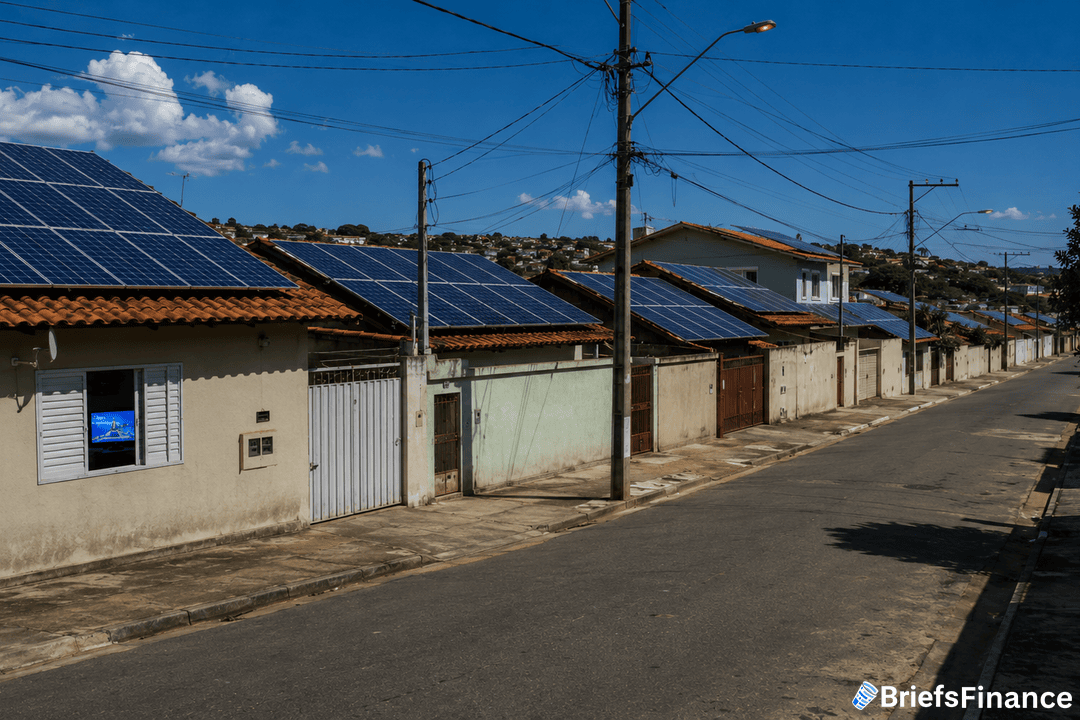
When a World Cup match starts, millions of Brazilians stop working and sit down to watch. Electricity demand drops sharply. But rooftop solar panels still generate power - and grid operators cannot control them. That creates a dangerous imbalance for Brazil's power grid.
The Grid's Control Problem
Brazil's grid operator, ONS, has to keep supply and demand equal at all times. Normally, it can dial down large power plants when demand falls. But about 4 million small-scale generation units - 90% of which are rooftop solar panels on homes and businesses - pump power into the system without any central control. The operator cannot order them to stop.
This becomes a big problem during events like World Cup matches. The only way ONS can rebalance the grid is to cut power from large renewable plants it can control. That is called curtailment.
"During periods of low electricity demand combined with high generation, such as on Sundays and public holidays, it creates operational challenges," Brazil's electricity regulator Aneel said.
Get your free investing masterclass bonus when you join Market Briefs, our free daily newsletter
Who Pays the Price
The pain from curtailment does not fall evenly. Large industrial energy users, represented by the association ABRACE, are the ones who signed long-term contracts for wind and solar power years ago. Now those projects are being forced to shut down at times.
"The parties suffering most now from curtailment are the very industrial companies that contracted these projects years ago with government subsidies," said Victor Iocca, who serves as director of electrical energy at ABRACE.
On the other side, the rooftop solar industry says it is not the problem. The Brazilian distributed generation association ABGD points out that its roughly 21 million customers supply power when it is most needed. According to Christino Áureo, who serves as the director of government and institutional relations at ABGD, "We need to provide a solution for the power system so that this expansion can eventually reach a balance."
But the uncertainty is already scaring off new investment. Atlas Renewable Energy, a wind and solar developer, suspended $1 billion in new projects earlier this month, citing a lack of clarity on curtailment solutions.
What's Next for the Grid
Authorities at Brazil's energy ministry and the regulator Aneel are discussing fixes. In May, Energy Minister Alexandre Silveira said that further work is required on the "technical and legal framework that can provide certainty to the proposed solutions."
One idea is battery storage. Another option is expanding electricity exports to neighboring countries.
The distributed generation association argues batteries are the most effective fix. "It's very clear to me that the solution involves batteries," said Áureo.
Subscribe to Market Briefs, our free daily newsletter, and claim your bonus investing masterclass