Free NewsletterPro Login

Free Live Investors Workshop

Seats limited

Tue, Sep 29.

The dollar is losing value.

Here’s how investors can still profit.

Hosted By

Jaspreet Singh

Founder, Briefs Finance

X

Warning: Undefined variable $stocks in /var/www/briefs.co/htdocs/wp-content/plugins/oxygen/component-framework/components/classes/code-block.class.php(133) : eval()'d code on line 448

Warning: foreach() argument must be of type array|object, null given in /var/www/briefs.co/htdocs/wp-content/plugins/oxygen/component-framework/components/classes/code-block.class.php(133) : eval()'d code on line 448

Warning: Undefined variable $funds in /var/www/briefs.co/htdocs/wp-content/plugins/oxygen/component-framework/components/classes/code-block.class.php(133) : eval()'d code on line 472

Warning: foreach() argument must be of type array|object, null given in /var/www/briefs.co/htdocs/wp-content/plugins/oxygen/component-framework/components/classes/code-block.class.php(133) : eval()'d code on line 472
/* the link was here */

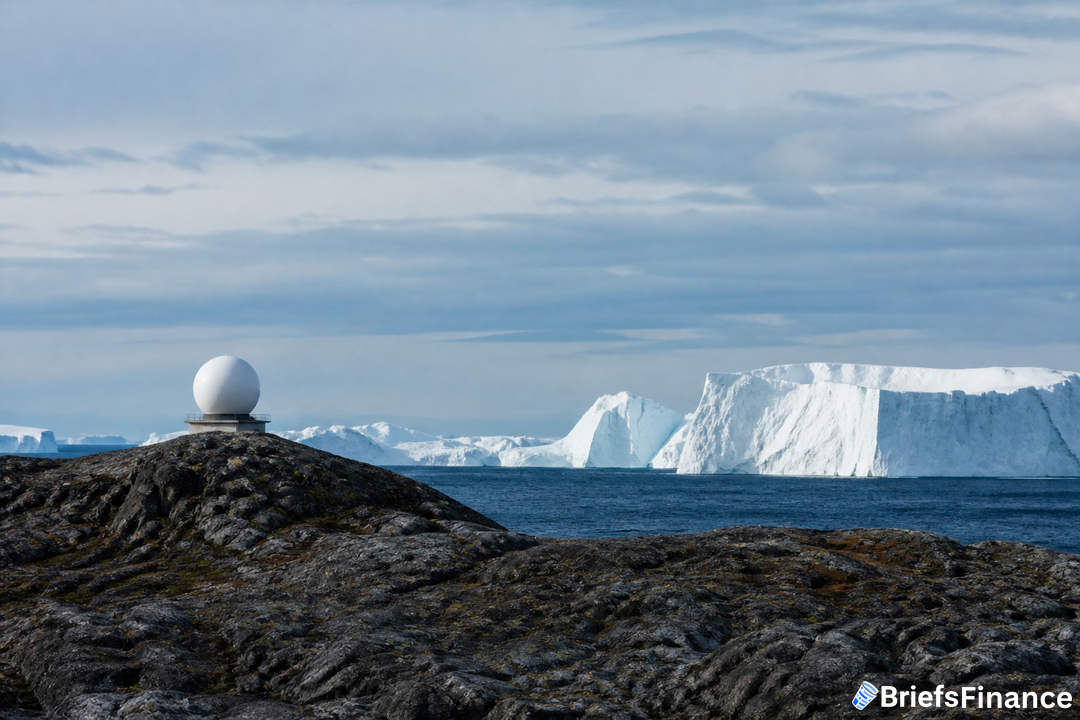
Trump Says U.S. Has "Permanent Control Over Security" in Greenland

Published Sep 18, 2026
Share:
Summary:
  • President Donald Trump says his team struck a deal with Denmark that gives the U.S. "permanent control over security" for Greenland, announcing it on social media and calling it cost free for America.
  • Trump did not provide the full text, while leaders in Denmark and Greenland said they anticipate a signing next week during the United Nations General Assembly.
  • A U.S. official said the accord would bar non-NATO militaries from basing in Greenland, curb risky investments, and let Washington add bases on the island if needed.

What Trump said and why it matters

Trump unveiled an agreement with Denmark that he described as giving the U.S. enduring authority over Greenland's security. He said it addresses "ALL of our many US concerns" and comes at "NO COST to the United States." He also posted, "The United States will FOREVER have the complete ability to do what is necessary in Greenland in order to secure and defend the security of Greenland, and the United States of America." The administration did not share full details on Friday, leaving key provisions unclear.

What's in the deal, according to officials and experts

A U.S. official, requesting anonymity to describe the terms, said the pact would flatly forbid military installations in Greenland by any nation outside NATO, restrict investments on the island viewed as risky to the U.S., and permit Washington to increase the count of American bases there if needed. Imran Bayoumi, formerly a Pentagon adviser and currently with the Atlantic Council, said the only potentially novel aspect is reporting that the U.S. could establish bases without first consulting Greenland or Denmark. He added that Greenlanders' reaction is uncertain and questioned whether the shift was worth "the two-plus years of turmoil in the transatlantic relationship."

How this compares with the long-standing setup

The U.S. and Denmark have had a defense arrangement since 1951 that lets American forces operate in Greenland. Washington has been expected to consult and inform Copenhagen about its plans, a practice often seen as largely a notification exercise. That pact has no end date.

In reality, Washington has for years had wide discretion over how many troops it stations on the island, and its presence there has been shrinking for decades. That is why it is not yet clear how much the new understanding actually changes day-to-day operations.

Global policy shifts remind investors that steady diversification protects and grows hard earned savings. Join Briefs Finance CEO Jaspreet Singh on September 29th for a FREE live investor workshop, How to Profit From A Dollar That's Losing its Value, where he shows how we're spotting investment opportunities as the dollar falls. Save your spot.

The politics behind the pivot

Trump's drive over Greenland has been a sore spot with European allies, with his repeated demands straining trust and posing one of NATO's most serious postwar tests. Since returning to office last year, he attempted to intimidate Denmark into handing over the island, including making veiled threats to take it by force and warning of higher tariffs on European economies that did not go along. Danish Prime Minister Mette Frederiksen welcomed the emerging agreement on Friday, saying, "I am glad that we are about to make a great agreement for Greenland, the Kingdom of Denmark, and the United States," and that it "strengthens our common security in the Arctic and the North Atlantic Area and therefore is great for NATO and Europe as well." Greenland's Prime Minister Jens-Frederik Nielsen said in May, "We are not going to cede sovereignty." Some Danes pushed for a boycott of U.S. goods amid the standoff.

The clash peaked in January at the World Economic Forum in Davos, where Trump assailed European allies. After talks with NATO Secretary General Mark Rutte, he pulled back, saying they had agreed on the outlines of a framework agreement on Greenland and the Arctic, and the U.S., Denmark, and Greenland formed a working group to oversee the dispute. Trump has argued that Russia and China want a foothold in Greenland and that only the U.S. can keep them out.

If the new arrangement ends his threats without changing who governs Greenland, that would be a win for Copenhagen and Nuuk. Still, the administration's big claims are hard to judge without the full text.

For your money, the headline takeaway is this looks like a cooling of a self-created flashpoint. Less brinkmanship in the Arctic lowers the odds of sudden trade jolts tied to this dispute, but the fine print on investment restrictions and base expansion could reshape who gets to build and finance projects on the island over time.

Calm, consistent planning helps you safeguard wealth and pursue long term growth. Our CEO Jaspreet Singh is hosting a FREE live investor workshop, How to Profit From A Dollar That's Losing its Value, on September 29th. Sign up free to join him live.

Disclosure

Recent News

1 2 3 80

Get Market Briefs delivered to your inbox every morning for free!

No fluff. No noise. No politics. Just finance news you can read in 5 minutes.

Blogs

September 17, 2026
Why America Bailed Out the Yen: The Japan Carry Trade, the Dollar and Your Mortgage Rate
  • In July 2026 the US sent money to steady the yen because Japan is the largest foreign owner of US debt, and Washington needs Japan to keep lending.
  • For decades the Japan carry trade let Wall Street borrow yen at essentially 0% and pour it into US stocks, real estate and Treasuries, and rising Japanese rates are shutting that off.
  • A weaker yen means fewer buyers for the dollar and for US debt, which pushes Treasury rates up and drags mortgage, car loan and credit card rates up with them.
Read More
September 16, 2026
Treasury Yields Are Spiking Because Lenders Are Backing Away From U.S. Debt
  • The U.S. is paying its highest 30-year borrowing rate in about two decades because its biggest lenders, the Fed, foreign governments, and banks, are all pulling back from Treasuries.
  • Every mortgage, car loan, credit card, and business loan is priced off the 10-year Treasury yield, so when Washington pays more to borrow, so do you.
  • With about $40 trillion of debt against a $32 trillion economy, the country either outgrows its debt or slides into a doom loop, and investors need a plan for both.
Read More
September 15, 2026
Fiat Currency Runs on Trust, and the World Just Stopped Trusting the Dollar
  • Gold has overtaken US treasuries as the world's top reserve asset, and central banks are now buying less US debt and more gold.
  • The US dollar is a fiat currency, meaning it's backed by a promise rather than gold, so it loses value when fewer countries want to hold it.
  • Whether the US economy or its national debt grows faster from here decides which assets stand to benefit next.
Read More
September 14, 2026
Why RAM Prices Are Soaring - and Where the Money Is Moving
  • Memory chips - the RAM inside phones, laptops, fridges, and trucks - are in a shortage Tim Cook called a 100-year flood, and some memory prices have climbed about 90% in a single quarter.
  • Four forces hit at once: AI demand, a production shutdown in 2023, build times that push any fix to 2028 at the earliest, and a bombed helium plant in Qatar.
  • The last two supply shocks ended in aggressive Fed rate hikes and market drops of around 45% and 20%, and this time Washington is spending heavily to bring memory production home.
Read More
September 11, 2026
How Is the Economy Doing? Washington Says It's Fixed, but the Numbers Don't Agree
  • Treasury Secretary Scott Bessent says the economy is fixed because lower earners' incomes are now rising faster than top earners'.
  • The Atlanta Fed and Bank of America show different numbers, and Hilton, Marriott, and McDonald's can't agree on what they're seeing either.
  • Whichever side is right, the economy is built to make investors rich, and inflation is how it does it.
Read More
September 10, 2026
US National Debt Hits $40 Trillion: Why the Economy Hasn't Collapsed Yet
  • The US national debt crossed $40 trillion in 2026 and is growing faster than the economy. The debt to GDP ratio now sits at 125%, the highest outside the pandemic and higher than World War II.
  • On September 9, 2026, Treasury Secretary Scott Bessent rolled out an emergency plan for the government to lend money to itself. Ray Dalio now says the dollar has roughly three years before real pain.
  • Empires rarely default. They debase. Since 1971, median household income grew about 8x while houses grew 17x and the S&P 500 grew 360x, so investors got richer while workers fell behind.
Read More
September 9, 2026
Your 401k Is Fueling the AI Bubble
  • About $10 trillion of 401k money sits in a $77 trillion stock market, mostly through target date funds and S&P 500 funds. Roughly 30% of every S&P 500 dollar lands in five AI-heavy tech stocks.
  • Four bubble signals run hotter today than before the 2000 crash: top-ten concentration, tech's share of the index, the Buffett Indicator, and how much of the market index funds own.
  • You only lock in an AI bubble loss if you sell. The 2022, 2020, 2008, and 2000 crashes were all buying windows for long-term investors, and the US-China AI race means government money could keep flowing in.
Read More
September 9, 2026
What Is Wealth Preservation? How To Protect Your Money From Anything
  • Wealth preservation is an investing strategy built around keeping the money you've already made instead of chasing growth.
  • It leans on assets that hold steady when markets fall - gold, Treasury bonds, and companies that keep earning through wars, crashes, and pandemics.
  • The tradeoff is real: you give up some upside, and the two key numbers to check are maximum drawdown and correlation to the market.
Read More
September 8, 2026
Why Is Everything So Expensive? Why Prices May Never Come Back Down
  • Official inflation is 3.4% and prices are up 32% since 2020, but rent (41%), gas (47%), car insurance (64%) and ground beef (79%) all outran the 28% median wage.
  • The Federal Reserve targets 2% inflation on purpose. Rising prices push extra dollars to investors and shrink the real cost of a $40 trillion national debt.
  • Investors who simply owned the S&P 500 gained about 150% over the same six years, and the Fed's September 16 decision will show whether it protects the dollar or the economy first.
Read More
September 7, 2026
The U.S. Housing Market Just Flipped: Renting a Home Now Beats Buying One
  • The US is in a buyer's market in 41 of the 50 largest metro areas, but prices sit near record highs and mortgage rates are close to 7%.
  • The same median house costs 27% more than it did in 2021 while the monthly payment costs 90% more, and incomes rose a little more than 10%.
  • A 2008-style crash is not showing up in the data, so the pressure is landing on buyers instead of prices.
Read More
1 2 3 27
Share via
Copy link











