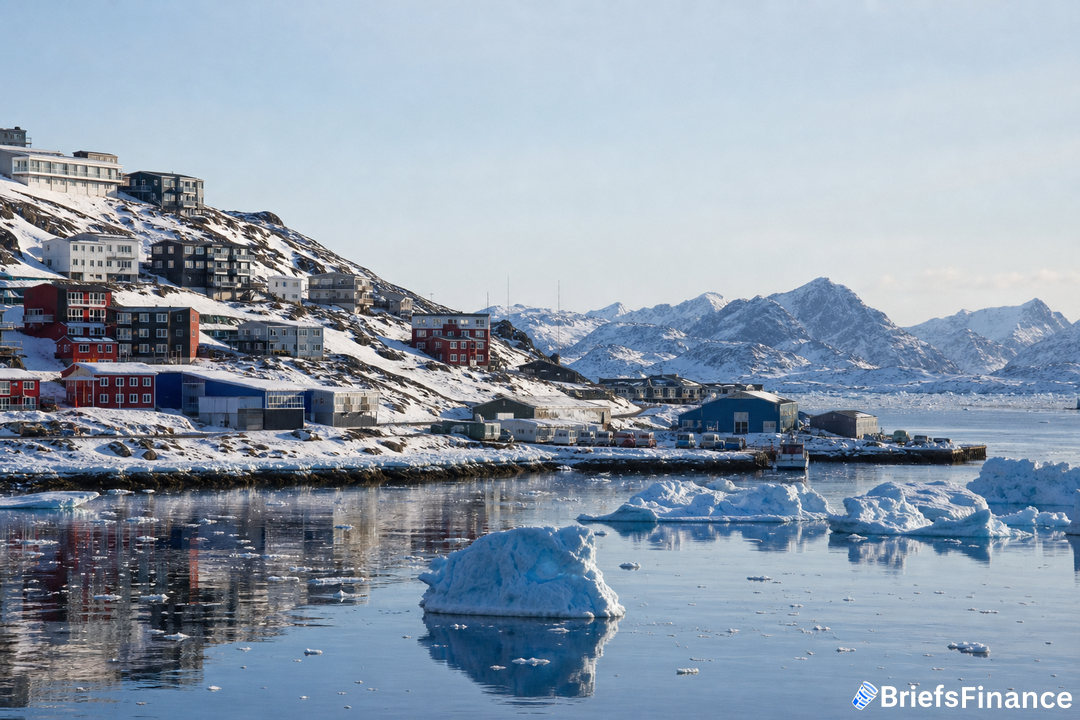
What's on the agenda in Nuuk
Ursula von der Leyen will return to Greenland's capital on Sunday for her second visit, alongside Danish Prime Minister Mette Frederiksen, with a plan that is widely expected to include new support for the self-governing Danish territory.
The backdrop is getting noisier. Icelanders just rejected restarting EU membership talks, and U.S. President Donald Trump has again pressed the case for U.S. control of Greenland on national security grounds. After refusing to rule out using military force to annex the island, he said in late January that he and NATO Secretary General Mark Rutte had put together a "framework of a future deal" concerning the territory. Since then, a working group of officials from the U.S., Denmark and Greenland has been meeting to discuss next steps.
Why it matters now
Analysts see three big drivers for the trip: shoring up Arctic security, stepping up economic and infrastructure investment, and tightening cooperation across the North Atlantic and the wider Arctic. The Financial Times reported the EU is weighing a 2026-27 package of around €200 million that could focus on critical minerals, renewable energy and undersea cable projects.
Kristina Spohr, a professor at the London School of Economics, framed the visit as a show of solidarity with Greenland and Denmark at a tense moment. She pointed to sabotage and hybrid-warfare concerns, questions around Russian trawlers near Svalbard, and Chinese and Russian dual-use scientific activity in the Chukchi Sea and through the Bering Strait, noting the U.S. has said such vessels must not enter American national waters. She also highlighted the GIUK gap - the key sea route connecting the Arctic to the Atlantic through Greenland, Iceland and the U.K. - and said the landscape is highly volatile, including because Washington is making life "incredibly difficult," particularly for Greenland and Denmark.
CNBC requested comment from the European Commission - the EU's executive branch - but it had not replied before von der Leyen's visit. Denmark's Foreign Ministry said it would not comment, speaking through a spokesperson.
Understanding what moved a market beats knowing that it moved. Get the free Market Briefs daily newsletter and follow the drivers.
Local signals from Greenland
Brussels has been investing in the Arctic for years and is preparing to update its Arctic policy. "We are not newcomers here. But today's environment demands more," said EU commissioner Jozef Síkela at the EU Arctic Forum.
On the ground, the focus is practical. "What can we really do?" asked Andreas Raspotnik. "We can invest, we can offer support on pre-agreed issues such as infrastructure, investments in education and increasing our presence there."
There is also a regional moment to watch: on Monday, Greenland will host its biannual national meeting with Frederiksen and Faroese Premier Beinir Johannesen.
What this could mean for your money
If a roughly €200 million plan for 2026-27 zeroes in on minerals, clean power and subsea cables, it hints at where public contracts and project pipelines may open up in the Arctic. Add in the EU's permanent presence in Nuuk created when von der Leyen opened the Commission's office in March 2024 and those earlier agreements near €94 million, and the direction of travel is clear: more attention and more euros flowing north.
Keep an eye on three signals: concrete numbers von der Leyen unveils in Nuuk, outcomes from Monday's Greenland-Denmark-Faroes meeting, and any updates from the U.S.-Denmark-Greenland working group. Together, they will show whether today's geopolitics turns into real projects that touch energy, connectivity and supply chains you rely on.