Free NewsletterPro Login
S&P 500 6,287 +0.42%
DOW 44,521 -0.18%
NASDAQ 21,103 +0.71%
S&P 500 +12.4%
Briefs Finance Fund +24.8%
JOIN THE FUND →

The US Just Hit Record Honey Imports. The Bees Are Why.

Published May 26, 2026
[tts_player]
Share:
Summary:
  • US bee hives died off at the highest rate ever in the year ending April 2025, with more than half lost.
  • US honey output is at its lowest level in 30 years.
  • Imports now make up about 80% of US honey use, led by India, Argentina, Brazil, and Vietnam.

People in the US are eating more honey than ever.

The country's bees can barely supply any of it. So the US is buying record amounts from other lands to fill the gap.

The Bee Die-Off Is Worse Than People Think

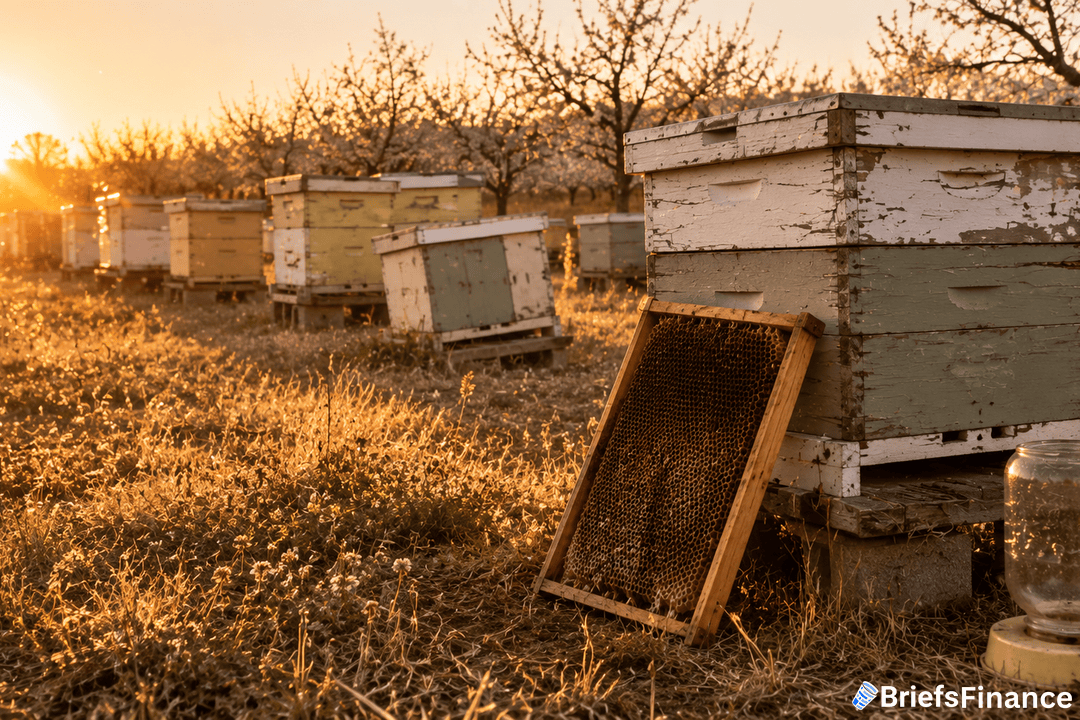
In the year ending April 2025, US bee keepers lost more than half of their hives. That's the highest die-off rate on record.

USDA experts traced it to two things at once. A bug called the varroa mite spread viruses to bees, while the bug stopped dying from amitraz, the last drug bee keepers used to fight it.

In plain English: the bug is winning. The drug doesn't work.

US honey output has fallen to its lowest point in 30 years. Since 2000, almost 40% of US output has gone.

Stories like this don't often hit your trading screen. But they shape the food economy.

Market Briefs joins the dots every morning. Five-minute reads, with an investing masterclass thrown in as a free bonus.

Demand Is Going The Wrong Way

People want more honey, not less.

US honey use has climbed to 550 million pounds a year. The shift to "clean eating" away from corn syrup helped drive it.

Prices are up about 30% in the past five or six years. The math doesn't work for US supply.

So imports are filling almost all of the gap. Four lands supply about 79% of US honey imports:

  • India (about 39%)
  • Argentina (about 23%)
  • Brazil (about 11%)
  • Vietnam (about 6%)

Honey is now an import good, like coffee and bananas. The US is the world's top honey buyer.

Why Investors Should Care

This story has more market angles than it looks. Almonds, blueberries, and apples need bees to grow.

If bee keepers can't keep hives alive, food brands pay more for things like cereal and ice cream. Many of those brands trade on US stock markets.

Duties on imported honey have been rising too. The Commerce Department lifted duties on honey from Argentina from 16.9% to 58.34% last year.

Duties on top Vietnam sellers now run as high as 154%. So imported honey is getting pricier as US supply is shrinking.

Price pressure is coming from both sides. That's the kind of supply story that quietly pushes grocery inflation higher.

What To Watch

USDA-backed work on new mite drugs is the thing to track. If a swap for amitraz works, US hive losses could ease.

If it doesn't, the "honey gap" gets wider. Bee deaths could also push up costs for big crops like almonds. Most US almond growers rent hives to grow the nuts.

That cost flows through to brands that sell almonds, almond milk, and snack bars on store shelves across the US.

Either way, the next time honey shows up on a grocery shelf, it has likely been on a plane.

For the supply chain stories that move prices, sign up for Market Briefs. The daily newsletter comes with a 45-minute video course on smart investing at no extra cost.

Disclosure

Recent News

1 2 3 28

Get Market Briefs delivered to your inbox every morning for free!

No fluff. No noise. No politics. Just finance news you can read in 5 minutes.

Blogs

June 25, 2026
How Stocks Work: A Simple Guide for Beginners
  • A stock is a slice of ownership in a company - buy one, and you own a piece of the business.
  • You make money two ways: the share price rising over time, and dividends paid to shareholders.
  • The simplest path for most beginners is buying into the whole market through a low-cost index fund.
Read More
June 25, 2026
Stop Loss vs Stop Limit: What's the Difference?
  • A stop loss order sells your stock once it hits a trigger price, prioritizing getting you out.
  • A stop limit order only sells within a price range you set, prioritizing price over a guaranteed exit.
  • The trade-off: a stop loss almost always executes; a stop limit might not if the price moves too fast.
Read More
June 25, 2026
Energy Stocks: A Simple Guide for Investors
  • Energy stocks are companies that produce and supply the power the world runs on, from oil and gas to newer sources.
  • They make up one of the 11 sectors of the market and tend to move with energy prices and big-picture shifts.
  • Like any sector, the key is diversification and understanding the forces driving demand.
Read More
June 18, 2026
What Is a Stop Loss Order? A Simple Guide
  • A stop loss order automatically sells a stock once it falls to a price you set.
  • It's a tool to cap losses or lock in gains without watching the market all day.
  • It works best for active strategies, and can backfire if used carelessly on long-term holdings.
Read More
June 18, 2026
Best S&P 500 Index Fund: How to Choose One
  • The best S&P 500 index fund for most investors is simply the cheapest, most established one that tracks the index well.
  • Funds like VOO, IVV, and SPY all hold the same 500 companies, so the biggest difference is the fee.
  • Pick one, automate your buys, and let time do the heavy lifting.
Read More
June 17, 2026
What Are Penny Stocks? Risks and Rewards Explained
  • Penny stocks are very low-priced shares of very small companies, often trading for just a few dollars or less.
  • They promise huge gains but carry huge risks: low liquidity, high failure rates, and wild price swings.
  • Most investors are better served by quality companies and funds than by chasing cheap shares.
Read More
June 17, 2026
Best Stocks for Beginners With Little Money
  • The best stocks for beginners with little money usually aren't individual stocks at all - they're low-cost index funds.
  • You can start with $100 or less and use small, regular investments to build wealth over time.
  • Focus on diversification and consistency, not on picking the next big winner.
Read More
June 16, 2026
Tech Stocks: A Simple Guide for New Investors
  • Tech stocks are companies in the information technology and related sectors, from software to chips to the internet giants.
  • They've driven much of the market's growth, but they can be volatile and richly valued.
  • The smart approach is to understand what you own and not let one sector run your whole portfolio.
Read More
June 16, 2026
What Is a Joint Stock Company? A Simple Guide
  • A joint stock company is a business owned by many people, each holding shares of stock that represent a slice of ownership.
  • It's the basic idea behind every public company you can buy on the stock market today.
  • Owning a share makes you a part-owner, entitled to a piece of the profits and growth.
Read More
June 16, 2026
Capital Gains Tax in California: A Simple Guide
  • Capital gains tax is what you owe when you sell an investment for more than you paid for it.
  • How long you held it matters: long-term gains are taxed more gently than short-term gains at the federal level.
  • Smart investors lower the bill with tools like tax-loss harvesting and holding for the long run.
Read More
1 2 3 23
Share via
Copy link










