Warning: Undefined variable $stocks in /var/www/briefs.co/htdocs/wp-content/plugins/oxygen/component-framework/components/classes/code-block.class.php(133) : eval()'d code on line 448
Warning: foreach() argument must be of type array|object, null given in /var/www/briefs.co/htdocs/wp-content/plugins/oxygen/component-framework/components/classes/code-block.class.php(133) : eval()'d code on line 448
Warning: Undefined variable $funds in /var/www/briefs.co/htdocs/wp-content/plugins/oxygen/component-framework/components/classes/code-block.class.php(133) : eval()'d code on line 472
Warning: foreach() argument must be of type array|object, null given in /var/www/briefs.co/htdocs/wp-content/plugins/oxygen/component-framework/components/classes/code-block.class.php(133) : eval()'d code on line 472
/* the link was here */
Market's dipped a bit on Wednesday after digesting the Supreme Court's tariff pause.
U.S. Secretary Bessent says the U.S. is prepared to pay back companies for the tariffs they received, if needed.
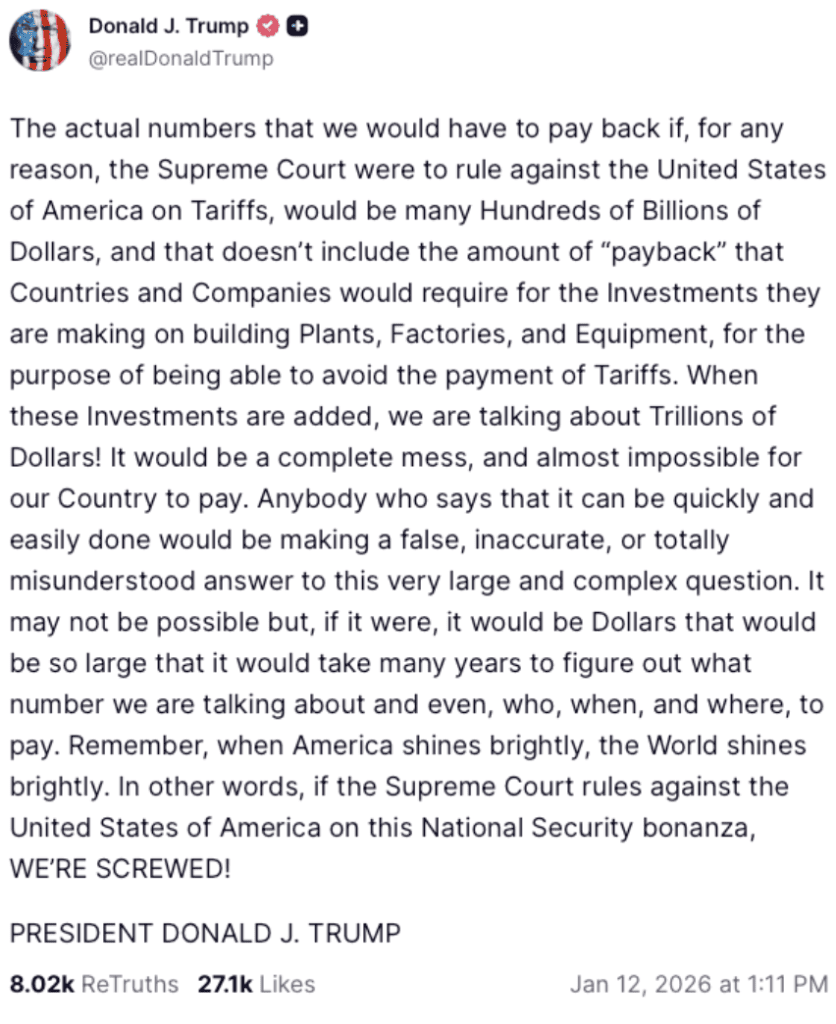
President Trump said the tariffs were a success and a ruling against them would mean the U.S. is 'screwed.'
Markets held their breath Wednesday morning as investors awaited a Supreme Court decision on the Trump administration's tariff policy - a decision that never came.
The court handed down three decisions on Wednesday, and tariffs were not among them.
A verdict from the highest court in the land has been looming over much of the market, as many companies are looking to plan out their shipping and freight orders for Q2 and Q3 of 2026.
The freight industry itself has faced significant struggles in the face of the tariffs, with many companies loading up on goods before the tariffs hit, triggering a destocking event.
The Tariffs, which were implemented using the International Emergency Economic Powers Act, have been challenged by many of the impacted companies as an illegal tax, and an overreach of presidential authority.
If the supreme court does rule them as illegal, it could trigger widespread refunds to companies that have been paying the cost.
National Economic Council Director, Kevin Hassett, said that the White House is creating a contingency plan if that happens, telling CNBC’s Squawk on the Street:
“There was a big call last night with all the principals to talk about if the Supreme Court were to rule against this IEEPA tariff, what would the next step be? “
U.S. Treasury Secretary, Scott Bessent, also displayed confidence, saying “It won't be a problem if we have to do it.”
President Trump himself did not echo that same confidence, taking to his social media to say that if the Supreme Court were to rule against the tariffs “we’re screwed!”
Trump has been championing the tariffs as the major reason for a strong U.S. economy, saying his tariff policy has generated $18 trillion in U.S. investment.
On Tuesday, January 14th the President spoke to the Detroit Economic Club, saying “one of the biggest reasons for this unbelievable success has been our historic use of tariffs.”
While some analysts have questioned the validity of the $18 trillion dollar claim, U.S. markets have shown a strong start to 2026, hovering around record highs.
However, markets began to slip on Wednesday after news broke that the Court’s decision had been delayed, with the S&P 500 down more than 1% by 12:00 PM EST.
Briefs Finance analyst Jackson Moreland said the losses are expected, describing a market on-edge:
“The court’s decision is looming over a big portion of the American economy. It’s not just freight, this ruling will set the tone for retail, luxury, even industries like energy. Right now, there’s an air of uncertainty, and investors are frozen”
Not everything is down in the face of the Court’s delayed decision, as precious metals are on the rise, with both Gold and Silver showing gains.
Briefs Money shows you what to do with every paycheck, and in what order: how much to spend, save, and invest, when to build an emergency fund, and which debt to pay off first.
The Climb to Wealth course walks you through the system step by step, and the Personal Finance Spreadsheet is where you track your own numbers.
Investing is one piece of building wealth. The system that gets money to your investments, and keeps it there, decides the outcome.
The Briefs Score shows growth, income, and wealth preservation investors how well a stock fits their goal, with a separate letter grade for each one.
The most common mistake is treating the letter as an instruction. An A tells you a stock scores well for one goal, not that you should buy today.
Research works best as one input in a process you own. The grade shows how a stock stacks up. You supply the goal, the timeline, and the rules for being wrong.
Briefs Terminal lets you size up any public company in about ten minutes: what the stock costs, what it earns, how fast sales are growing, and what it pays you, all on one page.
It lines those numbers up against the company's closest competitors for you, so you can tell if a number is impressive or just average.
Below that are the income statement, balance sheet, and cash flow statement from the company's SEC filings, the latest news, and transcripts of its earnings calls.
Briefs sorts its stock grades and monthly reports by three investor goals: growth, income, and wealth preservation. Pick yours and you know which report and which grade to read first.
Growth investors want stocks that beat the S&P 500. Income investors want to get paid in cash. Wealth preservation investors want stocks that hold up when the market drops.
The same stock can score an A- for one goal and a D- for another, so picking your goal comes before picking any stock.
A watchlist on Briefs Terminal lets you group stocks by the idea you're tracking and follow each one's price, one-day move, and 52-week high and low in one place.
Each list has its own name and description, so you always know why a stock is on it, and you can make as many lists as you have ideas.
The monthly growth, income, and wealth preservation reports under the Briefs Research tab hand you new themes to track that you didn't hear about online.
The ETF planning tool takes an idea like "I want to invest in fast food companies," asks what you mean, and finds the ETFs that match, with the reasons, the holdings, and the sources.
Build a Plan then shows what your money could grow to in those ETFs over the years you choose, with conservative, expected, and optimistic estimates next to the S&P 500.
It gets you from an idea to an actual plan without researching dozens of companies one at a time.
The typical American household earned more in 2025 than in any year on record, yet only 30% of Americans say they could pay a surprise $1,000 bill from savings, so the problem isn't income but what the income gets spent on.
An asset puts money in your pocket and a liability takes money out, and the wealthy buy assets first, then let the assets pay for the fun stuff.
Before you buy anything, ask one question: does this put money in my pocket, or take money out of my pocket? Then you need a plan for the money you keep.
Your first money goal isn't investing, it's $2,000 in its own account named Do Not Touch, built by moving 10% of every paycheck into it automatically.
More than a third of American adults couldn't cover a $400 surprise bill with cash or savings, according to the Federal Reserve, and that's how one bad day turns into years of credit card payments.
Once the $2,000 is there, attack every debt charging more than 10% interest, highest rate first, because you can't out-invest a 22% credit card so paying it off is the investment.
Meet Bunty, a fictional investor with the worst timing in history: he put $100,000 into the market in four chunks right before four crashes, never sold, and by 2025 it had grown to more than $500,000.
Investors who jump in and out of the market miss its best days, and missing just a handful of those days can cut your final result roughly in half.
The fix is ABB, Always Be Buying: you buy on a schedule through booms, crashes and scary headlines, which matches the market, and beating it takes knowing where the money is moving first.