Free NewsletterPro Login
S&P 500 6,287 +0.42%
DOW 44,521 -0.18%
NASDAQ 21,103 +0.71%
S&P 500 +12.4%
Briefs Finance Fund +24.8%
JOIN THE FUND →

Steak Nears $12.80 in May 2026, Yet Shoppers Keep Buying

Published Jul 3, 2026
[tts_player]
Share:
Summary:
  • The average price for a pound of ground beef reached $6.75 in May 2026, up nearly 13% from a year earlier.
  • Beef sales for the Fourth of July holiday period rose by $352 million compared to the same stretch in 2025.
  • The U.S. cattle herd is at its smallest size in decades after years of drought and high feed costs forced herd liquidation.

Beef prices are near all-time highs. Yet consumers keep buying steak - and they are trading up to premium cuts and organic options.

Prices Climb, Demand Holds
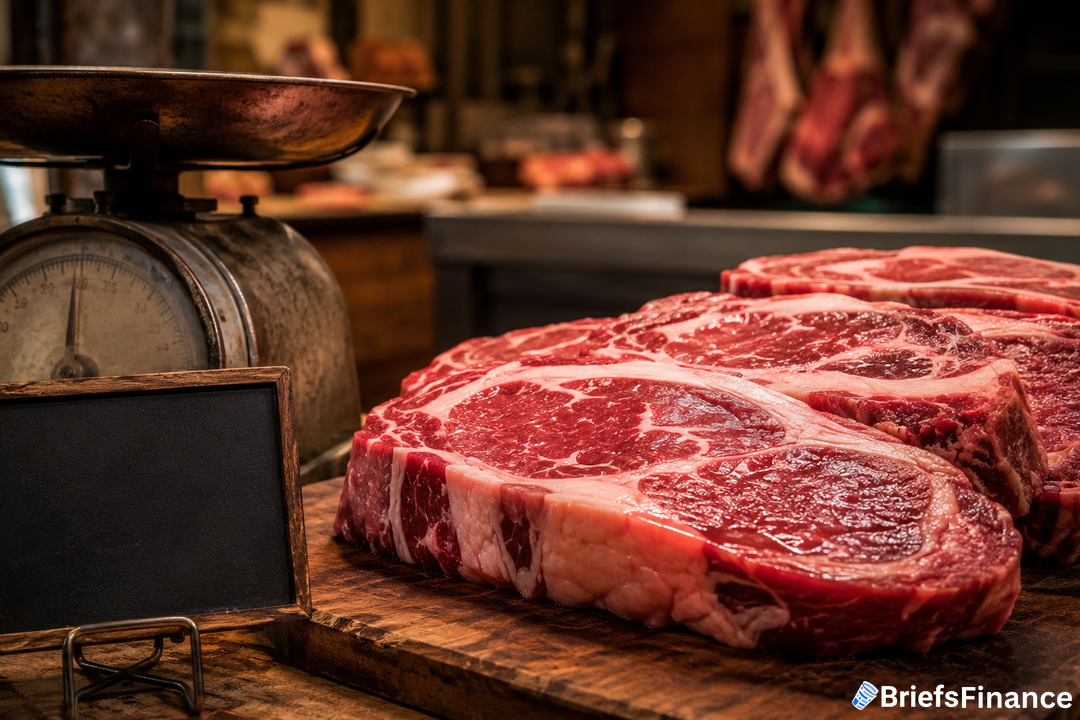
The price for steak reached $12.80 per pound in May 2026, marking a 16% increase year-over-year and representing the second highest figure on record.

Despite the sticker shock, shoppers are not cutting back. A Kroger spokesperson said, "We are seeing customer demand for steaks remain quite high, with a shift towards more premium and organic options." Omaha Steaks saw sales of its new USDA certified tender top sirloin filet value cut jump 25% in the weeks before Father's Day 2026 compared to 2025.

Get your free investing masterclass bonus when you join Market Briefs, our free daily newsletter

The Supply Squeeze
The reason for high prices is simple: there are far fewer cattle. Years of drought and expensive feed pushed ranchers to sell off herds. This scarcity of cattle has pushed up prices for live animals, which in turn raises the cost consumers pay for beef in stores and eateries. It would take several years to rebuild the national herd, which could later boost beef availability and lower prices.

The current supply shortage stems from a multi-year drought across the Great Plains and Southwest that began in 2020, forcing many ranchers to cull breeding stock due to soaring hay and grain costs. As a result, the U.S. cattle inventory fell to 87.2 million head in January 2026, the lowest since 1962, according to USDA data. Without a quick turnaround, tight supplies are expected to persist.

Shoppers Look for More Than Price
Consumers are becoming pickier. NielsenIQ reports that 42% of shoppers now favor USDA Prime quality claims when buying meat. Another 40% look for "no added hormones," 37% prefer "grass-fed," and 36% seek "no antibiotics ever."

NielsenIQ noted in a June report, "Shoppers are looking past the label and into the story behind the meat." The research firm also observed, "Consumers are entering the holiday with discipline, making more trips but with clear intent behind each one."

At LongHorn Steakhouse, parent company Darden Restaurants sees an opportunity. CEO Rick Cardenas said, "The guests know they're getting high quality steaks when they come to LongHorn [Steakhouse]. They get a great value. And it doesn't hurt that there's a high beef inflation in the market. And so the relative value looks a little bit better." Meanwhile, Omaha Steaks CEO Nate Rempe added, "Customers are still celebrating dad with premium proteins, but they're also being thoughtful about value and versatility."

What to Watch
Investors are left wondering for how much longer this trend will persist. Rebuilding the national herd requires several years if no foreign cattle are imported, and only after that could beef supplies increase and prices drop. For now, the tension between tight supply and resilient demand keeps steak prices near record levels.

Subscribe to Market Briefs, our free daily newsletter, and claim your bonus investing masterclass

Disclosure

Recent News

1 2 3 32

Get Market Briefs delivered to your inbox every morning for free!

No fluff. No noise. No politics. Just finance news you can read in 5 minutes.

Blogs

June 29, 2026
Portfolio Diversification: Why Putting All Your Eggs in One Basket Destroys Wealth
  • Real diversification means spreading investments across all 11 economic sectors plus bonds, alternatives, and cash so no single bet can sink the portfolio.
  • Different sectors perform at different times, so a diversified portfolio captures upswings while smoothing the brutal drawdowns that wipe out concentrated bets.
  • Total market index funds offer the simplest path to diversification, and annual rebalancing is what keeps the structure working over time.
Read More
June 29, 2026
Non Taxable Income: What It Is and Why It Matters
  • Non taxable income is money you receive that you don't owe income tax on.
  • The tax code treats workers, investors, and business owners very differently, and investors often come out ahead.
  • Learning how income is taxed is a quiet superpower for keeping more of what you earn.
Read More
June 29, 2026
Semiconductor Stocks: A Simple Guide for Investors
  • Semiconductor stocks are companies that design and make computer chips, the brains inside nearly every modern device.
  • The AI boom has turned chips into one of the market's most important and most watched groups.
  • They offer big growth potential, but come with high valuations and a notoriously cyclical history.
Read More
June 25, 2026
How Stocks Work: A Simple Guide for Beginners
  • A stock is a slice of ownership in a company - buy one, and you own a piece of the business.
  • You make money two ways: the share price rising over time, and dividends paid to shareholders.
  • The simplest path for most beginners is buying into the whole market through a low-cost index fund.
Read More
June 25, 2026
Stop Loss vs Stop Limit: What's the Difference?
  • A stop loss order sells your stock once it hits a trigger price, prioritizing getting you out.
  • A stop limit order only sells within a price range you set, prioritizing price over a guaranteed exit.
  • The trade-off: a stop loss almost always executes; a stop limit might not if the price moves too fast.
Read More
June 25, 2026
Energy Stocks: A Simple Guide for Investors
  • Energy stocks are companies that produce and supply the power the world runs on, from oil and gas to newer sources.
  • They make up one of the 11 sectors of the market and tend to move with energy prices and big-picture shifts.
  • Like any sector, the key is diversification and understanding the forces driving demand.
Read More
June 18, 2026
What Is a Stop Loss Order? A Simple Guide
  • A stop loss order automatically sells a stock once it falls to a price you set.
  • It's a tool to cap losses or lock in gains without watching the market all day.
  • It works best for active strategies, and can backfire if used carelessly on long-term holdings.
Read More
June 18, 2026
Best S&P 500 Index Fund: How to Choose One
  • The best S&P 500 index fund for most investors is simply the cheapest, most established one that tracks the index well.
  • Funds like VOO, IVV, and SPY all hold the same 500 companies, so the biggest difference is the fee.
  • Pick one, automate your buys, and let time do the heavy lifting.
Read More
June 17, 2026
What Are Penny Stocks? Risks and Rewards Explained
  • Penny stocks are very low-priced shares of very small companies, often trading for just a few dollars or less.
  • They promise huge gains but carry huge risks: low liquidity, high failure rates, and wild price swings.
  • Most investors are better served by quality companies and funds than by chasing cheap shares.
Read More
June 17, 2026
Best Stocks for Beginners With Little Money
  • The best stocks for beginners with little money usually aren't individual stocks at all - they're low-cost index funds.
  • You can start with $100 or less and use small, regular investments to build wealth over time.
  • Focus on diversification and consistency, not on picking the next big winner.
Read More
1 2 3 24
Share via
Copy link










