Free NewsletterPro Login

The USDA Is Spending Over $1 Billion To Fight Screwworm In Texas Cattle

Published Jun 8, 2026
Share:
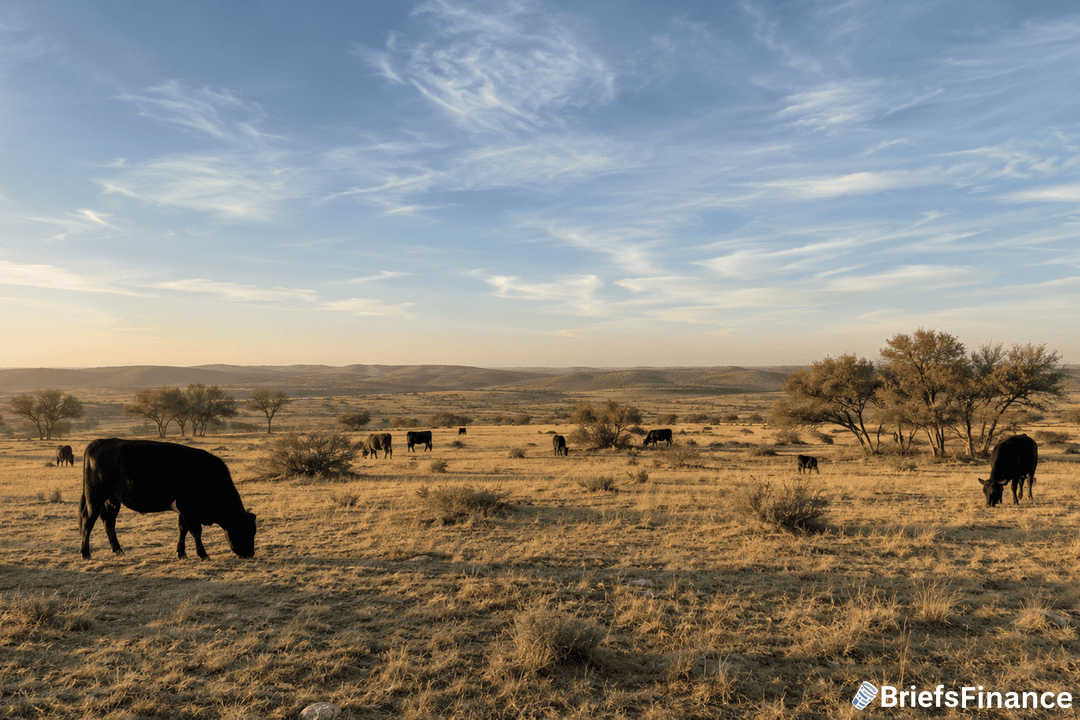
Cows grazing on a dry, grassy plain with scattered trees under a partly cloudy sky at sunset; distant hills visible in the background. BriefsFinance logo appears in the bottom right corner.
Summary:
  • The USDA has confirmed four screwworm cases in Texas, the first in the U.S. since the 1960s.
  • Secretary Brooke Rollins said the U.S. food supply is "not at risk" because screwworms do not infest meat or produce.
  • The U.S. is dropping about 10 million sterile flies a week to push the pest back, part of an effort costing over $1 billion.

A pest the U.S. wiped out 60 years ago is back. It showed up in Texas cattle.

And the government is spending more than $1 billion to kill it again.

For ranchers, that is a big deal. Beef is one of the country's biggest farm products.

For investors who track beef prices, it is worth watching too. The flesh-eating screwworm threatens livestock.

It does not touch the steak in the grocery case. The bigger risk is to the herds that supply it.

What The Screwworm Actually Is

The New World screwworm is a fly. Its larvae burrow into the open wounds of living animals.

Left untreated, those wounds can turn deadly. The pest mainly hits cattle, wildlife, and pets.

In rare cases, it can even harm people. That is why ranchers watch it so closely.

The USDA has now confirmed four cases in Texas. They include a calf and a dog.

This is the first in the U.S. since the 1960s. Early signs suggest the dog had just been in Mexico, which is likely where the pest crossed over.

The first Texas case turned up in early June. The U.S. had not seen the pest since 1966.

Secretary Brooke Rollins tried to calm fears on Monday. She noted the pest does not infest meat, fruits, or vegetables.

That is why she said the food supply is "not at risk."

For investors who track the cattle market, Market Briefs ties stories like this back to your money every morning, and you get a free investing masterclass when you sign up.

The Old Playbook

The U.S. beat this pest once before, back in the 1960s. It plans to run the same plan again.

The trick is to release sterile flies. They mate with wild ones, so no offspring are born.

Think of it like flooding a dating pool with partners who can never have kids. Over time, the wild population collapses on its own.

Right now the U.S. is dropping about 10 million sterile flies a week. They go out by air and by ground.

It is slow, steady work, but it worked once before.

The goal is to push the pest back into Mexico. Then the plan is to wipe it out for good.

The stakes are real for the beef business. A bad outbreak can thin herds and lift prices.

Texas Governor Greg Abbott has already expanded a state disaster order.

What To Watch

The fight is not without friction. Texas Agriculture Commissioner Sid Miller knocked the USDA for a slow response that let the pest cross the border.

Rollins fired back and called his comments "disturbing and disruptive."

Each new case raises the odds the pest spreads past Texas. For now, the bigger question for the cattle market is how fast the spread gets contained.

If you want news like this tied back to your money each morning, sign up for Market Briefs, and a 45-minute investing course is thrown in for free.

Disclosure

Get Market Briefs delivered to your inbox every morning for free!

No fluff. No noise. No politics. Just finance news you can read in 5 minutes.

Blogs

May 30, 2026
Financial Literacy Books That Actually Build Wealth
  • The best financial literacy books don't just teach budgeting, they shift how you think about money.
  • Two classics stand out: The Intelligent Investor for valuing investments, and Rich Dad Poor Dad for the owner's mindset.
  • Reading is only step one. The real wealth comes from acting on what you learn.
Read More
May 30, 2026
What Is a Roth Conversion? A Simple Guide
  • A Roth conversion moves money from a traditional retirement account into a Roth account.
  • You pay taxes on the money now, in exchange for tax-free growth and withdrawals later.
  • It can pay off if you expect higher taxes or more income in the future, but the timing and tax hit matter a lot.
Read More
May 30, 2026
Trailing Stop Loss: How to Protect Your Gains
  • A trailing stop loss is an order that automatically sells a stock if it falls a set percentage from its recent high.
  • As the stock rises, the sell point rises with it, locking in gains while capping losses.
  • It's most useful for active strategies like momentum investing, not for long-term buy-and-hold.
Read More
May 30, 2026
5 Types of Wealth: Why Money Is Only One of Them
  • Real wealth is more than a bank balance. It spans your finances, health, mind, purpose, and freedom.
  • Money is powerful, but it amplifies the life you already have rather than fixing a broken one.
  • True financial wealth means your cash flow covers your expenses, so your money works while you live.
Read More
May 30, 2026
How to Invest in Private Equity: A Beginner's Guide
  • Private equity means investing in companies that aren't listed on the stock market.
  • Traditional private equity is built for experienced, high-net-worth investors with large amounts to invest.
  • New rules have opened more accessible paths, like startup crowdfunding and real estate deals, often starting around $100.
Read More
May 30, 2026
What Is a Call Option? A Simple Guide With Examples
  • A call option gives you the right to buy a stock at a set price by a set date.
  • Investors buy calls when they expect a stock to rise, using less money than buying the shares outright.
  • The most you can lose buying a call is the premium, but time works against you, so it's an advanced tool.
Read More
May 30, 2026
EBITDA Formula: How to Calculate It Step by Step
  • EBITDA stands for Earnings Before Interest, Taxes, Depreciation, and Amortization, a measure of a company's core profit.
  • The formula adds those four items back to net income to show what the underlying business earns.
  • Investors use EBITDA to compare companies and to judge how many times earnings a stock is selling for.
Read More
May 30, 2026
What Is a Stock Option? A Plain-English Guide
  • A stock option is a contract giving you the right, but not the obligation, to buy or sell a stock at a set price by a set date.
  • There are two types: calls (the right to buy) and puts (the right to sell).
  • Options are powerful but risky, so they suit investors who already have the basics down.
Read More
May 30, 2026
Put Option: What It Is and How It Works
  • A put option gives you the right to sell a stock at a set price by a set date.
  • Investors use puts to bet a stock will fall, or as insurance to protect shares they own.
  • The most you can lose buying a put is the premium you paid, which makes it a defined-risk tool.
Read More
May 30, 2026
Operating Margin: What It Is and How to Calculate It
  • Operating margin shows how much profit a company keeps from its core business after paying its running costs.
  • The formula is operating income divided by revenue, shown as a percent.
  • A strong, steady operating margin signals a well-run business that controls its costs.
Read More
1 2 3 22
Share via
Copy link











