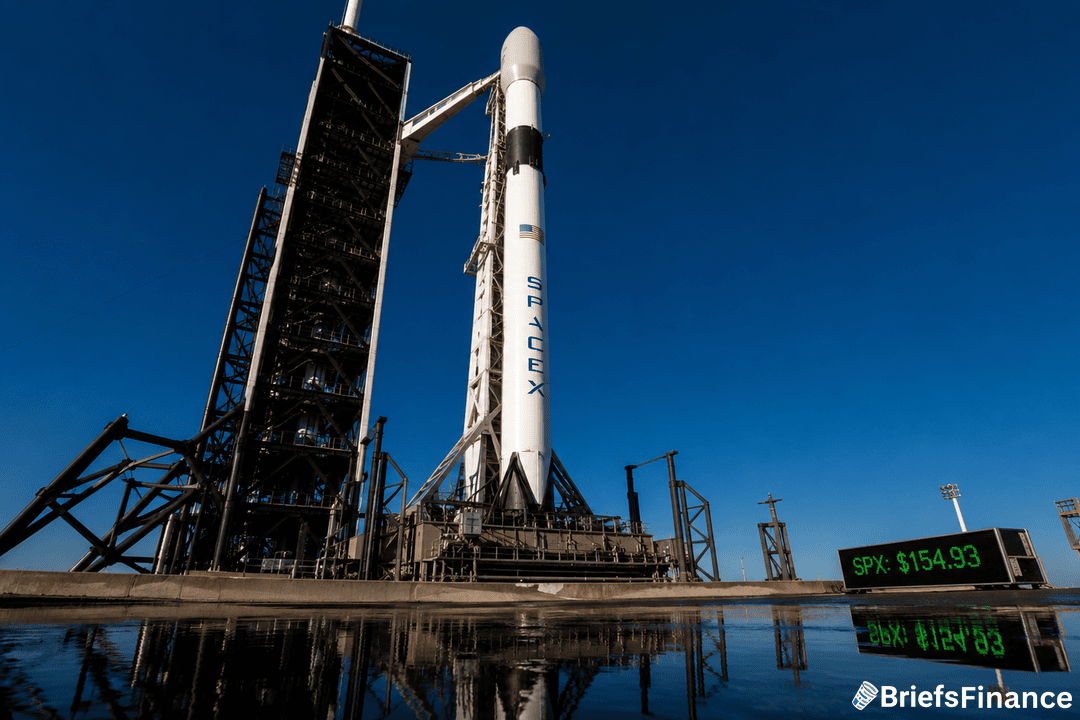
Following Friday's market close, SpaceX shares officially entered the Russell 1000 index; Monday marks the first full trading session as an index member, with a scheduled addition to the Nasdaq-100 on July 7. The stock has dropped nearly a quarter from its peak, yet index membership signals a major vote of confidence. The key question is whether this milestone can halt the slide.
The company went public on June 12 at $135 per share and soared to an all-time high of $225.64 days later, only to reverse sharply. The limited float - just 86 million shares out of 13 billion outstanding - has amplified the volatility. Institutional investors tracking the Russell 1000 and Nasdaq-100 will need to acquire shares, but the scarcity could push prices higher if demand outstrips supply. Meanwhile, SpaceX's recent merger with xAI has added a strong artificial intelligence component, giving the company a second growth engine beyond its core rocket and satellite businesses.
Why the Stock Dropped
Then it sank to a low of $147.11. S&P Global chose not to expedite SpaceX's entry into its indexes because of concerns that passive funds would struggle to acquire enough shares due to the limited float.
What Index Inclusion Means
The Russell 1000 addition is automatic for large stocks. But the Nasdaq-100 inclusion on July 7 forces funds like the Invesco QQQ ETF to buy SpaceX shares all at once. That wave of forced buying could give shares another boost.
Get your free investing masterclass bonus when you join Market Briefs, our free daily newsletter
On June 29, SpaceX shares traded as high as $159.88 before settling at $154.93, up 1.1% for the day. That move came on a day when the S&P 500 gained 0.7% and the Dow rose 0.8%. So the company is only slightly outperforming the broader market. However, more shares are expected to become available for trading within the next six months.
Worth Noting
SpaceX is now valued at about $2 trillion. Musk has stated he expects SpaceX to generate over $100 billion in annual revenue by 2028, while analysts project roughly $103 billion. The SpaceX merger with xAI in February gave the company a strong AI business. As Musk wrote late Sunday, "I would be disappointed if SpaceX did not significantly exceed these milestones."
In the months ahead, the company's share price will be driven more by investor sentiment regarding these ambitious targets than by index inclusion alone.
Background: A High-Flying Growth Story
SpaceX, founded by Elon Musk, has transformed the aerospace sector with reusable rockets and the Starlink satellite constellation. The merger with xAI, Musk's artificial intelligence venture, positions the firm to apply AI in space operations and beyond. Its roughly $2 trillion market capitalization reflects enthusiasm for these twin growth drivers, even as the stock retreats from its early highs.
The upcoming index additions could provide a near-term catalyst, but the long-term trajectory hinges on delivering on Musk's bold revenue forecasts. The company's limited float and high valuation make it a volatile but potentially rewarding bet for investors watching the July 7 Nasdaq-100 inclusion.
Subscribe to Market Briefs, our free daily newsletter, and claim your bonus investing masterclass