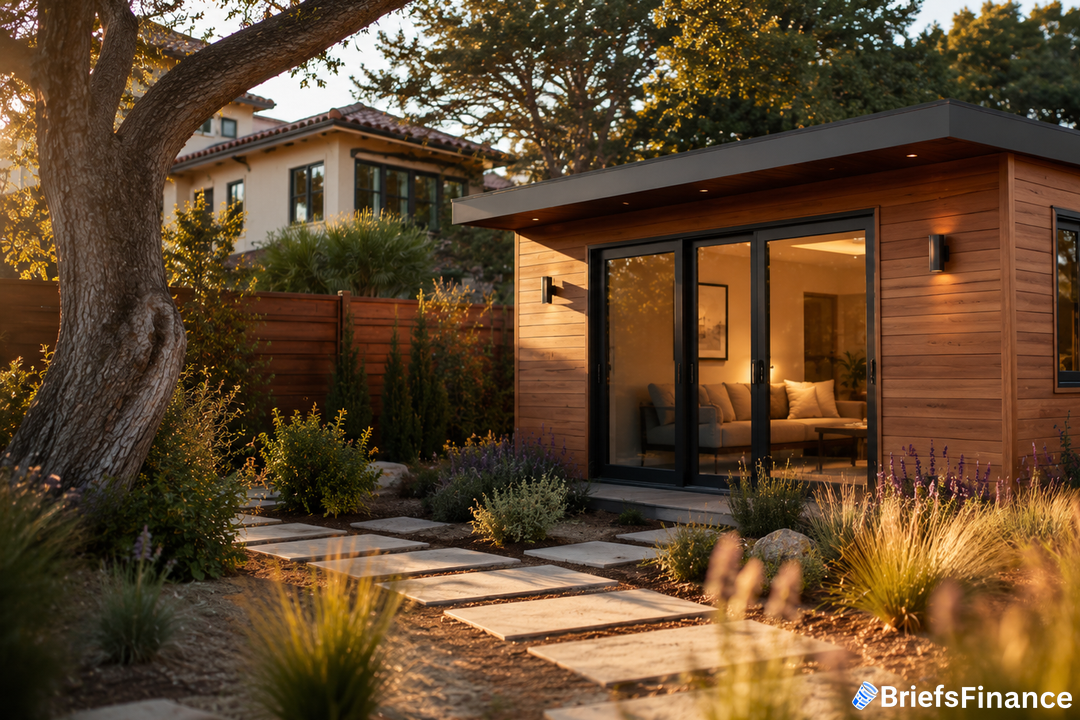
The Rise of Backyard Homes in Exclusive Enclaves
Across the Bay Area, accessory dwelling units have become far more prevalent.
State data shows that ADUs are even more common elsewhere in California, making up 26% of the state's new home permits last year. That is partly because the Bay Area has little undeveloped land left, forcing it to rely more on multifamily construction. Since 2021, the region has steadily permitted 1,100 to 1,400 ADUs annually, while multifamily projects have swung up and down. In 2024, when multifamily permits fell sharply, ADUs accounted for a record nearly 28% of new approvals.
This surge is largely the result of California's recent legislative push over the last decade to loosen zoning restrictions. Laws such as AB 68 and AB 881 eliminated minimum lot-size requirements for ADUs, removed owner-occupancy mandates, and capped impact fees. These changes made it far simpler for homeowners to add a small unit to their property, especially in suburbs where land is scarce and large apartment buildings face fierce resistance. The result has been a steady pipeline of new units, mostly in already built-up neighborhoods.
Get the market news that matters in a five-minute read with Market Briefs, our free daily newsletter
For instance, prior to these reforms, homeowners in many suburbs faced restrictive zoning that often required large lot sizes or owner occupancy, effectively barring ADUs. The new laws not only removed those barriers but also limited the fees cities could charge, making projects financially viable. As a result, ADU construction has become a popular alternative to larger developments, especially in areas where land is expensive and community opposition to new apartments is high.
Not all cities depend on ADUs. Inland communities such as Bakersfield and Manteca - which still have open land for traditional subdivisions - saw very few accessory unit permits. In San Francisco, where tall apartment buildings dominate new supply, only one in ten new homes was an ADU.
Even suburbs that typically resist densification have embraced them. Local governments benefit from ADUs because they help meet required housing targets, and in Mountain View and Santa Clara, all low-income-affordable units permitted last year were ADUs.
Do ADUs Actually Improve Affordability?
The effect of these small homes on California's housing crisis remains unclear. Researchers have done little to measure how ADUs influence local rents, and the UC Berkeley survey highlighted that many owners do not put their units on the rental market. According to the UC Berkeley survey, a spokesperson said, "Many owners do not put their units on the rental market."
Still, supporters contend that ADUs ease pressure on the housing stock regardless of occupancy. By providing space for relatives or tenants, they reduce competition for conventional homes, especially in towns where little else gets built. A handful of cities now even allow ADU owners to sell the units as condominiums.
In the Bay Area, the ADU boom shows no sign of slowing. Yet whether it truly solves the region's affordability puzzle depends on whether these small homes eventually reach the people who need them most.
Join Market Briefs, our free daily newsletter, for a quick daily rundown of the markets