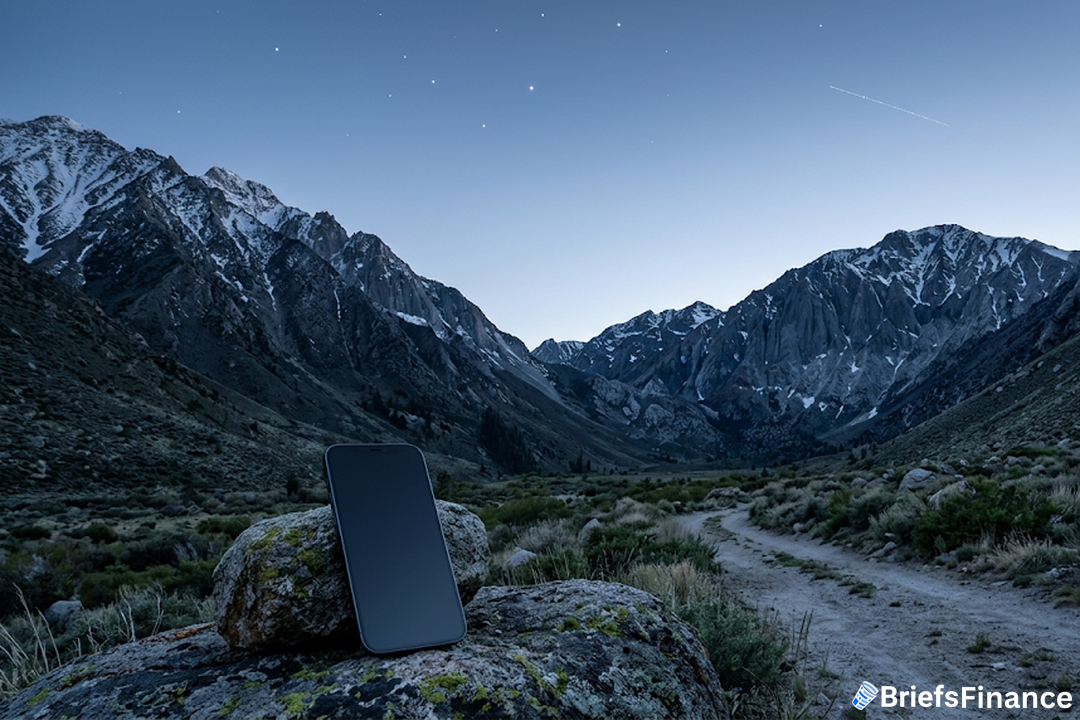
The Plan for a Phone That Never Loses Signal
Amazon wants to build a network in space that talks straight to your smartphone, so you can stay connected even where there are no cell towers.
This week, Amazon submitted an application to the Federal Communications Commission (FCC) seeking permission to launch as many as 5,105 satellites. These would form what is called a direct-to-device network, or D2D for short. Instead of relying on cell towers on the ground, your phone would connect to satellites overhead.
Amazon already has more than 390 of its own satellites in orbit for its Project Kuiper internet service. This new network would layer on top of that. The company plans to combine its existing satellite infrastructure with the assets it will get from buying Globalstar, a satellite operator it agreed to purchase for roughly $11.6 billion in April 2026.
That deal is expected to close in 2027.
Get the market news that matters in a five-minute read with Market Briefs, our free daily newsletter
Why Amazon Is Making This Bet
In its FCC filing, Amazon said it wants to reach people who are "unserved or underserved" by current wireless networks. The company also noted the network could assist in emergency responses such as search-and-rescue missions, and provide connections to remote work sites, fleet operations, and supply chains that terrestrial networks struggle to serve.
"Amazon looks forward to delivering on the promise of D2D connectivity, including to the millions of people living, traveling and working in places beyond the reach of existing networks today," the company wrote.
The market is already getting crowded. SpaceX's Starlink constellation has more than 10,000 satellites in orbit today, and it offers a direct-to-cell service called Starlink Mobile through a partnership with T-Mobile. Additionally, SpaceX purchased wireless spectrum rights from EchoStar to bolster its system.
Amazon is racing to catch up. The FCC recently gave the company a break on one deadline: it had been required to launch 1,600 first-generation satellites by July 30, 2026, but the agency waived that requirement. Amazon now must launch a total of 3,232 first-generation satellites by July 2029.
This extension gives Amazon more time to complete its Project Kuiper constellation while preparing the new D2D network. The company's investment in Globalstar and its own satellite infrastructure underscores its commitment to closing the gap with SpaceX.
For anyone holding a smartphone, the payoff is straightforward: in a few years, you may not have to worry about dead zones anymore. The question is which company builds the network that gets there first - and whether investors have the patience to wait for it.
What It Means for Investors
Direct-to-device satellite technology represents a paradigm shift in mobile connectivity, promising to bridge the digital divide for remote areas and provide reliable communication during emergencies. Both Amazon and SpaceX are investing heavily in this space, with Amazon's planned 5,105-satellite network complementing its existing Project Kuiper internet service, which already has over 390 satellites in orbit. The Globalstar acquisition adds valuable spectrum and infrastructure to Amazon's portfolio, positioning it to challenge SpaceX's early lead. Investors watching the satellite sector will need to weigh the capital-intensive nature of these deployments against the potential long-term returns from a virtually global addressable market.
Join Market Briefs, our free daily newsletter, for a quick daily rundown of the markets