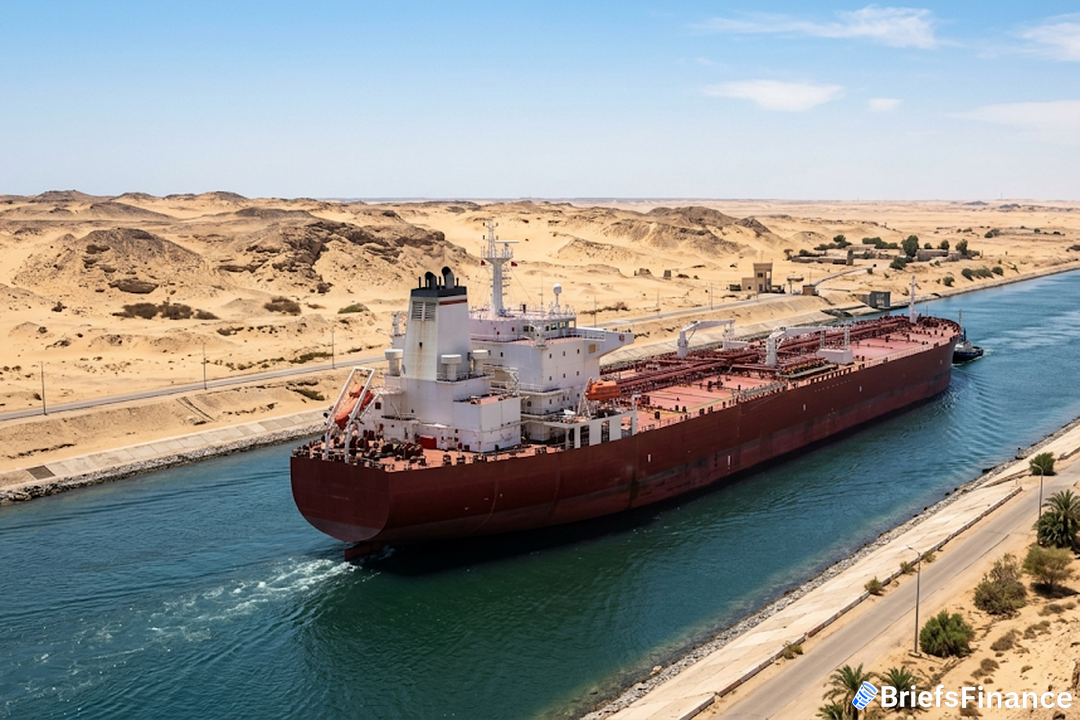
One Ship Took the Long Way
A very large crude carrier, or VLCC, is a ship built to haul roughly 2 million barrels of oil. But if you want to squeeze a fully loaded VLCC through the Suez Canal, you have a problem.
The canal is not wide or deep enough. So the ship has to offload about half its cargo before it can transit, then pick the oil back up on the other side.
That is exactly what the Olympic Luck did late Sunday. The Olympic Luck, a Greek-owned supertanker, had originally been headed for Europe but changed its destination and now transports Saudi crude toward an undisclosed Asian port. Instead of taking the direct route past Yemen through the Bab el-Mandeb Strait, it sailed north through the Suez Canal and into the Mediterranean.
Get the market news that matters in a five-minute read with Market Briefs, our free daily newsletter
The reasons behind Olympic Luck's decision to take this longer route remain uncertain. Analysts point to factors such as its Western ownership or a cautious buyer in Asia.
A second VLCC, the Marshall Islands-flagged DHT Gazelle, was idling at the entrance of the Suez Canal after loading Saudi crude from the Red Sea port of Yanbu. It is headed to a refinery in the Philippines. Its last broadcast from the Arabian Sea came on July 17, meaning it likely passed through the Bab el-Mandeb with its transponder turned off.
Traffic Is Dropping Fast
On Sunday, Kpler reported that eight commodity ships, primarily consisting of smaller product tankers and bulk carriers, passed through the Strait of Hormuz. Movement through that channel was thin on Monday, and traders are closely monitoring whether activity picks up after the United States and Iran agreed to a pause in hostilities following a recent escalation.
Chinese tankers hauling Saudi crude have openly traveled through Bab el-Mandeb, as has at least one Greek ship that moved through the strait with its identification system switched off. Two Pakistani-flagged Aframax tankers, the Lahore and the Karachi, each partially loaded from Yanbu. On Sunday evening, the Lahore entered the Gulf of Aden, while the Karachi continues its journey partially loaded toward the strait.
At least two vessels transporting naphtha departed the Persian Gulf over the weekend while keeping their transponders off - a move that should offer some comfort to Asian buyers who process the fuel into chemicals.
The Red Sea route remains critical for global oil and goods shipments, and the recent Houthi blockade has forced many shipowners to weigh longer alternatives. The Suez Canal, though slower and more expensive for fully laden VLCCs, provides a safe bypass when the Bab el-Mandeb Strait grows too dangerous. The Olympic Luck's detour underscores how quickly geopolitical risks are reshaping tanker traffic.
This rerouting highlights the vulnerability of the Bab el-Mandeb chokepoint, through which roughly 9 million barrels of oil pass daily. Houthi attacks have already disrupted insurance premiums and forced some operators to switch off identification systems. The longer Suez alternative adds days to voyages and requires costly lightening operations, but for Western-owned vessels like the Olympic Luck, the security trade-off appears worthwhile.
Join Market Briefs, our free daily newsletter, for a quick daily rundown of the markets