Free NewsletterPro Login
S&P 500 6,287 +0.42%
DOW 44,521 -0.18%
NASDAQ 21,103 +0.71%
S&P 500 +12.4%
Briefs Finance Fund +24.8%
JOIN THE FUND →

Oil Prices Climb as Trump Considers Strikes on Iran

A stylized illustration of a cylindrical cup with blue arrows and lines indicating a swirling or rotational motion inside the cup.
Published Jan 29, 2026
[tts_player]
Share:
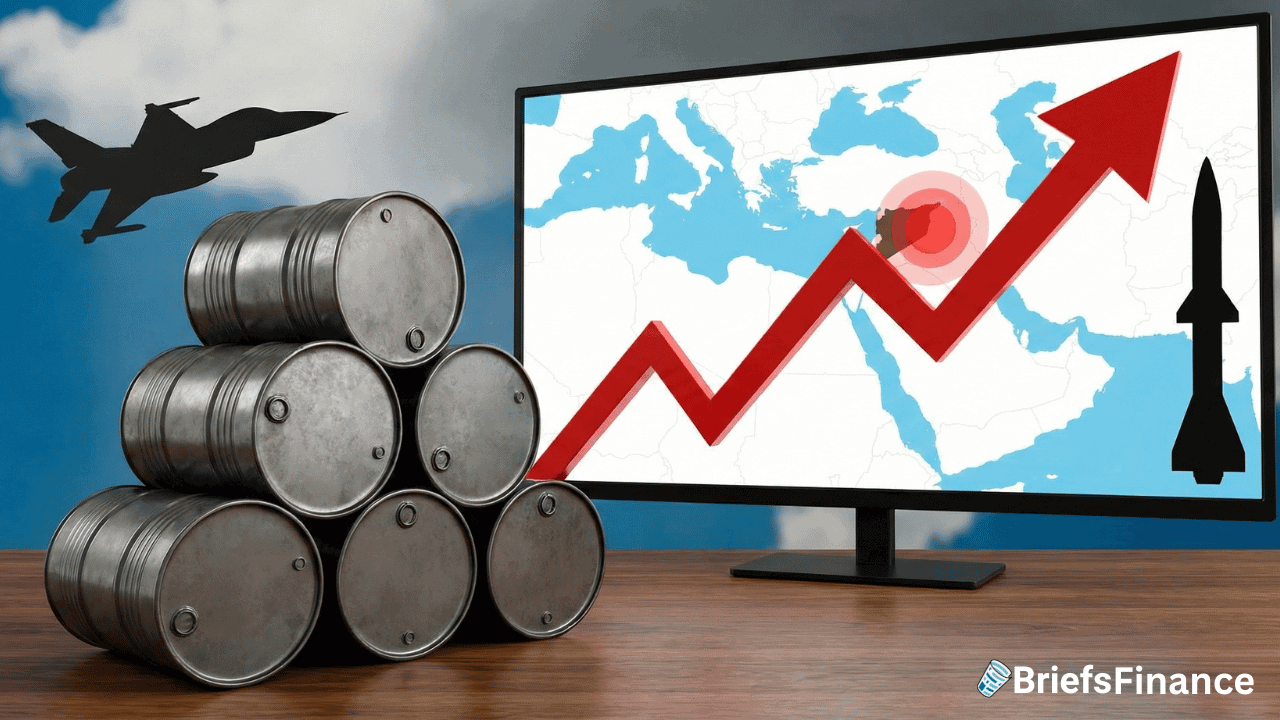
A stack of oil barrels, a rising red graph over a Middle East map on a screen, a fighter jet, and a missile silhouette highlight oil price growth linked to Iran and escalating geopolitical tensions.
Summary:

  • Crude oil prices increased over 2% on Thursday, U.S. crude rising to $64.77 per barrel.
  • Global benchmark Brent crude rose to $69.99 per barrel, reflecting market reactions to geopolitical tensions.
  • President Trump has deployed the Abraham Lincoln Carrier Strike Group to the Middle East amid tensions with Iran.

Crude Oil Prices Surge

On Thursday, crude oil prices experienced a significant rise, with U.S. crude increasing by $1.56, or 2.5%, to $64.77 per barrel.

The global benchmark, Brent crude, also saw an uptick of $1.59, or 2.3%, reaching $69.99 per barrel. This surge in oil prices is attributed to growing geopolitical tensions in the Middle East, particularly regarding Iran.

Trump's Military Posture

President Donald Trump has taken a decisive military stance by deploying the Abraham Lincoln Carrier Strike Group to the Middle East.

This move comes as tensions escalate between the U.S. and Iran, particularly concerning Iran's nuclear program. Trump has issued a warning to Iran, stating that time is running out for the country to negotiate a deal regarding its nuclear ambitions.

Threats of Military Action

In a recent statement, Trump threatened Iran with larger military strikes than those that took place in June 2025. He emphasized that the next attack would be more severe, urging Tehran not to provoke further military action.

His comments were shared in a post on Truth Social, where he warned, "The next attack will be far worse! Don't make that happen again." This rhetoric indicates a potential escalation in U.S.-Iran relations.

Concerns Over Oil Supply

The oil market is closely watching the unrest in Iran, particularly following a recent government crackdown on protests that has resulted in thousands of deaths. Multiple sources have reported that Trump is considering targeted strikes on Iranian security forces.

The intention behind these potential strikes is to inspire anti-government protests within Iran. Market analysts are concerned that any military intervention by the U.S. could disrupt crude oil supplies in the region, affecting global oil prices.

Implications for Investors

As the situation develops, investors are advised to monitor the oil market closely. The potential for military action and the ongoing unrest in Iran may create volatility in oil prices.

The situation underscores the interconnectedness of geopolitical events and financial markets, making it crucial for investors to stay informed about developments in the region.

Disclosure

Recent News

1 2 3 27

Get Market Briefs delivered to your inbox every morning for free!

No fluff. No noise. No politics. Just finance news you can read in 5 minutes.

Blogs

June 18, 2026
What Is a Stop Loss Order? A Simple Guide
  • A stop loss order automatically sells a stock once it falls to a price you set.
  • It's a tool to cap losses or lock in gains without watching the market all day.
  • It works best for active strategies, and can backfire if used carelessly on long-term holdings.
Read More
June 18, 2026
Best S&P 500 Index Fund: How to Choose One
  • The best S&P 500 index fund for most investors is simply the cheapest, most established one that tracks the index well.
  • Funds like VOO, IVV, and SPY all hold the same 500 companies, so the biggest difference is the fee.
  • Pick one, automate your buys, and let time do the heavy lifting.
Read More
June 17, 2026
What Are Penny Stocks? Risks and Rewards Explained
  • Penny stocks are very low-priced shares of very small companies, often trading for just a few dollars or less.
  • They promise huge gains but carry huge risks: low liquidity, high failure rates, and wild price swings.
  • Most investors are better served by quality companies and funds than by chasing cheap shares.
Read More
June 17, 2026
Best Stocks for Beginners With Little Money
  • The best stocks for beginners with little money usually aren't individual stocks at all - they're low-cost index funds.
  • You can start with $100 or less and use small, regular investments to build wealth over time.
  • Focus on diversification and consistency, not on picking the next big winner.
Read More
June 16, 2026
Tech Stocks: A Simple Guide for New Investors
  • Tech stocks are companies in the information technology and related sectors, from software to chips to the internet giants.
  • They've driven much of the market's growth, but they can be volatile and richly valued.
  • The smart approach is to understand what you own and not let one sector run your whole portfolio.
Read More
June 16, 2026
What Is a Joint Stock Company? A Simple Guide
  • A joint stock company is a business owned by many people, each holding shares of stock that represent a slice of ownership.
  • It's the basic idea behind every public company you can buy on the stock market today.
  • Owning a share makes you a part-owner, entitled to a piece of the profits and growth.
Read More
June 16, 2026
Capital Gains Tax in California: A Simple Guide
  • Capital gains tax is what you owe when you sell an investment for more than you paid for it.
  • How long you held it matters: long-term gains are taxed more gently than short-term gains at the federal level.
  • Smart investors lower the bill with tools like tax-loss harvesting and holding for the long run.
Read More
June 15, 2026
Top Covered Call ETFs: How to Compare Them
  • Top covered call ETFs are income funds that own stocks and sell call options against them to generate steady cash.
  • The best one for you is the fund whose income, holdings, and fees fit your goals, not simply the one with the flashiest yield.
  • They all share one trade-off: more income today, less upside in a big rally.
Read More
June 15, 2026
What Are Stock Options? A Plain-English Guide
  • Stock options are contracts that give you the right, but not the obligation, to buy or sell a stock at a set price by a set date.
  • There are two kinds: calls (the right to buy) and puts (the right to sell).
  • Options can multiply gains or wipe out your money fast, so they suit investors who already know the basics.
Read More
June 15, 2026
EBITDA Margin: What It Is and How to Calculate It
  • EBITDA margin measures how much core profit a company keeps from each dollar of sales, before interest, taxes, and accounting deductions.
  • The formula is EBITDA divided by revenue, shown as a percent.
  • A higher, steadier EBITDA margin usually signals a more efficient, more durable business.
Read More
1 2 3 23
Share via
Copy link









