Free NewsletterPro Login
S&P 500 6,287 +0.42%
DOW 44,521 -0.18%
NASDAQ 21,103 +0.71%
S&P 500 +12.4%
Briefs Finance Fund +24.8%
JOIN THE FUND →

FedEx Just Had Its Best Quarter in Years - Here’s Why

A stylized illustration of a cylindrical cup with blue arrows and lines indicating a swirling or rotational motion inside the cup.
Published Mar 22, 2026
[tts_player]
Share:
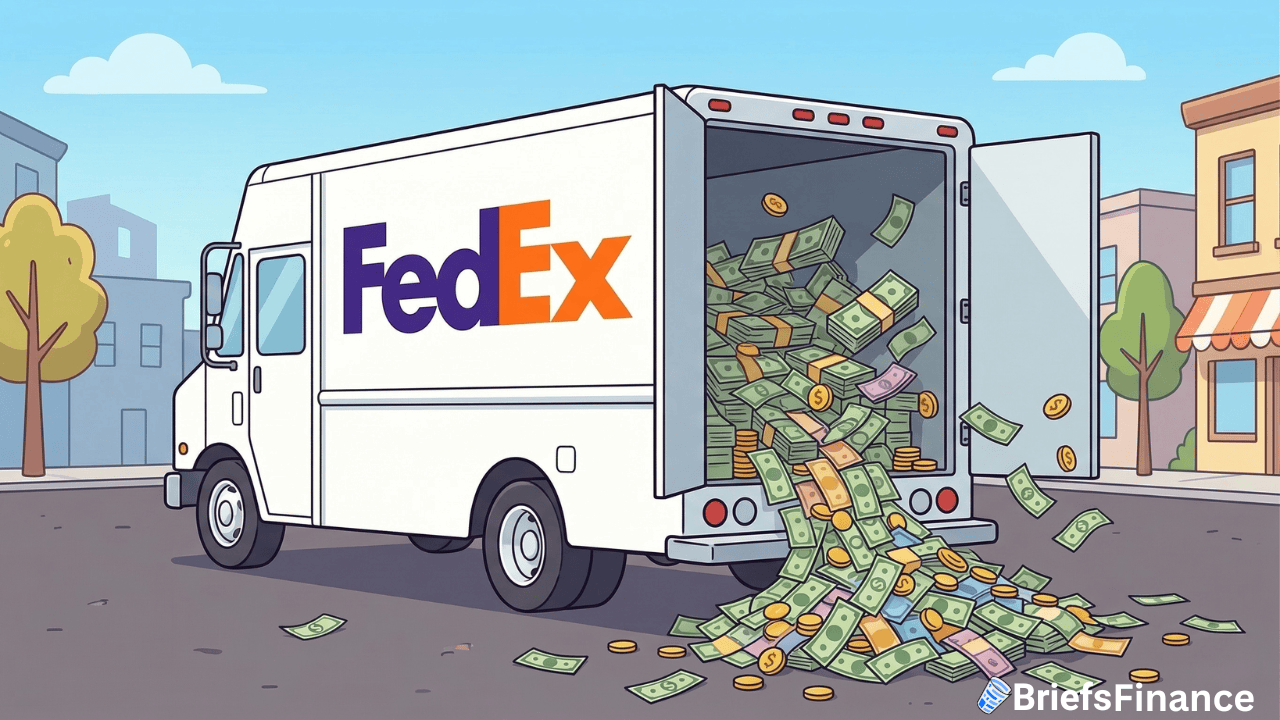
A FedEx truck is parked with its back open, and cash and coins are spilling out onto the street, hinting at the company’s impressive financial performance after its best quarter yet.
Summary:
  • The numbers: FedEx earned $5.25 per share last quarter, crushing Wall Street's $4.09 forecast, on $24 billion in sales.
  • The raise: The company now expects to earn $19.30 to $20.10 per share this year - up sharply from its earlier range of $17.80 to $19.
  • The bet: FedEx is running one of the largest corporate AI education programs in the country, covering nearly all of its 440,000 employees worldwide.

Earnings came in 28% above what analysts expected. 

  • Sales topped forecasts by more than half a billion dollars. 

And the company bumped its outlook higher - projecting full-year profit well above where it stood just three months ago.

The stock soared about 9% in after-hours trading.

Where the Money Came From

The biggest driver behind the beat is a cost-cutting plan called Network 2.0. 

It's FedEx's internal push to streamline its package operations using automation and AI.

The company originally targeted about $1 billion in savings from the effort. Now leadership says that number will come in even higher.

Operating profit hit $1.68 billion for the quarter - far above the $1.39 billion analysts had penciled in. 

Bottom-line profit climbed to $1.06 billion, up from $909 million during the same stretch last year.

CEO Raj Subramaniam credited tight execution and the company's growing digital toolkit for the results.

It’s Sky-High AI Play

FedEx is in the middle of one of the biggest AI training rollouts in corporate America. 

Nearly all of its 440,000 workers are being put through a personalized learning program built with Accenture.

The program kicked off in early December and every employee gets training shaped around their actual job - whether they're loading trucks at a sorting hub or handling customs forms. 

And the material refreshes on a monthly cycle.

Vishal Talwar, FedEx's top data and technology executive, said the entire leadership team flew out to Silicon Valley for two full days to evaluate potential tech partners. 

"I have never seen an organization's full C-suite take off for two days just to learn," he said.

That kind of commitment from the top is unusual. 

  • Accenture's own research shows that fewer than 3 in 10 companies have woven ongoing AI education into how they operate.

The Freight Wild Card

FedEx confirmed that its freight arm will become a standalone public company on June 1, right on schedule.

That move could surface value that's been hidden inside the larger business for years. 

It also cleans up the FedEx story - giving investors a simpler way to price the core delivery operation by itself.

What to Watch

FedEx flagged "modest" disruptions from the Iran conflict but called the Middle East a small slice of total revenue.

The bigger question is whether the AI push starts showing up in the financials over the next few quarters. 

So far, frontline workers are already chasing corporate roles at a higher clip since the training launched.

Investors are betting FedEx can keep trimming costs while still growing the top line.

But what actually comes next has investors looking towards the sky.
Disclosure

Recent News

1 2 3 27

Get Market Briefs delivered to your inbox every morning for free!

No fluff. No noise. No politics. Just finance news you can read in 5 minutes.

Blogs

June 18, 2026
What Is a Stop Loss Order? A Simple Guide
  • A stop loss order automatically sells a stock once it falls to a price you set.
  • It's a tool to cap losses or lock in gains without watching the market all day.
  • It works best for active strategies, and can backfire if used carelessly on long-term holdings.
Read More
June 18, 2026
Best S&P 500 Index Fund: How to Choose One
  • The best S&P 500 index fund for most investors is simply the cheapest, most established one that tracks the index well.
  • Funds like VOO, IVV, and SPY all hold the same 500 companies, so the biggest difference is the fee.
  • Pick one, automate your buys, and let time do the heavy lifting.
Read More
June 17, 2026
What Are Penny Stocks? Risks and Rewards Explained
  • Penny stocks are very low-priced shares of very small companies, often trading for just a few dollars or less.
  • They promise huge gains but carry huge risks: low liquidity, high failure rates, and wild price swings.
  • Most investors are better served by quality companies and funds than by chasing cheap shares.
Read More
June 17, 2026
Best Stocks for Beginners With Little Money
  • The best stocks for beginners with little money usually aren't individual stocks at all - they're low-cost index funds.
  • You can start with $100 or less and use small, regular investments to build wealth over time.
  • Focus on diversification and consistency, not on picking the next big winner.
Read More
June 16, 2026
Tech Stocks: A Simple Guide for New Investors
  • Tech stocks are companies in the information technology and related sectors, from software to chips to the internet giants.
  • They've driven much of the market's growth, but they can be volatile and richly valued.
  • The smart approach is to understand what you own and not let one sector run your whole portfolio.
Read More
June 16, 2026
What Is a Joint Stock Company? A Simple Guide
  • A joint stock company is a business owned by many people, each holding shares of stock that represent a slice of ownership.
  • It's the basic idea behind every public company you can buy on the stock market today.
  • Owning a share makes you a part-owner, entitled to a piece of the profits and growth.
Read More
June 16, 2026
Capital Gains Tax in California: A Simple Guide
  • Capital gains tax is what you owe when you sell an investment for more than you paid for it.
  • How long you held it matters: long-term gains are taxed more gently than short-term gains at the federal level.
  • Smart investors lower the bill with tools like tax-loss harvesting and holding for the long run.
Read More
June 15, 2026
Top Covered Call ETFs: How to Compare Them
  • Top covered call ETFs are income funds that own stocks and sell call options against them to generate steady cash.
  • The best one for you is the fund whose income, holdings, and fees fit your goals, not simply the one with the flashiest yield.
  • They all share one trade-off: more income today, less upside in a big rally.
Read More
June 15, 2026
What Are Stock Options? A Plain-English Guide
  • Stock options are contracts that give you the right, but not the obligation, to buy or sell a stock at a set price by a set date.
  • There are two kinds: calls (the right to buy) and puts (the right to sell).
  • Options can multiply gains or wipe out your money fast, so they suit investors who already know the basics.
Read More
June 15, 2026
EBITDA Margin: What It Is and How to Calculate It
  • EBITDA margin measures how much core profit a company keeps from each dollar of sales, before interest, taxes, and accounting deductions.
  • The formula is EBITDA divided by revenue, shown as a percent.
  • A higher, steadier EBITDA margin usually signals a more efficient, more durable business.
Read More
1 2 3 23
Share via
Copy link










