Free NewsletterPro Login

FedEx Just Had Its Best Quarter in Years - Here’s Why

A stylized illustration of a cylindrical cup with blue arrows and lines indicating a swirling or rotational motion inside the cup.
Published Mar 22, 2026
Share:
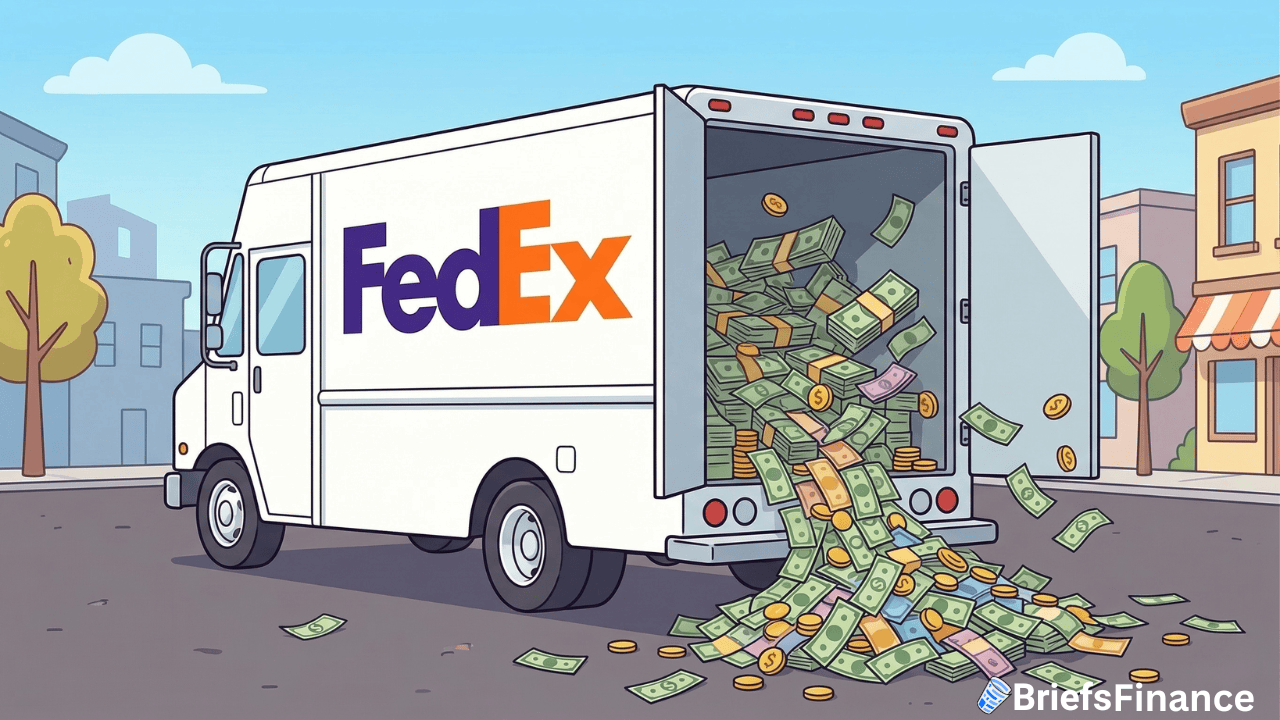
A FedEx truck is parked with its back open, and cash and coins are spilling out onto the street, hinting at the company’s impressive financial performance after its best quarter yet.
Summary:
  • The numbers: FedEx earned $5.25 per share last quarter, crushing Wall Street's $4.09 forecast, on $24 billion in sales.
  • The raise: The company now expects to earn $19.30 to $20.10 per share this year - up sharply from its earlier range of $17.80 to $19.
  • The bet: FedEx is running one of the largest corporate AI education programs in the country, covering nearly all of its 440,000 employees worldwide.

Earnings came in 28% above what analysts expected. 

  • Sales topped forecasts by more than half a billion dollars. 

And the company bumped its outlook higher - projecting full-year profit well above where it stood just three months ago.

The stock soared about 9% in after-hours trading.

Where the Money Came From

The biggest driver behind the beat is a cost-cutting plan called Network 2.0. 

It's FedEx's internal push to streamline its package operations using automation and AI.

The company originally targeted about $1 billion in savings from the effort. Now leadership says that number will come in even higher.

Operating profit hit $1.68 billion for the quarter - far above the $1.39 billion analysts had penciled in. 

Bottom-line profit climbed to $1.06 billion, up from $909 million during the same stretch last year.

CEO Raj Subramaniam credited tight execution and the company's growing digital toolkit for the results.

It’s Sky-High AI Play

FedEx is in the middle of one of the biggest AI training rollouts in corporate America. 

Nearly all of its 440,000 workers are being put through a personalized learning program built with Accenture.

The program kicked off in early December and every employee gets training shaped around their actual job - whether they're loading trucks at a sorting hub or handling customs forms. 

And the material refreshes on a monthly cycle.

Vishal Talwar, FedEx's top data and technology executive, said the entire leadership team flew out to Silicon Valley for two full days to evaluate potential tech partners. 

"I have never seen an organization's full C-suite take off for two days just to learn," he said.

That kind of commitment from the top is unusual. 

  • Accenture's own research shows that fewer than 3 in 10 companies have woven ongoing AI education into how they operate.

The Freight Wild Card

FedEx confirmed that its freight arm will become a standalone public company on June 1, right on schedule.

That move could surface value that's been hidden inside the larger business for years. 

It also cleans up the FedEx story - giving investors a simpler way to price the core delivery operation by itself.

What to Watch

FedEx flagged "modest" disruptions from the Iran conflict but called the Middle East a small slice of total revenue.

The bigger question is whether the AI push starts showing up in the financials over the next few quarters. 

So far, frontline workers are already chasing corporate roles at a higher clip since the training launched.

Investors are betting FedEx can keep trimming costs while still growing the top line.

But what actually comes next has investors looking towards the sky.
Disclosure

Get Market Briefs delivered to your inbox every morning for free!

No fluff. No noise. No politics. Just finance news you can read in 5 minutes.

Blogs

May 30, 2026
Financial Literacy Books That Actually Build Wealth
  • The best financial literacy books don't just teach budgeting, they shift how you think about money.
  • Two classics stand out: The Intelligent Investor for valuing investments, and Rich Dad Poor Dad for the owner's mindset.
  • Reading is only step one. The real wealth comes from acting on what you learn.
Read More
May 30, 2026
What Is a Roth Conversion? A Simple Guide
  • A Roth conversion moves money from a traditional retirement account into a Roth account.
  • You pay taxes on the money now, in exchange for tax-free growth and withdrawals later.
  • It can pay off if you expect higher taxes or more income in the future, but the timing and tax hit matter a lot.
Read More
May 30, 2026
Trailing Stop Loss: How to Protect Your Gains
  • A trailing stop loss is an order that automatically sells a stock if it falls a set percentage from its recent high.
  • As the stock rises, the sell point rises with it, locking in gains while capping losses.
  • It's most useful for active strategies like momentum investing, not for long-term buy-and-hold.
Read More
May 30, 2026
5 Types of Wealth: Why Money Is Only One of Them
  • Real wealth is more than a bank balance. It spans your finances, health, mind, purpose, and freedom.
  • Money is powerful, but it amplifies the life you already have rather than fixing a broken one.
  • True financial wealth means your cash flow covers your expenses, so your money works while you live.
Read More
May 30, 2026
How to Invest in Private Equity: A Beginner's Guide
  • Private equity means investing in companies that aren't listed on the stock market.
  • Traditional private equity is built for experienced, high-net-worth investors with large amounts to invest.
  • New rules have opened more accessible paths, like startup crowdfunding and real estate deals, often starting around $100.
Read More
May 30, 2026
What Is a Call Option? A Simple Guide With Examples
  • A call option gives you the right to buy a stock at a set price by a set date.
  • Investors buy calls when they expect a stock to rise, using less money than buying the shares outright.
  • The most you can lose buying a call is the premium, but time works against you, so it's an advanced tool.
Read More
May 30, 2026
EBITDA Formula: How to Calculate It Step by Step
  • EBITDA stands for Earnings Before Interest, Taxes, Depreciation, and Amortization, a measure of a company's core profit.
  • The formula adds those four items back to net income to show what the underlying business earns.
  • Investors use EBITDA to compare companies and to judge how many times earnings a stock is selling for.
Read More
May 30, 2026
What Is a Stock Option? A Plain-English Guide
  • A stock option is a contract giving you the right, but not the obligation, to buy or sell a stock at a set price by a set date.
  • There are two types: calls (the right to buy) and puts (the right to sell).
  • Options are powerful but risky, so they suit investors who already have the basics down.
Read More
May 30, 2026
Put Option: What It Is and How It Works
  • A put option gives you the right to sell a stock at a set price by a set date.
  • Investors use puts to bet a stock will fall, or as insurance to protect shares they own.
  • The most you can lose buying a put is the premium you paid, which makes it a defined-risk tool.
Read More
May 30, 2026
Operating Margin: What It Is and How to Calculate It
  • Operating margin shows how much profit a company keeps from its core business after paying its running costs.
  • The formula is operating income divided by revenue, shown as a percent.
  • A strong, steady operating margin signals a well-run business that controls its costs.
Read More
1 2 3 22
Share via
Copy link










