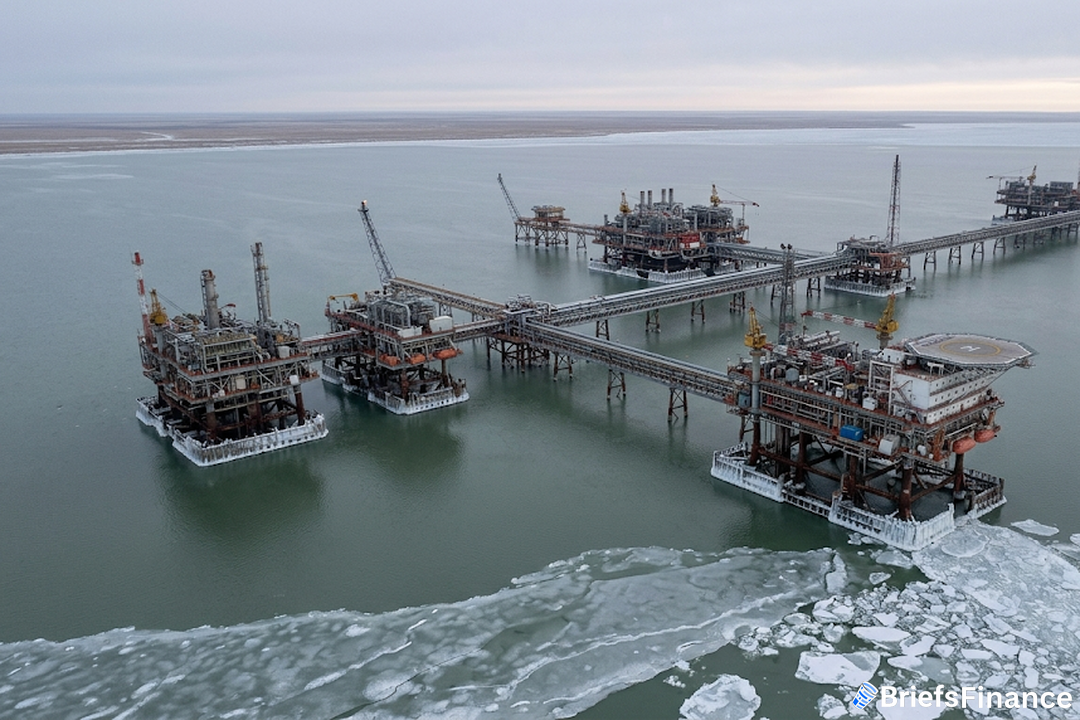
One of the World's Hardest Oil Fields
Kashagan was supposed to be a miracle. Discovered in 2000, it was the biggest oil find in decades, and Eni, the Italian company running it at the time, once predicted peak production of 1.5 million barrels a day.
Instead, the field became famous for delays and cost overruns that dragged on for years. The developed eastern part now produces about 450,000 barrels a day.
ExxonMobil, one of the current partners, thinks the western side is worth another shot. Its plan is an $80 billion venture, owned equally with state-run KazMunayGas National Co., to unlock the undeveloped half of the field.
If it works, the field could pump up to 600,000 barrels a day more. But Exxon has attached a condition: according to people familiar with the talks, the project is contingent on ending the long-standing $150 billion dispute with Kazakhstan.
A $150 Billion Argument and a $5 Billion Fine
Kazakhstan's arbitration demands total roughly $150 billion, with most of that sum representing revenue the state says it lost because of the project's delays. There is also a separate $5 billion environmental fine.
Kazakhstan's state oil company, KazMunayGas, backs Exxon's idea, but the plan still needs political approval, which is far from guaranteed. Exxon and KazMunayGas declined to comment, and so did Kazakhstan's Energy Ministry.
The negotiation has a clever structure. Exxon would give Kashagan's other current partners minority shares in the new project.
Get the free Always Be Buying eBook and learn the simple system for building wealth on any income
Companies that join would have sulfur-fine claims dropped as soon as the venture is formed, and the rest would disappear once the final investment decision is made. Companies that decline would also get Kazakhstan's claims dropped, as long as they do not challenge the new project's development rights in western Kashagan.
But those firms could not renew their part of the existing eastern license after it expires.
Eni, which once ran the field, has separately told Kazakhstan that it and unnamed partners want to develop western Kashagan.
The current venture, known as NCOC, has Exxon, China National Petroleum Corp., Eni, Inpex, KazMunayGas, Shell and TotalEnergies as major partners. Most declined to comment; CNPC did not respond, and Eni did not reply right away.
The Numbers Behind the Fight
Government figures show Kashagan has produced about 1 billion barrels in its first decade, out of estimated recoverable reserves of 16 billion barrels.
Exxon wants to pull about 10 billion of those from western Kashagan. North Caspian Operating Co. expects this year's output to average roughly 500,000 barrels daily before climbing to as much as 710,000 by 2031.
The first step is cheap by comparison. Preparing the development concept for the western project could cost $250 million, and the pre-construction design and engineering phase would cost about $2 billion, starting in 2028.
Development would begin after a go-ahead in 2030. For context, an extra 600,000 barrels a day is a lot of oil, and it would add to the global supply that helps set the price at your local gas station.
Why the Structure Matters
The arbitration is not the only obstacle. Exxon's proposal gives Kashagan's current partners a clear choice: join the western-project venture and have sulfur penalties dropped, or stay outside the project and lose the chance to prolong their eastern license stake once it lapses. That structure explains why the negotiation is about both money and control of the field's next phase.
What It Means for Investors
Oil prices are set by global supply and demand, and big new projects like this one are how supply grows over time. If western Kashagan gets built, it adds a meaningful stream of oil that helps keep prices in check.
If it stalls, that supply stays off the table. The dispute is the key, and Exxon has made the project conditional on settling the $150 billion claim; firms that stay out would also give up the option to prolong their eastern license interest once it lapses.
For investors, this is a deal worth watching even if you never buy an oil stock. The next few years will show whether Kazakhstan and Exxon can find common ground at an oil field that has already taken longer than anyone expected.
Download the free Always Be Buying eBook and start putting your money to work today