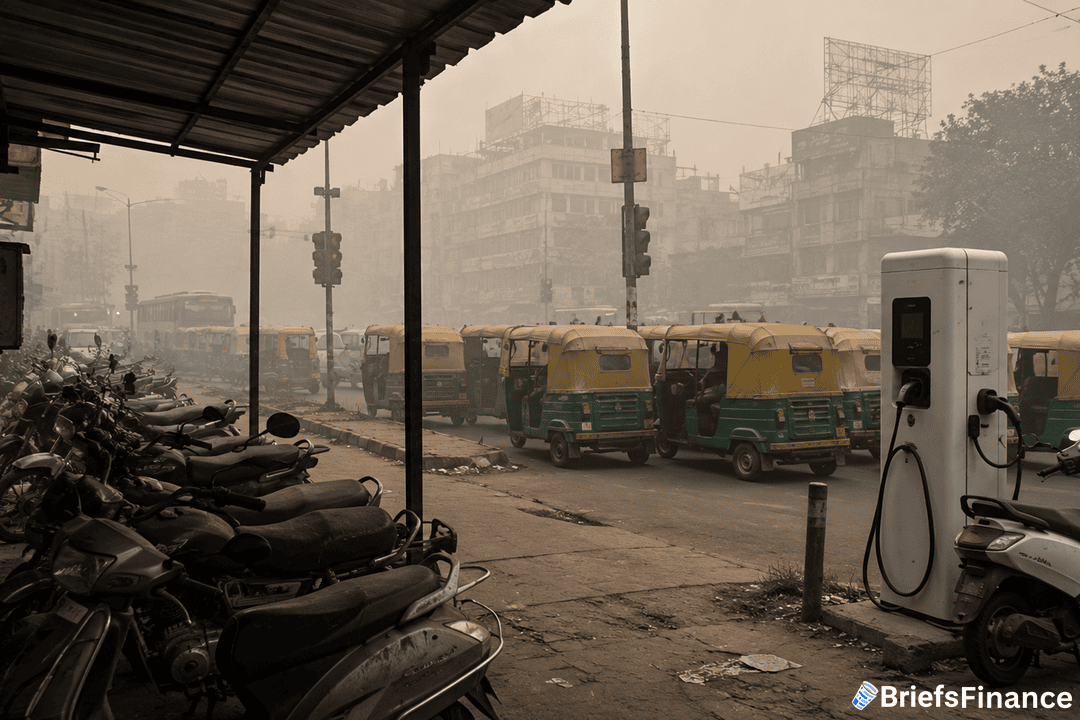
New Delhi chokes on smog every winter. Vehicle emissions cause roughly 23% of the city's air pollution. Now the government is betting big on electric vehicles to change that. But the plan includes hard deadlines that could upend India's largest vehicle market.
Ban Timeline and Subsidies
The policy bans registration of new gas-powered motorcycles, scooters, and small trucks in a phased manner: small trucks by January 1, 2027, and two-wheelers by April 1, 2028.
That gives manufacturers less than two years to retool production.
The policy comes with cash incentives to ease the transition.
Get your free investing masterclass bonus when you join Market Briefs, our free daily newsletter
Electric cars and utility vehicles priced under 3 million rupees are not subject to road tax or registration fees. The total package is worth 150 billion rupees, or about $1.6 billion.
Industry Reaction and Challenges
According to Autocar, the country's largest automotive industry group had previously voiced objections to a draft version of the policy when it was released in April. The final version still includes the phase-out, so the industry must now scale up fast. Two-wheelers are one of India's biggest vehicle categories. The 2028 deadline will force manufacturers to expand electric-scooter production, dealerships, and charging networks.
Tarun Mehta, CEO of electric-scooter maker Ather Energy, praised the approach. "What stands out is not just the scale of the investment, but the way the policy has been designed. The combination of incentives, phased electrification mandates and charging infrastructure creates a very strong foundation." His company stands to benefit directly as demand for electric scooters jumps.
Consumer subsidies start in July.
India is the world's largest market for two-wheelers, with more than 20 million units sold annually. Delhi alone has millions of petrol-powered scooters and motorcycles on its roads, making up a large share of the city's transport emissions. The policy's success will depend on whether manufacturers can quickly build affordable electric models and a reliable charging network to replace the entrenched petrol fleet.
What to Watch
Watch how quickly manufacturers can build charging stations and supply chains. The ban only applies to new registrations, so millions of petrol two-wheelers will stay on the road for years. The real test is whether Delhi can enforce the rule and whether other Indian cities follow its lead.
Delhi's air quality crisis has long been a public health emergency, with vehicle exhaust contributing significantly to dangerous levels of particulate matter each winter. The shift to electric two-wheelers alone could cut a major source of nitrogen oxides and fine particles, but the transition also requires a stable electricity grid and widespread charging points to avoid simply shifting pollution elsewhere.
Subscribe to Market Briefs, our free daily newsletter, and claim your bonus investing masterclass