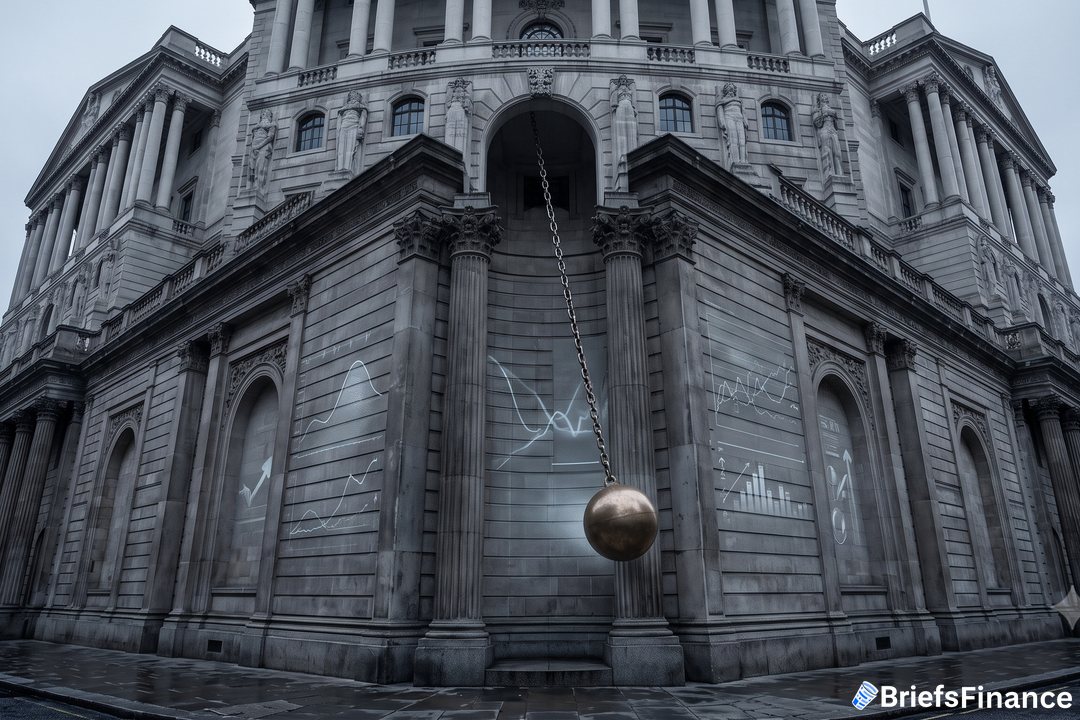
Bank of England Governor Andrew Bailey issued a caution that it is premature to think about lowering interest rates, noting that households have not yet experienced the full impact of the conflict in Iran. While addressing the European Central Bank's conference in Sintra, Portugal, on Wednesday, Bailey stated that any cuts to borrowing costs are currently not being considered, even though inflation risks have diminished after the drop in energy prices.
He cautioned about a "delayed reaction" from the conflict, attributing it to the UK's energy price cap - a mechanism that restricts the amount suppliers can bill households for each unit of gas and electricity.
"It's appropriate at the moment to borrow a soccer analogy: I'm afraid, we always look a bit better in the first half than we do in the second half," Bailey offered that metaphor during his appearance at the ECB gathering in Portugal.
Get your free investing masterclass bonus when you join Market Briefs, our free daily newsletter
The Bank of England has navigated a challenging period, having raised interest rates 14 times since late 2021 to combat soaring inflation. With the recent energy truce and cooling price pressures, the central bank now faces a delicate balancing act between supporting growth and preventing any resurgence of price increases.
This tightening cycle has been one of the most aggressive in decades, with inflation peaking above 10% before retreating. The ceasefire between the US and Iran earlier this year helped lower wholesale energy costs, but the delayed effect of previous price spikes is still filtering through to household bills via the quarterly cap adjustment. Economists now expect UK inflation to hit a lower peak than the Bank projected in April, yet the full impact of past energy price rises may take months to fade.
Over recent months, Bailey has adopted a cautious stance, opting to wait and watch rather than raising rates to combat any inflationary shock from the Iran war. Alan Taylor, an MPC member known for his dovish stance, has gone further, stating that policymakers must be prepared to lower rates if inflation turns out to be mild. Bailey's approach seems to have worked, as the inflation threat has subsided rapidly following the drop in energy prices after the US and Iran reached a ceasefire.
In response, traders have drastically reduced their expectations for rate increases, with market participants now pricing in under 0.25 percentage points of tightening for the current year. Nevertheless, some policymakers worry that the energy shock might still trigger secondary impacts on wages and prices.
"There was an expectation that we would cut rates this year, that's not unreasonable in the context of the softening economy," he said. "That was off the table in March, and is off the table at the moment."
Subscribe to Market Briefs, our free daily newsletter, and claim your bonus investing masterclass