Free NewsletterPro Login
S&P 500 6,287 +0.42%
DOW 44,521 -0.18%
NASDAQ 21,103 +0.71%
S&P 500 +12.4%
Briefs Finance Fund +24.8%
JOIN THE FUND →

AI's Hunger for Electricity Spurs $220B Data Center Move to 800-Volt DC

Published Jul 3, 2026
[tts_player]
Share:
Summary:
  • RBC Europe analyst Mark Fielding projects the data center equipment market will reach $220 billion annually over the next five years, up from $60 billion in 2024.
  • A single 800-volt DC cable can transmit nearly three times the power of conventional AC cables, but adoption is forecast to hit just 20% of data centers by 2030.
  • Companies such as Schneider Electric and Siemens are developing 800-volt DC sidecars, while older products like traditional transformers and uninterruptible power supplies face declining demand.

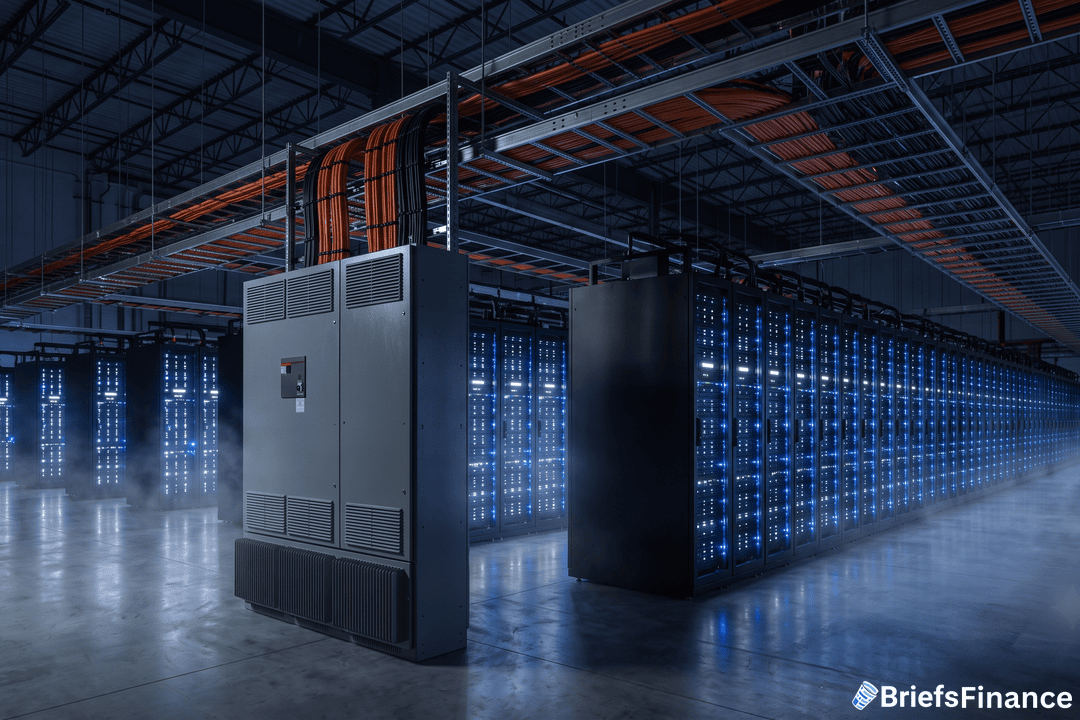
The shift is from traditional alternating-current (AC) systems to 800-volt direct-current (DC).

According to Fielding, achieving superior AI performance depends on packing more computing power into data center racks, an objective that demands increased voltage levels.

But the change will be slow. He says a meaningful earnings impact is unlikely before 2030.

Winners, Losers, and Sidecars

The transition will start with "sidecar" devices. These let existing data centers add 800-volt DC for high-density AI workloads without replacing the whole AC system. Siemens is developing these sidecars, drawing on its high-voltage experience. The executive in charge of Siemens' data center solutions and services, Ciaran Flanagan, said: "Today's data centers are predominantly AC and will remain operational for 20 to 30 years." He also noted that sidecars "allow operators to introduce 800 VDC for high-density AI workloads without replacing existing infrastructure."

Get your free investing masterclass bonus when you join Market Briefs, our free daily newsletter

Schneider Electric has been working on novel designs and recently finalized a $3.1 billion acquisition of Cognite, aiming to broaden its industrial data and AI software capabilities. Frederic Godemel, who serves as Schneider's executive vice president of energy management, said: "What we do is work with each of them on the time horizon of what can be deployed at scale." Godemel also cited regulatory hurdles and supply chain constraints for solid-state transformers as major obstacles, though he expressed confidence: "We will fix it."

Competitors such as ABB and Eaton are considered favorably because of their deep knowledge in high-voltage electrical gear and their history of acquisitions. Vertiv is expected to remain a market leader. But Legrand, a smaller French peer with heavy exposure to power distribution units, is seen as vulnerable.

Analysts also point to GE Vernova, currently experimenting with a solid-state transformer, and Siemens Energy, whose gas turbine operations are expected to keep growing. Alfa Laval merits attention due to its groundbreaking efforts in heat exchangers, says Alphavalue analyst Kulwinder Rajpal.

The long-term goal is a full 800-volt DC architecture built around a solid-state transformer. That technology is not yet commercially available. Fielding said: "The full solid-state transformer, 800-volt DC ideal solution, doesn't fully exist in a technical and commercial capability today."

Omid Vaziri, Bloomberg Intelligence analyst, said: "It is this big technological shift that will ultimately drive and set the scene for which company is best positioned to outperform." He added: "Product composition matters because some products could get cannibalized."

What to Watch

The transition will happen in stages. Sidecars come first, then full DC architectures after 2030. Major hurdles involve regulatory concerns and supply chain constraints for solid-state transformers.

Subscribe to Market Briefs, our free daily newsletter, and claim your bonus investing masterclass

Disclosure

Recent News

1 2 3 32

Get Market Briefs delivered to your inbox every morning for free!

No fluff. No noise. No politics. Just finance news you can read in 5 minutes.

Blogs

June 29, 2026
Portfolio Diversification: Why Putting All Your Eggs in One Basket Destroys Wealth
  • Real diversification means spreading investments across all 11 economic sectors plus bonds, alternatives, and cash so no single bet can sink the portfolio.
  • Different sectors perform at different times, so a diversified portfolio captures upswings while smoothing the brutal drawdowns that wipe out concentrated bets.
  • Total market index funds offer the simplest path to diversification, and annual rebalancing is what keeps the structure working over time.
Read More
June 29, 2026
Non Taxable Income: What It Is and Why It Matters
  • Non taxable income is money you receive that you don't owe income tax on.
  • The tax code treats workers, investors, and business owners very differently, and investors often come out ahead.
  • Learning how income is taxed is a quiet superpower for keeping more of what you earn.
Read More
June 29, 2026
Semiconductor Stocks: A Simple Guide for Investors
  • Semiconductor stocks are companies that design and make computer chips, the brains inside nearly every modern device.
  • The AI boom has turned chips into one of the market's most important and most watched groups.
  • They offer big growth potential, but come with high valuations and a notoriously cyclical history.
Read More
June 25, 2026
How Stocks Work: A Simple Guide for Beginners
  • A stock is a slice of ownership in a company - buy one, and you own a piece of the business.
  • You make money two ways: the share price rising over time, and dividends paid to shareholders.
  • The simplest path for most beginners is buying into the whole market through a low-cost index fund.
Read More
June 25, 2026
Stop Loss vs Stop Limit: What's the Difference?
  • A stop loss order sells your stock once it hits a trigger price, prioritizing getting you out.
  • A stop limit order only sells within a price range you set, prioritizing price over a guaranteed exit.
  • The trade-off: a stop loss almost always executes; a stop limit might not if the price moves too fast.
Read More
June 25, 2026
Energy Stocks: A Simple Guide for Investors
  • Energy stocks are companies that produce and supply the power the world runs on, from oil and gas to newer sources.
  • They make up one of the 11 sectors of the market and tend to move with energy prices and big-picture shifts.
  • Like any sector, the key is diversification and understanding the forces driving demand.
Read More
June 18, 2026
What Is a Stop Loss Order? A Simple Guide
  • A stop loss order automatically sells a stock once it falls to a price you set.
  • It's a tool to cap losses or lock in gains without watching the market all day.
  • It works best for active strategies, and can backfire if used carelessly on long-term holdings.
Read More
June 18, 2026
Best S&P 500 Index Fund: How to Choose One
  • The best S&P 500 index fund for most investors is simply the cheapest, most established one that tracks the index well.
  • Funds like VOO, IVV, and SPY all hold the same 500 companies, so the biggest difference is the fee.
  • Pick one, automate your buys, and let time do the heavy lifting.
Read More
June 17, 2026
What Are Penny Stocks? Risks and Rewards Explained
  • Penny stocks are very low-priced shares of very small companies, often trading for just a few dollars or less.
  • They promise huge gains but carry huge risks: low liquidity, high failure rates, and wild price swings.
  • Most investors are better served by quality companies and funds than by chasing cheap shares.
Read More
June 17, 2026
Best Stocks for Beginners With Little Money
  • The best stocks for beginners with little money usually aren't individual stocks at all - they're low-cost index funds.
  • You can start with $100 or less and use small, regular investments to build wealth over time.
  • Focus on diversification and consistency, not on picking the next big winner.
Read More
1 2 3 24
Share via
Copy link










