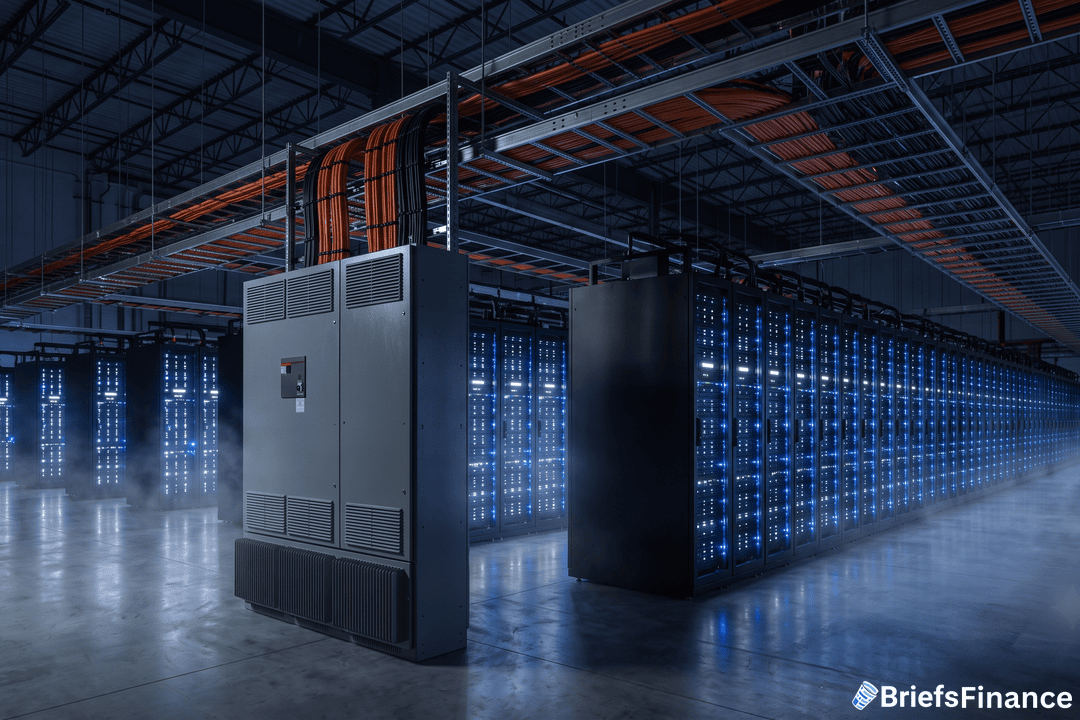
The shift is from traditional alternating-current (AC) systems to 800-volt direct-current (DC).
According to Fielding, achieving superior AI performance depends on packing more computing power into data center racks, an objective that demands increased voltage levels.
But the change will be slow. He says a meaningful earnings impact is unlikely before 2030.
Winners, Losers, and Sidecars
The transition will start with "sidecar" devices. These let existing data centers add 800-volt DC for high-density AI workloads without replacing the whole AC system. Siemens is developing these sidecars, drawing on its high-voltage experience. The executive in charge of Siemens' data center solutions and services, Ciaran Flanagan, said: "Today's data centers are predominantly AC and will remain operational for 20 to 30 years." He also noted that sidecars "allow operators to introduce 800 VDC for high-density AI workloads without replacing existing infrastructure."
Get your free investing masterclass bonus when you join Market Briefs, our free daily newsletter
Schneider Electric has been working on novel designs and recently finalized a $3.1 billion acquisition of Cognite, aiming to broaden its industrial data and AI software capabilities. Frederic Godemel, who serves as Schneider's executive vice president of energy management, said: "What we do is work with each of them on the time horizon of what can be deployed at scale." Godemel also cited regulatory hurdles and supply chain constraints for solid-state transformers as major obstacles, though he expressed confidence: "We will fix it."
Competitors such as ABB and Eaton are considered favorably because of their deep knowledge in high-voltage electrical gear and their history of acquisitions. Vertiv is expected to remain a market leader. But Legrand, a smaller French peer with heavy exposure to power distribution units, is seen as vulnerable.
Analysts also point to GE Vernova, currently experimenting with a solid-state transformer, and Siemens Energy, whose gas turbine operations are expected to keep growing. Alfa Laval merits attention due to its groundbreaking efforts in heat exchangers, says Alphavalue analyst Kulwinder Rajpal.
The long-term goal is a full 800-volt DC architecture built around a solid-state transformer. That technology is not yet commercially available. Fielding said: "The full solid-state transformer, 800-volt DC ideal solution, doesn't fully exist in a technical and commercial capability today."
Omid Vaziri, Bloomberg Intelligence analyst, said: "It is this big technological shift that will ultimately drive and set the scene for which company is best positioned to outperform." He added: "Product composition matters because some products could get cannibalized."
What to Watch
The transition will happen in stages. Sidecars come first, then full DC architectures after 2030. Major hurdles involve regulatory concerns and supply chain constraints for solid-state transformers.
Subscribe to Market Briefs, our free daily newsletter, and claim your bonus investing masterclass