Free NewsletterPro Login
S&P 500 6,287 +0.42%
DOW 44,521 -0.18%
NASDAQ 21,103 +0.71%

Warning: Undefined variable $funds in /var/www/briefs.co/htdocs/wp-content/plugins/oxygen/component-framework/components/classes/code-block.class.php(133) : eval()'d code on line 491

Warning: foreach() argument must be of type array|object, null given in /var/www/briefs.co/htdocs/wp-content/plugins/oxygen/component-framework/components/classes/code-block.class.php(133) : eval()'d code on line 491
/* the link was here */

A Trans-Pacific Copper Squeeze Pushes Prices to Historic Highs

Published Aug 7, 2026
[tts_player]
Share:
Summary:
  • London copper futures pushed above $14,000 a ton this week as trade flows between the US and China tightened the global market.
  • US copper stockpiles are building at a record pace while London and Shanghai exchange stockpiles drain, and traders are waiting on a potential tariff decision.
  • Citigroup's Tom Mulqueen expects continued warehouse withdrawals to push prices toward $15,000 a ton.

Prices Push Higher as Supplies Move

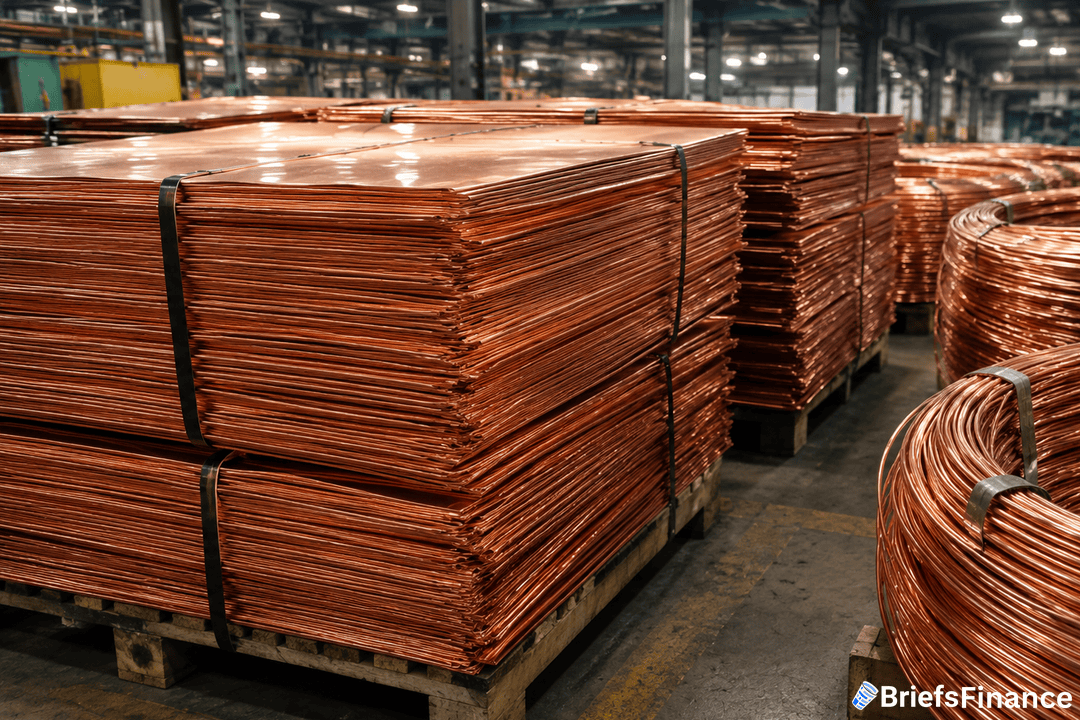
Copper shows up in everything from wires to electric cars. Right now, it is also stuck in a tug-of-war between the world's two biggest economies.

Many traders expect prices to soon top the record $14,500-plus reached briefly at the end of January during a wave of speculative buying in China.

In London at 2:02 p.m., copper futures on the London Metal Exchange were up 0.1%.

The price sat at $14,120 a ton. The bigger story is where the metal is actually sitting.

Comex copper, the US futures benchmark, hit a record Wednesday.

Traders buy copper where it's cheaper and sell it where it's more expensive. That arbitrage has been running since last year and has now reached a tempo not seen in more than a decade.

China's Supplies Are Running Thin

China is the world's biggest copper producer and consumer. Its smelters are cutting output because raw materials are tight, so buyers rely more on imports and Shanghai Futures Exchange stocks keep falling.

The problems showed up in July. Chinese smelter output fell more than forecast, according to Shanghai Metals Market, which cited higher ore prices and lower ore grades.

A lot of the metal moving into China is coming out of LME warehouses in Taiwan and South Korea. Over the past two weeks, traders have pulled batches of 4,000 to 6,000 tons out of those warehouses almost every day.

Get the free Always Be Buying eBook and learn the simple system for building wealth on any income

Some US LME warehouses also sent metal out because Comex prices were higher.

Since May, LME stockpiles have shrunk by over two-fifths.

Mercuria Energy Group, Trafigura Group, Vitol Group and Hartree Partners are among the trading firms that have recently withdrawn metal from LME depots. None of their representatives commented.

The market's pricing structure has turned to backwardation, a setup not seen since January. That means copper for immediate delivery now costs more than copper for delivery in three months.

"Even if demand is not at the moment doing amazingly, you can have a bit of a step change where the constraint on the supply is causing this draw on inventory," said Tom Mulqueen, Citigroup's metals strategist.

Typically, Chinese purchasers step aside when prices rise, and the latest surge is already giving some of them pause. That could slow import demand just as the market tightens.

Tariffs Hold the Key

A lot depends on a policy call that is still up in the air. President Trump has placed US duties on semi-finished copper, but not on refined copper.

Traders are waiting to see if he extends them to raw metal, and nobody has set a timeline.

Trump has scheduled a meeting with mining executives in Washington on Friday, and he plans to unveil several deals and memoranda of understanding. That could offer clues about where the policy is headed.

The range of outcomes is wide. If no refined-copper tariff comes, the pull from US buyers would fade and leave more metal for China.

If the uncertainty drags on, traders expect prices to keep climbing as available metal runs short. If Trump announces tariffs, a sharp surge is likely as traders rush shipments to the US before levies apply.

China's own supply picture adds another layer. One-quarter of its refined copper output comes from scrap, but stricter invoice checks have disrupted the recycling industry.

Small scrap collectors often use up their invoicing quotas and cannot complete sales, which weakens the buffer that scrap has provided for 20 years when mine supply fell or demand grew.

"You lose some of that elasticity because of these additional headwinds," Mulqueen said.

What It Means for Investors

For investors, copper is no longer just a commodity. It sits between US policy and China's supply problems, and the next few weeks could set the direction for the rest of the year.

Download the free Always Be Buying eBook and start putting your money to work today
Disclosure

Recent News

1 2 3 51

Get Market Briefs delivered to your inbox every morning for free!

No fluff. No noise. No politics. Just finance news you can read in 5 minutes.

Blogs

June 29, 2026
Portfolio Diversification: Why Putting All Your Eggs in One Basket Destroys Wealth
  • Real diversification means spreading investments across all 11 economic sectors plus bonds, alternatives, and cash so no single bet can sink the portfolio.
  • Different sectors perform at different times, so a diversified portfolio captures upswings while smoothing the brutal drawdowns that wipe out concentrated bets.
  • Total market index funds offer the simplest path to diversification, and annual rebalancing is what keeps the structure working over time.
Read More
June 29, 2026
Non Taxable Income: What It Is and Why It Matters
  • Non taxable income is money you receive that you don't owe income tax on.
  • The tax code treats workers, investors, and business owners very differently, and investors often come out ahead.
  • Learning how income is taxed is a quiet superpower for keeping more of what you earn.
Read More
June 29, 2026
Semiconductor Stocks: A Simple Guide for Investors
  • Semiconductor stocks are companies that design and make computer chips, the brains inside nearly every modern device.
  • The AI boom has turned chips into one of the market's most important and most watched groups.
  • They offer big growth potential, but come with high valuations and a notoriously cyclical history.
Read More
June 25, 2026
How Stocks Work: A Simple Guide for Beginners
  • A stock is a slice of ownership in a company - buy one, and you own a piece of the business.
  • You make money two ways: the share price rising over time, and dividends paid to shareholders.
  • The simplest path for most beginners is buying into the whole market through a low-cost index fund.
Read More
June 25, 2026
Stop Loss vs Stop Limit: What's the Difference?
  • A stop loss order sells your stock once it hits a trigger price, prioritizing getting you out.
  • A stop limit order only sells within a price range you set, prioritizing price over a guaranteed exit.
  • The trade-off: a stop loss almost always executes; a stop limit might not if the price moves too fast.
Read More
June 25, 2026
Energy Stocks: A Simple Guide for Investors
  • Energy stocks are companies that produce and supply the power the world runs on, from oil and gas to newer sources.
  • They make up one of the 11 sectors of the market and tend to move with energy prices and big-picture shifts.
  • Like any sector, the key is diversification and understanding the forces driving demand.
Read More
June 18, 2026
What Is a Stop Loss Order? A Simple Guide
  • A stop loss order automatically sells a stock once it falls to a price you set.
  • It's a tool to cap losses or lock in gains without watching the market all day.
  • It works best for active strategies, and can backfire if used carelessly on long-term holdings.
Read More
June 18, 2026
Best S&P 500 Index Fund: How to Choose One
  • The best S&P 500 index fund for most investors is simply the cheapest, most established one that tracks the index well.
  • Funds like VOO, IVV, and SPY all hold the same 500 companies, so the biggest difference is the fee.
  • Pick one, automate your buys, and let time do the heavy lifting.
Read More
June 17, 2026
What Are Penny Stocks? Risks and Rewards Explained
  • Penny stocks are very low-priced shares of very small companies, often trading for just a few dollars or less.
  • They promise huge gains but carry huge risks: low liquidity, high failure rates, and wild price swings.
  • Most investors are better served by quality companies and funds than by chasing cheap shares.
Read More
June 17, 2026
Best Stocks for Beginners With Little Money
  • The best stocks for beginners with little money usually aren't individual stocks at all - they're low-cost index funds.
  • You can start with $100 or less and use small, regular investments to build wealth over time.
  • Focus on diversification and consistency, not on picking the next big winner.
Read More
1 2 3 24
Share via
Copy link











