Free NewsletterPro Login

Warning: Undefined variable $stocks in /var/www/briefs.co/htdocs/wp-content/plugins/oxygen/component-framework/components/classes/code-block.class.php(133) : eval()'d code on line 448

Warning: foreach() argument must be of type array|object, null given in /var/www/briefs.co/htdocs/wp-content/plugins/oxygen/component-framework/components/classes/code-block.class.php(133) : eval()'d code on line 448

Warning: Undefined variable $funds in /var/www/briefs.co/htdocs/wp-content/plugins/oxygen/component-framework/components/classes/code-block.class.php(133) : eval()'d code on line 472

Warning: foreach() argument must be of type array|object, null given in /var/www/briefs.co/htdocs/wp-content/plugins/oxygen/component-framework/components/classes/code-block.class.php(133) : eval()'d code on line 472
/* the link was here */
×
Free investor livestream — Nov 17

How To Use ChatGPT & Claude To Research Stocks Like A Pro

01
The prompt we use to break down any stock
02
How to fact-check what AI tells you
03
How to compare two stocks in minutes

Beef Prices Hit A Record In May As The Screwworm Threatens Supply

Published Jun 10, 2026
Share:
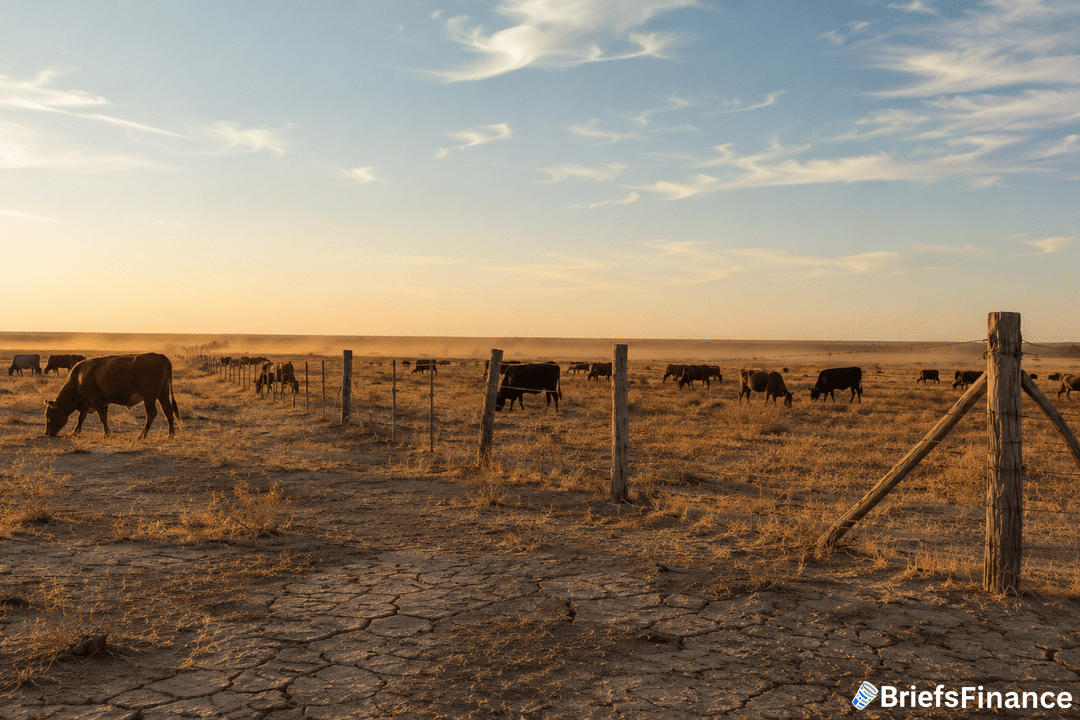
Cattle grazing on a dry, cracked field at sunset, with wooden fences dividing the pasture and a dusty sky in the background. The BriefsFinance logo is visible in the bottom right corner.
Summary:
  • Ground beef averaged about $7.06 a pound in May, up roughly 13% from a year ago, a record high.
  • The U.S. cattle herd is at a 75-year low after years of drought.
  • A flesh-eating parasite called the New World screwworm has turned up in Texas cattle for the first time in about 50 years.

Americans are paying record prices for beef, and the cattle math is getting worse, not better. A parasite last seen here decades ago just turned up in Texas.

Why Your Burger Costs More

Beef is pricey for a simple reason: there aren't enough cattle. The U.S. herd is at its smallest in 75 years, after years of drought made it too costly to raise more.

Drought dried up the grass and feed that herds depend on, which left ranchers with fewer animals to sell.

On top of that, the U.S. paused live cattle imports from Mexico. That one move pulled an estimated 1.2 million young cattle out of this year's supply.

Fewer cattle and the same hungry buyers means higher prices. Ground beef hit about $7.06 a pound in May, up roughly 13% from a year ago.

One economist called it Economics 101: supply shrinks, demand holds, and prices climb. Trade tensions added to the squeeze, though some tariffs on beef have since eased.

Rising grocery prices say a lot about the economy, and we break down what they mean for investors every weekday in Market Briefs, plus a free masterclass to get you started.

The Pest Making It Worse

The New World screwworm is a fly whose larvae burrow into the wounds of living animals. It was wiped out in the U.S. decades ago before turning up again in Texas.

The USDA says a real outbreak could cost the Texas economy $1.8 billion. The main weapon is oddly low-tech: flood the dating pool with sterile males so females mate but have no young.

The U.S. releases about 100 million sterile flies a week right now. Experts say stopping the spread needs 500 million, a pace a new Texas plant won't reach until 2027.

There's a stopgap in the meantime. Late last year the FDA cleared a Merck treatment that ranchers can pour on cattle to kill the pest.

Ranchers would normally build the herd back up when prices run this high. The screwworm makes that harder, since it puts the young cattle they'd add at risk.

Worth Noting

Industry leaders say the food supply is safe, and they stress this is a pest, not a disease. So there's no mass culling of cattle the way bird flu wipes out chicken flocks.

The country beat this same fly back in the 1960s, and it has far more tools now. But ranchers still eat the cost of extra labor, vets, and checks on their herds.

Beef demand is at a 40-year high, which is why a record price hasn't scared shoppers off yet. Past price spikes pushed many families toward cheaper chicken and pork.

Chicken and pork are the usual winners when beef gets too pricey. For now, though, demand for beef is holding firm.

The moment they trade steak for chicken is the moment prices finally cool.

Want the market read behind the headlines? Join the Market Briefs daily and grab a free investing masterclass while you're at it.

Disclosure

Recent News

1 2 3 … 112

Get Market Briefs delivered to your inbox every morning for free!

No fluff. No noise. No politics. Just finance news you can read in 5 minutes.

Blogs

October 23, 2026
Are We in a Recession? 5 Threats to the Economy and Where the Money Is Moving
  • The S&P 500 is up about 13% this year, but without AI it's in a bear market, with nearly 40% of its companies down more than 20% for four months or longer.
  • Jackson, Briefs Finance's head of investing research, sees five threats: rising interest rates, sticky inflation, an economy propped up by AI, a struggling UK, and high oil prices.
  • The opportunities he's watching mostly sit outside the dollar: rising economies like Brazil and Indonesia, US-backed emerging market bonds paying 7% to 9%, and the shifts that fear creates.
Read More
October 16, 2026
How Boring Math Makes You Rich: The Briefs Money Spreadsheet, Explained
  • Briefs Money shows you what to do with every paycheck, and in what order: how much to spend, save, and invest, when to build an emergency fund, and which debt to pay off first.
  • The Climb to Wealth course walks you through the system step by step, and the Personal Finance Spreadsheet is where you track your own numbers.
  • Investing is one piece of building wealth. The system that gets money to your investments, and keeps it there, decides the outcome.
Read More
October 16, 2026
Common Investing Mistakes: Why a Stock Grade Is One Tool, Not the Whole Toolkit
  • The Briefs Score shows growth, income, and wealth preservation investors how well a stock fits their goal, with a separate letter grade for each one.
  • The most common mistake is treating the letter as an instruction. An A tells you a stock scores well for one goal, not that you should buy today.
  • Research works best as one input in a process you own. The grade shows how a stock stacks up. You supply the goal, the timeline, and the rules for being wrong.
Read More
October 16, 2026
How to Read a Company's Numbers Without a Finance Degree (Using Briefs Terminal)
  • Briefs Terminal lets you size up any public company in about ten minutes: what the stock costs, what it earns, how fast sales are growing, and what it pays you, all on one page.
  • It lines those numbers up against the company's closest competitors for you, so you can tell if a number is impressive or just average.
  • Below that are the income statement, balance sheet, and cash flow statement from the company's SEC filings, the latest news, and transcripts of its earnings calls.
Read More
October 16, 2026
What Type of Investor Am I? The Three Investor Archetypes, Explained
  • Briefs sorts its stock grades and monthly reports by three investor goals: growth, income, and wealth preservation. Pick yours and you know which report and which grade to read first.
  • Growth investors want stocks that beat the S&P 500. Income investors want to get paid in cash. Wealth preservation investors want stocks that hold up when the market drops.
  • The same stock can score an A- for one goal and a D- for another, so picking your goal comes before picking any stock.
Read More
October 16, 2026
How to Build a Stock Watchlist That Isn't Just Stocks You Heard About
  • A watchlist on Briefs Terminal lets you group stocks by the idea you're tracking and follow each one's price, one-day move, and 52-week high and low in one place.
  • Each list has its own name and description, so you always know why a stock is on it, and you can make as many lists as you have ideas.
  • The monthly growth, income, and wealth preservation reports under the Briefs Research tab hand you new themes to track that you didn't hear about online.
Read More
October 16, 2026
How to Choose an ETF That Matches Your Idea (Using the ETF Planning Tool)
  • The ETF planning tool takes an idea like "I want to invest in fast food companies," asks what you mean, and finds the ETFs that match, with the reasons, the holdings, and the sources.
  • Build a Plan then shows what your money could grow to in those ETFs over the years you choose, with conservative, expected, and optimistic estimates next to the S&P 500.
  • It gets you from an idea to an actual plan without researching dozens of companies one at a time.
Read More
October 16, 2026
Is This Stock a Good Buy? How to Use the Briefs Score to Tell If a Stock Fits the Way You Invest
  • The Briefs Score shows growth, income, and wealth preservation investors how well a stock fits their goal, with a separate letter grade for each one.
  • One stock can score very differently for each. Nvidia showed an A- for growth and a D- for income, because it grows fast and pays almost no dividend.
  • Seven sub scores under each grade show what earned the letter, so you can see exactly where a stock is strong or weak for your goal.
Read More
October 16, 2026
How to Tell an Asset From a Liability: The One Question to Ask Before You Buy Anything
  • The typical American household earned more in 2025 than in any year on record, yet only 30% of Americans say they could pay a surprise $1,000 bill from savings, so the problem isn't income but what the income gets spent on.
  • An asset puts money in your pocket and a liability takes money out, and the wealthy buy assets first, then let the assets pay for the fun stuff.
  • Before you buy anything, ask one question: does this put money in my pocket, or take money out of my pocket? Then you need a plan for the money you keep.
Read More
October 16, 2026
How to Build Your First $2,000 Emergency Fund and Wipe Out Every Debt Over 10%
  • Your first money goal isn't investing, it's $2,000 in its own account named Do Not Touch, built by moving 10% of every paycheck into it automatically.
  • More than a third of American adults couldn't cover a $400 surprise bill with cash or savings, according to the Federal Reserve, and that's how one bad day turns into years of credit card payments.
  • Once the $2,000 is there, attack every debt charging more than 10% interest, highest rate first, because you can't out-invest a 22% credit card so paying it off is the investment.
Read More
1 2 3 … 29
Share via
Copy link










