Free NewsletterPro Login

Free Live Investors Workshop

Seats limited

Tue, Sep 29.

The dollar is losing value.

Here’s how investors can still profit.

Hosted By

Jaspreet Singh

Founder, Briefs Finance

X

Warning: Undefined variable $stocks in /var/www/briefs.co/htdocs/wp-content/plugins/oxygen/component-framework/components/classes/code-block.class.php(133) : eval()'d code on line 448

Warning: foreach() argument must be of type array|object, null given in /var/www/briefs.co/htdocs/wp-content/plugins/oxygen/component-framework/components/classes/code-block.class.php(133) : eval()'d code on line 448

Warning: Undefined variable $funds in /var/www/briefs.co/htdocs/wp-content/plugins/oxygen/component-framework/components/classes/code-block.class.php(133) : eval()'d code on line 472

Warning: foreach() argument must be of type array|object, null given in /var/www/briefs.co/htdocs/wp-content/plugins/oxygen/component-framework/components/classes/code-block.class.php(133) : eval()'d code on line 472
/* the link was here */

Argentina's Inflation Fell From 211% To 32% Under Milei

Published Jun 8, 2026
Share:
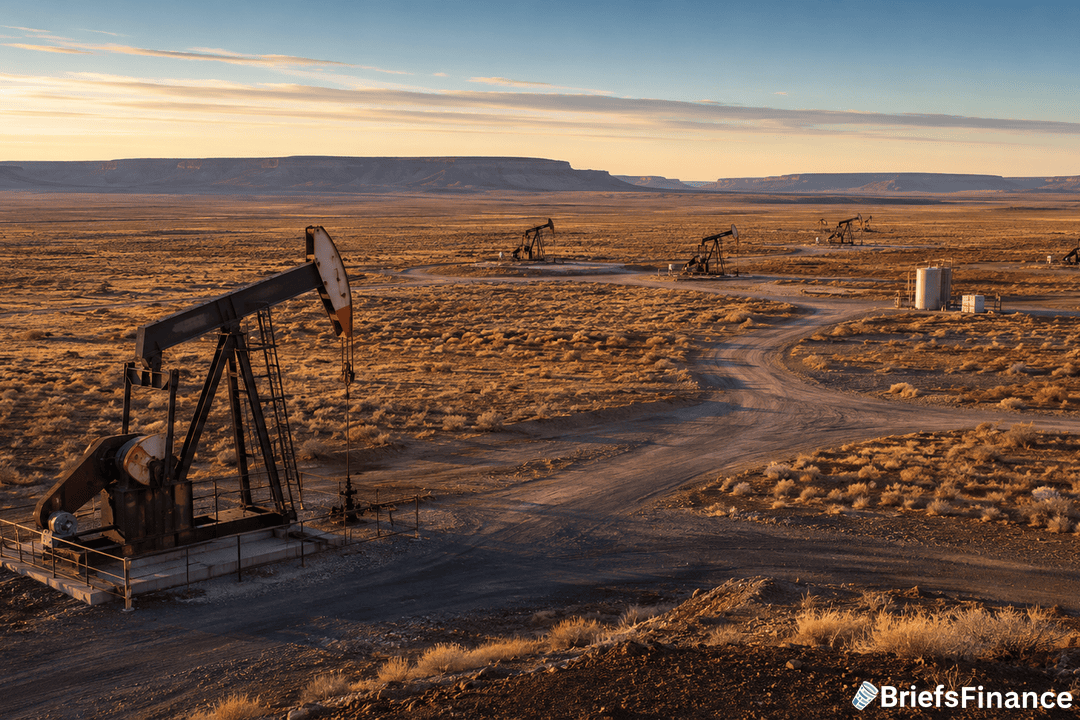
Oil pump jacks operate in a vast, arid landscape under a blue sky at sunset. Several pumps and equipment dot the dry, flat terrain, with distant mesas visible on the horizon.
Summary:
  • 108 economists, including Thomas Piketty, signed a 2023 letter warning Milei's plan could cause "devastation."
  • Argentina's inflation fell from 211% when he took office to about 32% in April.
  • Exports rose to almost $9 billion in a single month, up from about $5 billion in late 2023.

Before Argentina's 2023 election, 108 economists signed a warning letter. They said Javier Milei's plan could wreck the economy.

Two years later, the numbers point the other way.

The Bet Against Him Was Nearly Unanimous

Milei took office in December 2023, and the economy was a mess. Prices were soaring and growth was shrinking.

Inflation was running at 211%. Exports had slipped to about $5 billion a month.

The warning was loud. The letter included big names like Thomas Piketty.

The signers came from around the world. Some had advised world leaders for years.

Many feared a deep slump and lost jobs. The mood was grim heading into the vote.

It said his plan was "fraught with risks" and could "cause more devastation in the real world."

That is about as close to one voice as the field gets.

They were betting hard that his plan would fail. The early results have gone the other way.

Big policy turnarounds like this create real openings for investors - we break them down each morning in Market Briefs, plus a free investing masterclass when you join.

What Actually Happened

The fix was old-fashioned belt-tightening. Milei cut state aid and shut government offices.

He also stopped funding the deficit. That flipped the budget to a surplus.

There was more to the plan than cuts. He reset the exchange rate and let the dollar play a bigger role.

He also reopened the country to outside markets. That brought in fresh trade and competition.

His plan echoed an old playbook. Many likened it to the way Reagan ran the U.S. in the 1980s.

The early pain was real for many. Then the key numbers began to turn.

The results came fast. Inflation dropped to about 32% by April, down from that brutal 211%.

Exports tell the same story. They climbed to nearly $9 billion in a single month.

That is almost double where they sat when he arrived. Foreign money came back too.

A $20 billion swap line from the US Treasury helped steady the peso. Inflows then hit a record $18.8 billion late in 2025.

Energy added to the rebound. Oil output has risen about 32% since he took office.

Gas output is up about 11% as well. Both gave the country more to sell abroad.

Worth Noting

Not everything is fixed. Poverty has grown even as prices cooled.

Wages and savings took years of damage. Many families are still climbing back.

Milei still has critics at home. They warn the gains may not last.

A year of good numbers does not undo decades of pain. Still, the early scorecard is hard to argue with.

The economy grew 4.4% last year. One analyst put it plainly: Milei "really knows his stuff."

For now, the trend is clear. Argentina is in far better shape than feared.

The economists made their call. The data is making a different one.

Get the global money stories that matter delivered every morning - join Market Briefs here and a 45-minute investing course comes with it.

Disclosure

Recent News

1 2 3 79

Get Market Briefs delivered to your inbox every morning for free!

No fluff. No noise. No politics. Just finance news you can read in 5 minutes.

Blogs

September 17, 2026
Why America Bailed Out the Yen: The Japan Carry Trade, the Dollar and Your Mortgage Rate
  • In July 2026 the US sent money to steady the yen because Japan is the largest foreign owner of US debt, and Washington needs Japan to keep lending.
  • For decades the Japan carry trade let Wall Street borrow yen at essentially 0% and pour it into US stocks, real estate and Treasuries, and rising Japanese rates are shutting that off.
  • A weaker yen means fewer buyers for the dollar and for US debt, which pushes Treasury rates up and drags mortgage, car loan and credit card rates up with them.
Read More
September 16, 2026
Treasury Yields Are Spiking Because Lenders Are Backing Away From U.S. Debt
  • The U.S. is paying its highest 30-year borrowing rate in about two decades because its biggest lenders, the Fed, foreign governments, and banks, are all pulling back from Treasuries.
  • Every mortgage, car loan, credit card, and business loan is priced off the 10-year Treasury yield, so when Washington pays more to borrow, so do you.
  • With about $40 trillion of debt against a $32 trillion economy, the country either outgrows its debt or slides into a doom loop, and investors need a plan for both.
Read More
September 15, 2026
Fiat Currency Runs on Trust, and the World Just Stopped Trusting the Dollar
  • Gold has overtaken US treasuries as the world's top reserve asset, and central banks are now buying less US debt and more gold.
  • The US dollar is a fiat currency, meaning it's backed by a promise rather than gold, so it loses value when fewer countries want to hold it.
  • Whether the US economy or its national debt grows faster from here decides which assets stand to benefit next.
Read More
September 14, 2026
Why RAM Prices Are Soaring - and Where the Money Is Moving
  • Memory chips - the RAM inside phones, laptops, fridges, and trucks - are in a shortage Tim Cook called a 100-year flood, and some memory prices have climbed about 90% in a single quarter.
  • Four forces hit at once: AI demand, a production shutdown in 2023, build times that push any fix to 2028 at the earliest, and a bombed helium plant in Qatar.
  • The last two supply shocks ended in aggressive Fed rate hikes and market drops of around 45% and 20%, and this time Washington is spending heavily to bring memory production home.
Read More
September 11, 2026
How Is the Economy Doing? Washington Says It's Fixed, but the Numbers Don't Agree
  • Treasury Secretary Scott Bessent says the economy is fixed because lower earners' incomes are now rising faster than top earners'.
  • The Atlanta Fed and Bank of America show different numbers, and Hilton, Marriott, and McDonald's can't agree on what they're seeing either.
  • Whichever side is right, the economy is built to make investors rich, and inflation is how it does it.
Read More
September 10, 2026
US National Debt Hits $40 Trillion: Why the Economy Hasn't Collapsed Yet
  • The US national debt crossed $40 trillion in 2026 and is growing faster than the economy. The debt to GDP ratio now sits at 125%, the highest outside the pandemic and higher than World War II.
  • On September 9, 2026, Treasury Secretary Scott Bessent rolled out an emergency plan for the government to lend money to itself. Ray Dalio now says the dollar has roughly three years before real pain.
  • Empires rarely default. They debase. Since 1971, median household income grew about 8x while houses grew 17x and the S&P 500 grew 360x, so investors got richer while workers fell behind.
Read More
September 9, 2026
Your 401k Is Fueling the AI Bubble
  • About $10 trillion of 401k money sits in a $77 trillion stock market, mostly through target date funds and S&P 500 funds. Roughly 30% of every S&P 500 dollar lands in five AI-heavy tech stocks.
  • Four bubble signals run hotter today than before the 2000 crash: top-ten concentration, tech's share of the index, the Buffett Indicator, and how much of the market index funds own.
  • You only lock in an AI bubble loss if you sell. The 2022, 2020, 2008, and 2000 crashes were all buying windows for long-term investors, and the US-China AI race means government money could keep flowing in.
Read More
September 9, 2026
What Is Wealth Preservation? How To Protect Your Money From Anything
  • Wealth preservation is an investing strategy built around keeping the money you've already made instead of chasing growth.
  • It leans on assets that hold steady when markets fall - gold, Treasury bonds, and companies that keep earning through wars, crashes, and pandemics.
  • The tradeoff is real: you give up some upside, and the two key numbers to check are maximum drawdown and correlation to the market.
Read More
September 8, 2026
Why Is Everything So Expensive? Why Prices May Never Come Back Down
  • Official inflation is 3.4% and prices are up 32% since 2020, but rent (41%), gas (47%), car insurance (64%) and ground beef (79%) all outran the 28% median wage.
  • The Federal Reserve targets 2% inflation on purpose. Rising prices push extra dollars to investors and shrink the real cost of a $40 trillion national debt.
  • Investors who simply owned the S&P 500 gained about 150% over the same six years, and the Fed's September 16 decision will show whether it protects the dollar or the economy first.
Read More
September 7, 2026
The U.S. Housing Market Just Flipped: Renting a Home Now Beats Buying One
  • The US is in a buyer's market in 41 of the 50 largest metro areas, but prices sit near record highs and mortgage rates are close to 7%.
  • The same median house costs 27% more than it did in 2021 while the monthly payment costs 90% more, and incomes rose a little more than 10%.
  • A 2008-style crash is not showing up in the data, so the pressure is landing on buyers instead of prices.
Read More
1 2 3 27
Share via
Copy link











