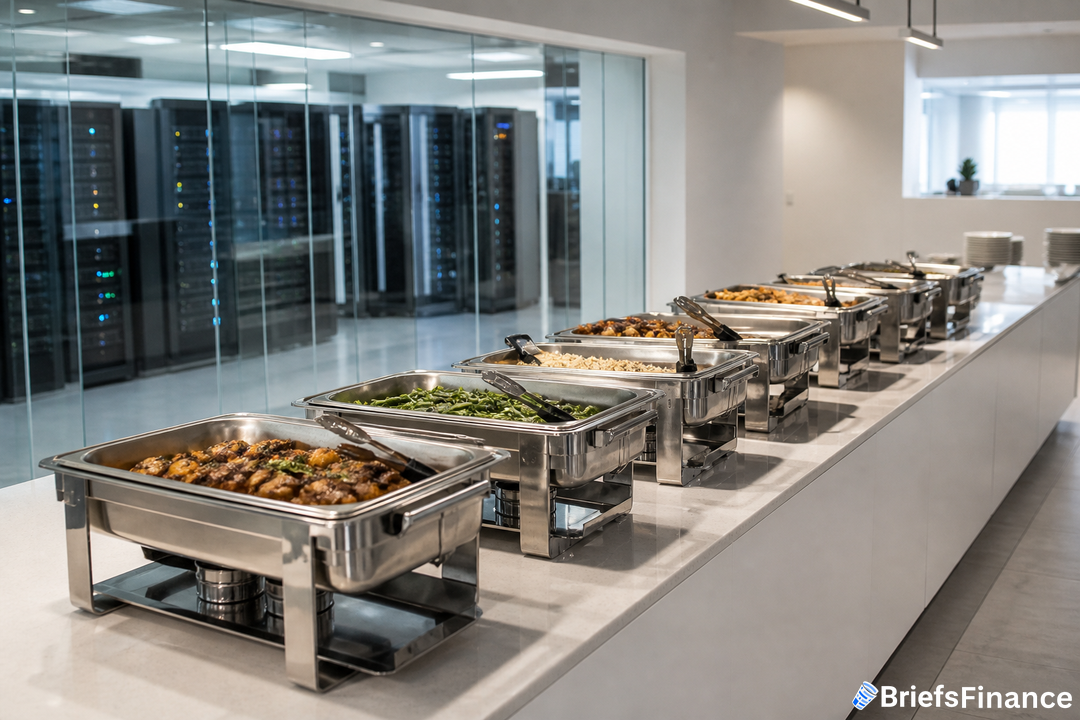
Why caterers are piling into server country
Big Tech's race to add computing power is creating a whole new line item for lunch. As hyperscale campuses mushroom across the US, operators are bringing in international providers such as US-based Aramark, the UK's Compass Group, and France's Sodexo for everything from laundry to round-the-clock snacks at sites still going up and at live facilities. The payoff is not small: catering companies have a $3 billion opening as data center headcounts rise and amenities expand to include food, gyms and entertainment.
Expect sustained demand, say Bloomberg Intelligence analysts Stuart Gordon and Evgeniy Batchvarov, who see several years of elevated need for catering, housekeeping and facilities management as buildouts continue. They project the outsourcing opportunity to hit an annualized $3.2 billion by 2032. BI also sketches a pecking order: Aramark around 35% share, Compass about 30%, and Sodexo near 20%. Aramark's bundled Nexus offering, which mixes dining, housekeeping, employee transport and fitness and wellness programs, has helped it grab an early lead, according to BI.
Contracts, dollars and what is already booked
In August, Aramark told analysts it is targeting an incremental $400 million to $500 million tied to data center deals across fiscal 2027 and 2028. This month, the company announced it will handle catering, fitness centers, and "resort-style entertainment" at a Texas data center employing more than 4,000 people; Citi analysts think the deal could boost run-rate revenue by about $100 million as the site ramps. Management has lifted its guidance two times this year, pointing to the data center opportunity.
Though smaller in this niche, Sodexo secured a July contract with Meta Platforms Inc., under which it will cater across Meta's worldwide network of offices, data centers and conference hubs. The opportunity is "significant," CEO Thierry Delaporte noted on a recent earnings call, with demand from both sites under construction and those already running. And it is not just the campuses.
"It's about all of the manufacturers and construction companies within that supply chain that are also our clients, and where their employees are our consumers, and they're going to be enriched by what's going on," Compass CEO Dominic Blakemore said earlier this month. In its most recent trading update, Compass reported that the hyperscaler-focused segment was its top performer, posting double-digit organic growth.
Opportunities in evolving industries remind investors to safeguard and nurture their savings. Join Briefs Finance CEO Jaspreet Singh on September 29th for a FREE live investor workshop, How to Profit From A Dollar That's Losing its Value, where he shows how we're spotting investment opportunities as the dollar falls. Save your spot.
How big could this get, and for how long
Sizing this market depends on headcount assumptions and spend per worker. BI expects the workforce tied to these services to crest at about 93,000 in 2033. Citi's Leo Carrington, by contrast, assumes 590,000 workers in 2034 and total revenue of $25 billion that year. Even with those differences, Gordon and Batchvarov expect annualized revenue to top out at $3.2 billion in 2032 and later ease to roughly half that as the frenzied build-out cools over an extended horizon.
Carrington's framework is straightforward: for food and facilities providers, revenue effectively moves in line with the number of people being served. Competition will be intense. After Sodexo set new 2030 targets, Carrington wrote he is not confident those ambitions will all be met in a market where two major competitors are performing extremely well.
The wild cards investors are watching
Local politics and AI caution could put speed bumps on the buildout. A September New York Times and Siena University poll reported that 61% of US voters are against building data centers, an increase of 12 percentage points versus a February and March survey by the Annenberg Public Policy Center of the University of Pennsylvania. Factor in appeals by leaders at AI labs to slow the development of frontier models on safety grounds, and many investors are assessing these catering wins one contract at a time. "The contracts need to be signed when the projects have got the green light," Carrington said. "That matters most."
For your wallet, the real tells are the signed deals and specific revenue additions, not blue-sky totals. Aramark's guided $400 million to $500 million uplift across 2027 and 2028 and Citi's roughly $100 million run rate from one Texas site tie directly to headcount and services. The longer arc depends on how many campuses actually get built, how long the construction wave lasts and which providers win each bid.
Keeping a long horizon helps your portfolio weather change and compound value. Our CEO Jaspreet Singh is hosting a FREE live investor workshop, How to Profit From A Dollar That's Losing its Value, on September 29th. Sign up free to join him live.