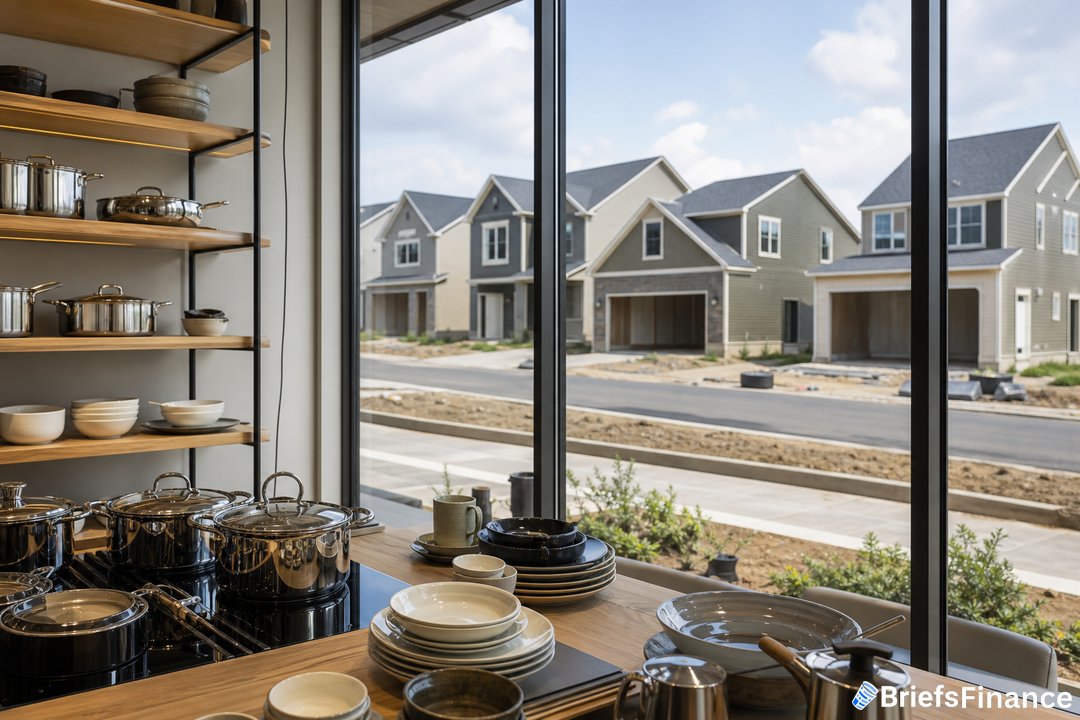
Why the stock is beating the sector
A soft housing market usually spells trouble for sofas and skillets, yet Williams-Sonoma has been a standout this year, with the stock up about 23% year to date and ahead of key peers and its home-furnishings benchmark. CEO Laura Alber told CNBC's Mad Money in late August that sharper product, service, quality and brand storytelling are pulling in new shoppers and bringing loyal customers back. Over the past three years, the stock has surged more than 200%.
The business is heavily tied to the U.S. - 96% of sales come from stateside shoppers - where higher interest rates and pricier energy and food have cooled housing activity. Even so, Alber said she wants tariff policy to stop shifting. "If they just stay in one place, it's going to be a lot easier for everybody, including our investors," she said.
The margin playbook that stuck
The company rebuilt its economics well before this year's rally. Operating margin was 7.9% in 2019 and climbed to 17.6% by 2021. After the pandemic housing rush faded and sales slipped, profitability still held up: 2025 revenue of $7.81 billion was down from $8.25 billion in 2021, yet operating income was nearly unchanged.
Peter Keith, who leads consumer research at Piper Sandler, credited a few big levers: fewer markdowns and a tighter delivery network that includes home drop-offs, which together drove more than 10 percentage points of EBIT margin expansion in the tough years. Selling more goods at full price also smoothed out order flow, he said, which helped the supply chain and padded margins. Success with smaller-ticket staples like candles, pillows and kitchen gear has made results less dependent on housing swings, though furniture remains central to the portfolio.
Pottery Barn, the biggest brand, illustrates the mix shift. From fiscal 2022 to 2025, its revenue fell more than 15%. On its March call for the fourth quarter of fiscal 2025, management acknowledged leaning too hard into decor to counter furniture softness after the post-Covid slowdown. The rebound is underway: Pottery Barn's comparable sales rose 5.1% in the quarter that ended in August.
In uncertain times, steady strategies help protect savings and pursue long term growth. Join Briefs Finance CEO Jaspreet Singh on September 29th for a FREE live investor workshop, How to Profit From A Dollar That's Losing its Value, where he shows how we're spotting investment opportunities as the dollar falls. Save your spot.
Digital, AI and the B2B booster
Online remains the profit engine, with e-commerce contributing more than two-thirds of total sales. The company is layering in AI to fuel that channel. During its November earnings call, management introduced an AI shopping assistant nicknamed "Olive." By August, the company said customers who use it buy at triple the rate of those who do not. Chief Technology and Digital Officer Sameer Hassan said on the May first-quarter call that AI is also lowering costs in logistics and delivery.
Business-to-business sales are another lift. In the latest quarter that ended in August, B2B grew nearly 15% as the company expanded into projects tied to passenger liners, retirement communities and university residences. The B2B arm generates about $1 billion annually today and, by the company's view, may grow to roughly twice that size over the next several years. Keith pointed to the multi-brand, store-plus-online model as a real edge in a highly fragmented furniture market.
Tariffs, refunds and what to watch next
There is one clear pressure point: sourcing. In 2025, more than 80% of merchandise purchases came from non-U.S. manufacturers, so tariff moves matter. According to Alber, the company repaid vendors and allocated $10 million to make $1,000 contributions to every employee's 401(k).
The second-quarter report shows $47.5 million was reimbursed to vendors. The company kept the refund out of reported earnings, which Keith said underlines the strength of the core business.
For your wallet, the through-line is durability. A U.S.-centric footprint facing a cooler housing backdrop, a margin-first playbook, an online business now supercharged with AI, and a growing B2B pipeline are what have powered that roughly 23% year-to-date gain - with tariff exposure as a key risk to track.
A thoughtful plan and calm discipline can keep your portfolio heading toward goals. Our CEO Jaspreet Singh is hosting a FREE live investor workshop, How to Profit From A Dollar That's Losing its Value, on September 29th. Sign up free to join him live.