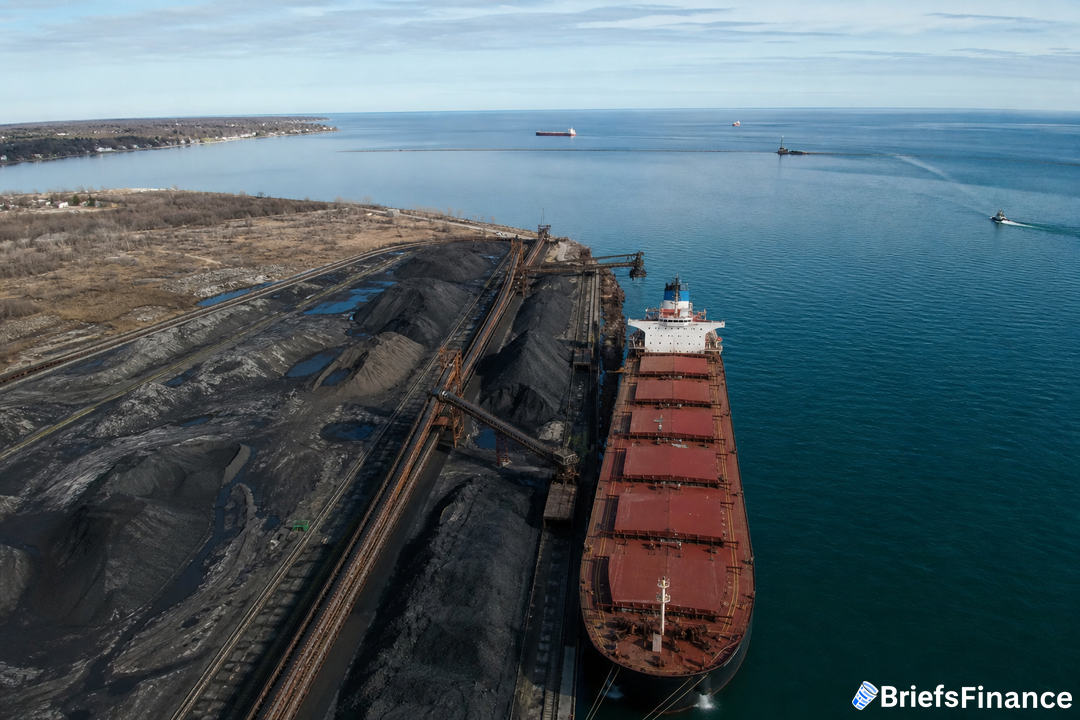
A fan-favorite freighter and a shifting Lakes economy
When the American Century glides into Duluth-Superior to take on Minnesota iron ore, it turns into a mini waterfront event: fog horn, cheering kids, and a running history lesson over the PA about a ship that has worked the Lakes for nearly 50 years. The 1,000-footer, built in 1981 in Sturgeon Bay, Wisconsin, runs on four General Motors diesel engines whose combined output tops that of a dozen Formula 1 cars, and it set coal payload records in the 1990s. Today it sails under American Steamship Co., part of Mainstay Maritime in Williamsville, New York, with roots back to a 1907 founding in Buffalo.
Pride aside, the fortunes of these aging lakers have for decades been yoked to a cross-border economy closely synchronized with Canada. Coal has slumped, U.S. tariffs have scrambled iron-ore trade, and a fresh rift between Ottawa and Washington now hangs over supply chains built for frictionless commerce. Kevin Beardsley of the Duluth Seaway Port Authority, where he serves as executive director, said, "Hope isn't a strategy, but we would expect that this trade war comes to an end at some point and we can get back to regular business." "Canada is looking at different supply chains and that type of thing, and that is a risk the longer this goes on."
The numbers in Duluth-Superior
Messages from the top have been mixed. In Ireland last weekend, President Donald Trump said there could be a deal with Canada "fairly soon," and when asked this week about Ottawa's outreach to the European Union, he issued fresh threats. Prime Minister Mark Carney told Bloomberg News on Monday that Canada is "ready to sit down" for talks.
On the docks, activity is down. By August, vessel traffic at Duluth-Superior was off 23% year over year, per port data. U.S.-flag calls fell about 19% and Canadian arrivals sank 37%.
Coal shipped 4.7 million tons in 2025 and is on pace for only 500,000 tons this year, the lowest since 1973. From Duluth-Superior, domestic iron ore shipments are 40% under the 2025 pace.
While the broad decline is blamed mostly on a coal terminal closure, there is also less iron ore moving north. The ore is mined near Duluth in the country's richest iron ranges and hauled across the Lakes, with the bulk now destined for mills in Ohio or Indiana. Canada's steel sector has taken substantial damage from Trump's tariffs on steel.
Zoom out and the stakes get clearer. By tonnage, Duluth-Superior is the largest Great Lakes port and anchors the western terminus of a 2,300-mile corridor that encompasses the St. Lawrence Seaway and a system of locks. Roughly two-fifths of the U.S.-Canada border runs across water, and about 200 million tons of bulk cargo traverse the Great Lakes and Seaway annually, including coal and grain, along with iron ore and limestone, plus salt, sand, and stone. As a yardstick, U.S. railroads move around 1.5 billion tons annually.
When trade routes shift, investors benefit from steady plans to protect and grow. Join Briefs Finance CEO Jaspreet Singh on September 29th for a FREE live investor workshop, How to Profit From A Dollar That's Losing its Value, where he shows how we're spotting investment opportunities as the dollar falls. Save your spot.
Built together, strained together
The Lakes economy is deeply intertwined. Ian Hamilton, president and CEO of the Hamilton-Oshawa Port Authority near Toronto, said the region's total output amounts to $6 trillion for the area. He added, "Over decades and decades of time, the Great Lakes, the states and the provinces have become a hugely integrated - the third-largest economy in the world if it was a country." Lately, U.S. counterparts are "all kind of scratching their heads going, 'Why are we disrupting this integrated market?'" he said, adding, "We've crossed the borders to drink in each other's bars and eat other's food and vacation at each other's properties."
Among its diversification moves, HOPA is working with Sault Ste. Marie, Ontario, on a proposed new port and on road and rail links to connect Canada's resource-heavy regions with domestic buyers and overseas trade. The U.S. could probably get by with less Canadian trade, Hamilton said, but he also warned, "I certainly appreciate that the United States could probably survive on less trade with Canada, but I also think that ultimately drives up the costs for everybody."
Operationally, the Great Lakes-Seaway is jointly managed: Canada runs 13 locks and the U.S. oversees two. In a late August speech, Unifor national president Lana Payne credited Canadians with building the seaway, while historian Ron Stagg noted that the major 1950s upgrades became a joint project after initial U.S. reluctance. As plans advanced, Canadian officials told Washington that if it didn't want to participate, Canada would proceed alone, Stagg said, and the U.S. then decided to take part.
Politics around the waterways can get quirky. A social media push urged Canadians to declare sovereignty over the "Strait of Our Moose," a tongue-in-cheek nod to the Welland Canal on the Canadian side that connects Lake Erie and Lake Ontario, and took a swipe at how Trump has yet to restore trade flows via the Strait of Hormuz in the U.S. war with Iran. For all the bluster, there is an old backstop: the 1871 Treaty of Washington says navigation on the St. Lawrence River "shall forever remain free and open for the purposes of commerce to the citizens of the United States."
The quieter fight over who carries the cargo
Tensions in Great Lakes shipping predate the latest tariff volleys. Jim Weakley, president of the Lake Carriers' Association in Westlake, Ohio, declined to comment on the dispute itself, saying it "has not impacted binational maritime trade on the Great Lakes." He pointed to long-term contracts and a thin spot market as reasons.
In a position paper, Weakley argued that "Canada has flagging laws, regulations and practices that endanger the economic viability, efficiency and service reliability of the US-flagged Great Lakes fleet's binational trade that also has resulted in the shrinking of the US-flagged Great Lakes fleet." The paper says the result "has created a Canadian monopoly on the binational Great Lakes trade," and lists grievances, including support for "the growth of the Chinese shipping building empire and receiving ships that have been subsidized by the Chinese government."
"It's difficult to find a shipyard that's willing to build a laker vessel," said Jason Card, the vice president of external affairs for the Ottawa-based binational Chamber of Marine Commerce.
Local disruptions remind us that a long term focus helps safeguard your savings. Our CEO Jaspreet Singh is hosting a FREE live investor workshop, How to Profit From A Dollar That's Losing its Value, on September 29th. Sign up free to join him live.