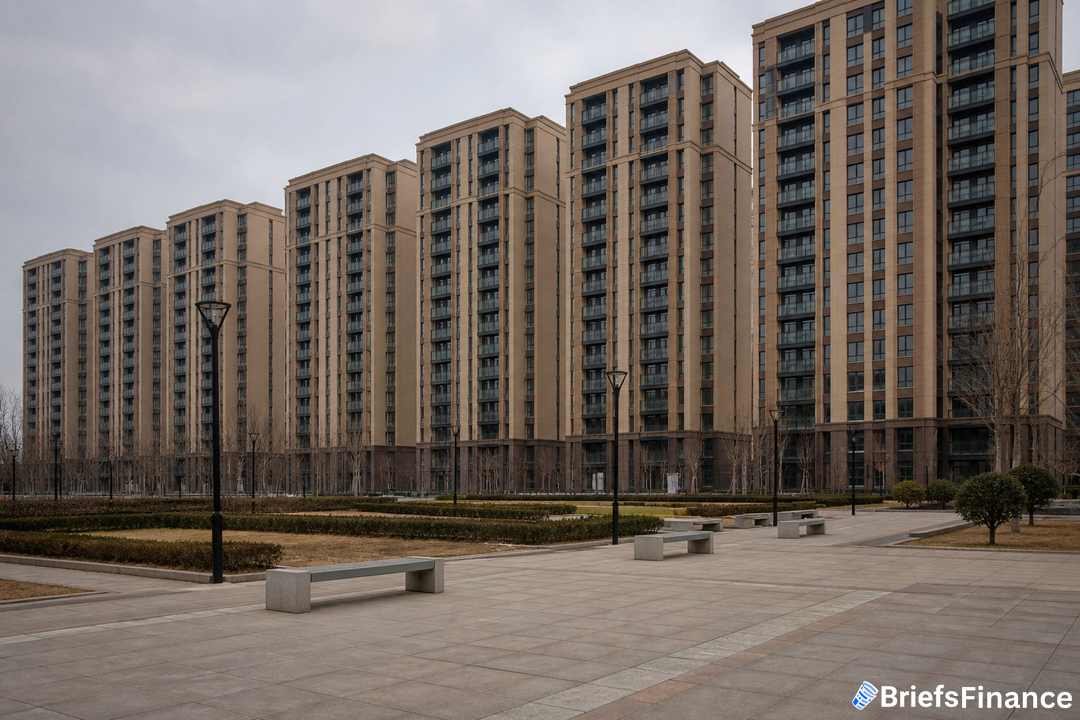
A swelling pipeline, thinner demand
China's REIT calendar is getting crowded. Bloomberg tallies around 30 products that are seeking the green light to collect a total of 90.4 billion yuan ($13.5 billion), with a further 3.9 billion yuan slated to come to market in the weeks ahead. The market has reached about $33 billion in size, but the pending fundraising alone is equivalent to roughly two fifths of the value of the 89 listed funds. That is stoking concern that the buyer base is not deep enough to chew through the steady flow of deals as performance sags.
The calendar for next week features two launches: the Yinhua Yuehai Water Resources fund intends to collect as much as $255 million, while the Huatai Zijin Huazhu Anzhu fund plans to price a $196 million IPO. The queue is still growing: New World Development Co. said Thursday it has applied to spin off a Shanghai commercial building as a REIT to list on the city's bourse, subject to regulatory signoff.
A chart accompanying the deal slate notes that pipeline figures reflect the latest prospectuses and some offerings could slip beyond the third quarter.
Why REITs became Beijing's go to
Officials have been tapping capital markets to support real estate and infrastructure projects and to shift some of the load off local governments. As the property slump since 2021 squeezed cash flows at local government financing vehicles, Beijing leaned more on REITs to free up capital already tied to real estate and put it back to work.
Early reforms and other tweaks helped the products gain traction, especially as a way to marshal large pools of money for infrastructure. Regulators later broadened eligibility, extending it past industrial parks and offices to cover assets such as rental housing, shopping malls, hotels, and additional kinds of commercial properties. What began as a tightly controlled pilot has become a regular program with faster signoffs. More recently, policymakers have positioned REITs as a key plank in a new property financing approach, pushing deals backed by rental housing and urban renewal projects.
"The REIT market slid into a deep correction as a flood of new supply collided with deteriorating fundamentals, unwinding the crowded trades that had supported the sector years ago," said Zhao Yunjiao, an analyst at CSCI Pengyuan Credit Ratings. The result, Zhao said, has been a market with "low odds of gains and steep drawdowns."
When new offerings crowd a market, disciplined planning helps protect your long term savings. Join Briefs Finance CEO Jaspreet Singh on September 29th for a FREE live investor workshop, How to Profit From A Dollar That's Losing its Value, where he shows how we're spotting investment opportunities as the dollar falls. Save your spot.
Performance is dulling the pitch
REITs are sold as bond like vehicles with steady payouts and predictable cash flows, but recent returns have dented that image. By weighted average, the group has dropped 10.4% over the past six months, and only half of this year's listings trade above issue. Oversubscription has fallen to about half of last year's level. A China Securities Index gauge of REITs now sits 28% below its 2022 high, and trading activity has dwindled to about one-fourth of the peaks reached two years earlier.
A prominent underperformer is an E Fund vehicle linked to an industrial park in Guangzhou. Since listing in 2024, it has fallen more than 50%, reported a first half net loss of 8 million yuan, and still offers an annualized dividend yield of just 4.5%. The trust said tenants are under financial pressure and competition is intensifying.
Even the new crowd pleasers have struggled. Two data center REITs now trade below offer, yielding 4.4% and 3.1% annualized. That tops the 1.7% on China's 10 year government bond, but it pales next to the CSI Telecommunication Services Index, up 30% this year.
Yields, spreads and what investors are asking
For the latest cohort, the CICC Xiamen Affordable Rental Housing Closed end Infrastructure Fund posted a 2.4% annualized cash payout for the first half, while the Huatai Zijin Suzhou Hengtai Rental Housing Closed end Infrastructure Fund distributed 3.4%; these are secured by assets whose operating lifespans exceed 50 years, offering only a slim premium over the 30 year Chinese government bond at 2.15%.
At Xiamen Chuangzhao Private Fund Management, chief investment officer Cai Yibin said, "The concept made sense: unlock capital tied up in assets owned by state firms and local government financing vehicles and recycle it into new investment." But Cai added that some assets were "packaged too aggressively and listed at peak performance." When rents and occupancy softened, investors began to doubt the pricing. "Then issuance becomes difficult and the market risks turning stagnant," he said.
When new issues outpace buyers, pricing power shifts and yields have to do more heavy lifting. That matters for everyday investors too, since REITs were supposed to offer steady income without venture sized risk, and yet the cooling interest outside of China's tech push suggests patience is wearing thin.
Steady habits and ongoing learning are key to growing and guarding your wealth. Our CEO Jaspreet Singh is hosting a FREE live investor workshop, How to Profit From A Dollar That's Losing its Value, on September 29th. Sign up free to join him live.