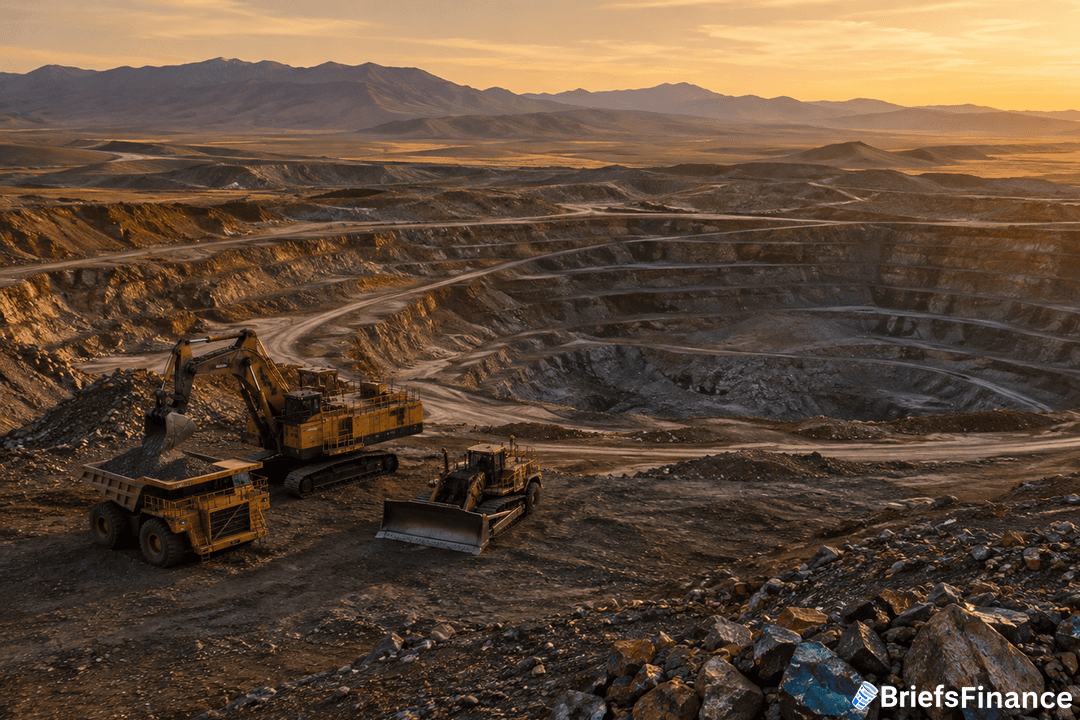
Your phone's battery, your car's electric motor, and the magnets inside wind turbines all need minerals that China mostly controls. Critical minerals are the raw materials behind batteries, magnets, aerospace parts, and defense gear. China controls most of that supply chain, and Trump said the U.S. must stop relying on unfriendly countries for those materials.
"We're putting our miners back to work," Trump said, "and we're reclaiming America's rightful place as the minerals superpower of the world."
The $3 Billion Push
The biggest piece goes to battery tech. The anode is the part of a battery that stores energy during charging, so this is a bet on batteries that last longer and charge faster. Sunrise Energy Metals will get $400 million from the Pentagon to expand scandium output in Australia.
Scandium is a lightweight metal used in aerospace and defense.
Niron Magnetics, a Minnesota company that makes magnets, gets $150 million. Ivanhoe Electric is set to receive more than $1 billion in Export-Import Bank financing for its Arizona copper project, known as Santa Cruz.
A $25 million investment will start a graphite mine in Alabama. Over $180 million is going to mining education programs, and executives from Rio Tinto, MP Materials, BHP, and other big names showed up for the announcement.
The China Factor
Rare earths are a group of metals used in the super-strong magnets inside electronics and electric motors.
Get the free Always Be Buying eBook and learn the simple system for building wealth on any income
More than a year ago, the Pentagon said it would invest $400 million in MP Materials, the only U.S. rare-earths producer. The push comes ahead of Chinese President Xi Jinping's scheduled September visit to Washington, and rare earths stay a tension point even after a trade truce eased some export controls on critical minerals and magnets.
Washington's goal is a fully domestic pipeline, so minerals are dug, processed, and turned into magnets on U.S. soil without Chinese involvement.
Trump said mines are reopening quickly, including what he called the first U.S. rare-earth mine in more than 70 years. He also pointed to construction of the first U.S. aluminum smelter since 1980.
On Friday, the U.S. International Development Finance Corp. said it would match Harena Rare Earths' $4.8 million investment in a Madagascar rare-earth mine that will send magnet metals to U.S. manufacturers.
The Workforce Problem
The money matters, but so do people. The mining industry faces an aging workforce and a shortage of engineers, geologists, and metallurgists.
Interest in mining schools has dropped for decades, leaving companies to fight over a small pool of talent. New mines can take years to open, which is why the education piece has to start now.
That money is meant to "train the next generation of American miners," Trump said. Aclara Resources CEO Ramón Barúa, who was at the meeting, said the administration was "all out supporting mining initiatives."
"This is critical to our national security," he said.
What It Means for Your Money
Mines and smelters take years to build, and progress so far has been slow. The payoff shows up in two quiet places. One is your wallet, because the whole point of a domestic supply chain is to give U.S. companies options beyond China.
The other place is your portfolio, because the companies landing these contracts are the clearest way to track whether the buildout is real. For the country, the stakes are bigger than any stock.
Trump wants the U.S. to be the "minerals superpower of the world," and the federal money is already moving. The mines will take years, and not every project will work.
But the direction is clear, and the stakes touch the products you buy and the prices you pay. That is why a Friday meeting in Washington is worth your attention.
Download the free Always Be Buying eBook and start putting your money to work today