Free NewsletterPro Login

Warning: Undefined variable $stocks in /var/www/briefs.co/htdocs/wp-content/plugins/oxygen/component-framework/components/classes/code-block.class.php(133) : eval()'d code on line 448

Warning: foreach() argument must be of type array|object, null given in /var/www/briefs.co/htdocs/wp-content/plugins/oxygen/component-framework/components/classes/code-block.class.php(133) : eval()'d code on line 448

Warning: Undefined variable $funds in /var/www/briefs.co/htdocs/wp-content/plugins/oxygen/component-framework/components/classes/code-block.class.php(133) : eval()'d code on line 472

Warning: foreach() argument must be of type array|object, null given in /var/www/briefs.co/htdocs/wp-content/plugins/oxygen/component-framework/components/classes/code-block.class.php(133) : eval()'d code on line 472
/* the link was here */

A Trans-Pacific Copper Squeeze Pushes Prices to Historic Highs

Published Aug 7, 2026
Share:
Summary:
  • London copper futures pushed above $14,000 a ton this week as trade flows between the US and China tightened the global market.
  • US copper stockpiles are building at a record pace while London and Shanghai exchange stockpiles drain, and traders are waiting on a potential tariff decision.
  • Citigroup's Tom Mulqueen expects continued warehouse withdrawals to push prices toward $15,000 a ton.

Prices Push Higher as Supplies Move

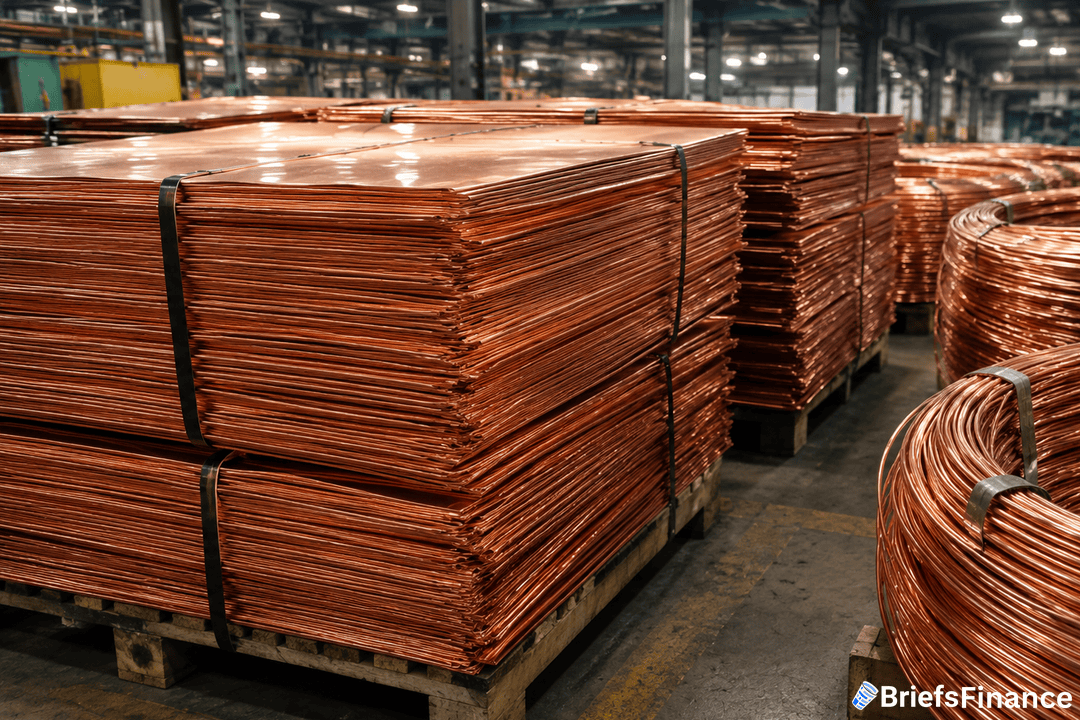
Copper shows up in everything from wires to electric cars. Right now, it is also stuck in a tug-of-war between the world's two biggest economies.

Many traders expect prices to soon top the record $14,500-plus reached briefly at the end of January during a wave of speculative buying in China.

In London at 2:02 p.m., copper futures on the London Metal Exchange were up 0.1%.

The price sat at $14,120 a ton. The bigger story is where the metal is actually sitting.

Comex copper, the US futures benchmark, hit a record Wednesday.

Traders buy copper where it's cheaper and sell it where it's more expensive. That arbitrage has been running since last year and has now reached a tempo not seen in more than a decade.

China's Supplies Are Running Thin

China is the world's biggest copper producer and consumer. Its smelters are cutting output because raw materials are tight, so buyers rely more on imports and Shanghai Futures Exchange stocks keep falling.

The problems showed up in July. Chinese smelter output fell more than forecast, according to Shanghai Metals Market, which cited higher ore prices and lower ore grades.

A lot of the metal moving into China is coming out of LME warehouses in Taiwan and South Korea. Over the past two weeks, traders have pulled batches of 4,000 to 6,000 tons out of those warehouses almost every day.

Get the free Always Be Buying eBook and learn the simple system for building wealth on any income

Some US LME warehouses also sent metal out because Comex prices were higher.

Since May, LME stockpiles have shrunk by over two-fifths.

Mercuria Energy Group, Trafigura Group, Vitol Group and Hartree Partners are among the trading firms that have recently withdrawn metal from LME depots. None of their representatives commented.

The market's pricing structure has turned to backwardation, a setup not seen since January. That means copper for immediate delivery now costs more than copper for delivery in three months.

"Even if demand is not at the moment doing amazingly, you can have a bit of a step change where the constraint on the supply is causing this draw on inventory," said Tom Mulqueen, Citigroup's metals strategist.

Typically, Chinese purchasers step aside when prices rise, and the latest surge is already giving some of them pause. That could slow import demand just as the market tightens.

Tariffs Hold the Key

A lot depends on a policy call that is still up in the air. President Trump has placed US duties on semi-finished copper, but not on refined copper.

Traders are waiting to see if he extends them to raw metal, and nobody has set a timeline.

Trump has scheduled a meeting with mining executives in Washington on Friday, and he plans to unveil several deals and memoranda of understanding. That could offer clues about where the policy is headed.

The range of outcomes is wide. If no refined-copper tariff comes, the pull from US buyers would fade and leave more metal for China.

If the uncertainty drags on, traders expect prices to keep climbing as available metal runs short. If Trump announces tariffs, a sharp surge is likely as traders rush shipments to the US before levies apply.

China's own supply picture adds another layer. One-quarter of its refined copper output comes from scrap, but stricter invoice checks have disrupted the recycling industry.

Small scrap collectors often use up their invoicing quotas and cannot complete sales, which weakens the buffer that scrap has provided for 20 years when mine supply fell or demand grew.

"You lose some of that elasticity because of these additional headwinds," Mulqueen said.

What It Means for Investors

For investors, copper is no longer just a commodity. It sits between US policy and China's supply problems, and the next few weeks could set the direction for the rest of the year.

Download the free Always Be Buying eBook and start putting your money to work today
Disclosure

Recent News

1 2 3 … 92

Get Market Briefs delivered to your inbox every morning for free!

No fluff. No noise. No politics. Just finance news you can read in 5 minutes.

Blogs

October 2, 2026
Fed Interest Rates May Rise Again in 2026 - and the Newest Culprit Is AI
  • Fed Governor Barr told a meeting our head of investing research attended that higher rates are likely in 2026, lower inflation may not come soon, and AI is now pushing prices up.
  • The same week, President Trump asked the biggest AI companies to police themselves under an accord that's morally but not legally binding, because the White House sees AI as a race with China.
  • Higher rates put downward pressure on asset prices and squeeze borrowers, but the way through hasn't changed: own investments, buy on a schedule, and treat downturns as discounts.
Read More
October 1, 2026
Housing Market 2026: Why Office Buildings Are Cracking Before Houses Do
  • Office buildings are selling for 80% to 95% off because their five-year loans are resetting at much higher rates while half-empty floors have gutted the income those buildings are valued on.
  • Housing is under pressure, not cracking: a $400,000 mortgage costs $975 more a month than at 3%, but six of every seven mortgages are still under 6% and those owners are staying put.
  • Whether pressure turns into cracks is a race between unaffordability and the economy, and either way Jaspreet's rule is to treat your house as a liability and buy only what you can afford.
Read More
September 30, 2026
Dividend Investing vs. Growth Investing: Why the Slower Portfolio Can End Up Bigger
  • "What stock should I buy?" is the wrong first question. Growth, income, or wealth preservation comes first, and the goal changes which stocks even make sense.
  • At $500 a month for 30 years, 13% growth builds about $1.75 million. 10% growth plus a reinvested 4% dividend builds a little more than $2.2 million and pays a little more than $80,000 a year.
  • Income investors have US dividend ETFs, REITs, and international dividend funds to study. Growth investors have the Nasdaq 100, AI and chip funds, and small caps. None of it is a recommendation.
Read More
September 29, 2026
Why Is Gold Going Down? A 5.2% Treasury Yield Just Took Its Job
  • President Trump rejected Iran's deal to reopen the Strait of Hormuz, oil prices jumped back up, and gold fell instead of rising.
  • Treasury yields hit their highest level in more than 20 years, so investors sold gold and bought Treasuries that pay interest.
  • Higher Treasury yields make the national debt, mortgages, car loans, and credit cards more expensive, with the Fed's next rate decision due October 28.
Read More
September 28, 2026
The Strategic Bitcoin Reserve: Why the Government Wants Bitcoin to Explode
  • The US government holds about 328,000 Bitcoin, worth roughly $25 billion, and since a 2025 executive order it keeps seized coins instead of selling them.
  • Washington wants a bigger pile of assets so its $40 trillion national debt looks smaller next to them, which lets it keep borrowing and spending.
  • Bitcoin's wild price swings, and a government holding a coin built to escape governments, are the two risks investors need to watch.
Read More
September 25, 2026
BRIEFS EXCLUSIVE: 43% Of Respondents Say Bills Outran Their Income Over Past Two Years
  • 43% of the 494 Market Briefs readers surveyed said their bills grew faster than their income over the past two years, even though 79% could cover a surprise $5,000 expense tomorrow.
  • Half of readers own gold or crypto, the two classic bets against a weaker dollar, and only 13% bought nothing at all in the last 12 months.
  • The median reader says it takes $150,000 a year to feel financially secure, about $62,000 above the U.S. median household income.
Read More
September 25, 2026
The Economy Is Booming. So Why Did Stocks and Bonds Fall Together?
  • S&P Global says the US economy is growing at its fastest rate since 2021, with corporate profits up 28.9% in a year, almost four times the historical average.
  • Stocks and bonds fell at the same time, which is not how the two markets normally behave, because Treasury yields above 5% now compete with stocks for investors' money.
  • Jaspreet Singh lays out three ways to invest through a shift like this: always be buying, buy the crash, or follow the money before it hits the headlines.
Read More
September 24, 2026
The 2026 Economic Reset Is Starting: Are We in a Recession, or Is the Pain Still Ahead?
  • The Federal Reserve has flipped from stimulating the economy to fighting inflation with higher interest rates, while the White House still wants growth at almost any cost.
  • The national debt tops $40 trillion, has outgrown the entire U.S. economy, and its interest payments are now the government's fastest-growing expense.
  • Higher rates bring pain for private equity, private credit, and speculative assets, but they open opportunities for investors holding cash, treasuries, and value assets.
Read More
September 23, 2026
Are We in a Recession? Without AI, America Might Already Be in One - and Washington Knows It
  • The White House attributes about three quarters of U.S. economic growth to AI, and many believe the economy would already be in a recession without it.
  • Washington has three reasons it cannot let the AI boom slow down: staying the world's superpower, outgrowing $40 trillion in national debt, and protecting a government stock portfolio worth billions.
  • Every market goes through booms and busts, and investors who understand the cycle get to buy the downturn instead of panic-selling with the crowd.
Read More
September 22, 2026
Will Interest Rates Go Down in 2026? Where the Money Moves Either Way
  • The Fed is leaning toward higher rates to fight 4% inflation, while the White House and a cracking job market push the other way.
  • If rates rise, money has tended to move toward short-term Treasuries, floating-rate loans, energy, banks and dividend payers.
  • If rates fall, it has tended to move toward gold, silver and Bitcoin, real estate, small caps, the S&P 500 and speculative bets.
Read More
1 2 3 … 28
Share via
Copy link











