Free NewsletterPro Login

Free Live Investors Workshop

Seats limited

Tue, Sep 29.

The dollar is losing value.

Here’s how investors can still profit.

Hosted By

Jaspreet Singh

Founder, Briefs Finance

X

Warning: Undefined variable $stocks in /var/www/briefs.co/htdocs/wp-content/plugins/oxygen/component-framework/components/classes/code-block.class.php(133) : eval()'d code on line 448

Warning: foreach() argument must be of type array|object, null given in /var/www/briefs.co/htdocs/wp-content/plugins/oxygen/component-framework/components/classes/code-block.class.php(133) : eval()'d code on line 448

Warning: Undefined variable $funds in /var/www/briefs.co/htdocs/wp-content/plugins/oxygen/component-framework/components/classes/code-block.class.php(133) : eval()'d code on line 472

Warning: foreach() argument must be of type array|object, null given in /var/www/briefs.co/htdocs/wp-content/plugins/oxygen/component-framework/components/classes/code-block.class.php(133) : eval()'d code on line 472
/* the link was here */

Beijing Retaliates Against Washington With Curbs on Drone Exports and Penalties

Published Aug 5, 2026
Share:
Summary:
  • China's Commerce Ministry rolled out a four-part package of trade countermeasures on August 5, 2026.
  • Drone exports to the US will now require strict case-by-case approval.
  • Beijing sanctioned six US organizations and opened an investigation into imported office printers and copiers.

A New Blow to a Fragile Truce

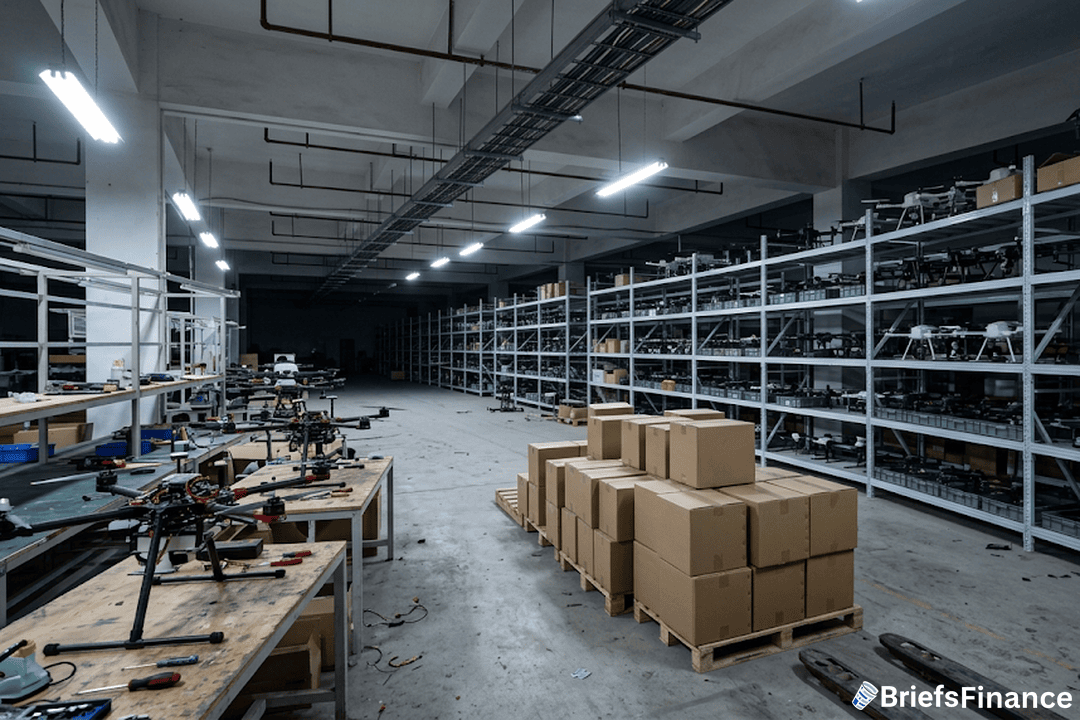
China is the world's biggest maker of drones. Last year, DJI Technologies, headquartered in Shenzhen, accounted for roughly seven in ten commercial drones bought in the US.

So when Beijing announced on Wednesday, August 5, 2026, that every drone shipment to the US would now need strict case-by-case approval, that was not a symbolic gesture. It was the sharpest piece of a four-part package of countermeasures from China's Commerce Ministry, and it added fresh strain to a fragile trade truce between the world's two largest economies.

The ministry pointed at Washington as the reason. It cited the FCC's ban on certain overseas-built robots and power inverters, along with Washington's decision to put 43 Chinese companies - more than 40 - on a forced-labor blacklist.

A ministry spokesperson said the US actions "contradicted the common understandings reached by the two heads of state and damaged China's legitimate rights," adding that Beijing had to respond. The spokesperson called the response broadly restrained and asked Washington to drop its measures and return to consultations.

Why Drones Are the Sharpest Piece

Under the new rules, drones, their key parts, and related technologies covered by China's export-control list for dual-use goods - products that can serve both civilian and military purposes - will all require approval before they can head to the US.

Get the free Always Be Buying eBook and learn the simple system for building wealth on any income

The US has been trying to cut that reliance for a while. In December, the FCC banned most foreign-made drones and critical unmanned-aircraft-system parts, though the ban only affects newly imported or sold items, not the ones already in use.

Beijing also went after the people and companies behind those US moves. It sanctioned six US organizations, including Applied DNA Sciences and Stratum Reservoir, for their alleged role in US Xinjiang-related sanctions. It separately sanctioned Compliance Testing for helping the FCC act against China.

The Countermeasures Go Beyond Drones

China also opened a foreign-trade national-security investigation into imported office printers, copiers, and similar imaging equipment that includes imported software. The review could create real friction for foreign office-gear makers who sell into China.

The timing shows how quickly the relationship soured. The 43 sanctions landed one day after Vice Premier He Lifeng held a video conversation last week with Scott Bessent, the US Treasury secretary, and Jamieson Greer, the US trade representative. So the two sides are still talking, but the actions keep piling up.

More US restrictions may be on the way. A Tuesday Bloomberg article, based on information from someone familiar with the matter, said the FCC is preparing a rule to ban Chinese-made data-center components.

Reuters said the FCC was weighing a ban on imports of new Chinese optical transceiver models. More US restrictions would bring more Chinese countermeasures, the spokesperson warned.

What This Means for Your Portfolio

Xi Jinping and Donald Trump are set to meet in the US next month, which suggests both sides still see a reason to talk. At their May summit in Beijing, they agreed to foster a stable, constructive strategic relationship, but that agreement is now being tested.

For investors, the real story is supply chains. If Chinese drone exports slow down, US businesses that rely on DJI could face delays or higher prices.

The same math applies if the FCC moves against Chinese data-center components.

Trade friction rarely stays inside one industry. It ripples through earnings calls, product prices, and the companies sitting in the middle.

Over the next few months, watching how these restrictions play out may tell you more about your portfolio than any single headline.

Download the free Always Be Buying eBook and start putting your money to work today
Disclosure

Recent News

1 2 3 81

Get Market Briefs delivered to your inbox every morning for free!

No fluff. No noise. No politics. Just finance news you can read in 5 minutes.

Blogs

September 18, 2026
Kevin Warsh Just Defied Trump: What the Fed Rate Hike Means for Your Money
  • The Fed raised rates for the first time since 2023 in a unanimous vote led by Kevin Warsh, the chairman President Trump appointed to cut them.
  • Higher rates make the $40 trillion national debt, business loan resets and mortgages more expensive, but they strengthen the dollar and pay investors holding cash.
  • The war with Iran is pushing up oil, grocery and chip prices, another hike is likely in 2026, and recession talk is about to get louder.
Read More
September 17, 2026
Why America Bailed Out the Yen: The Japan Carry Trade, the Dollar and Your Mortgage Rate
  • In July 2026 the US sent money to steady the yen because Japan is the largest foreign owner of US debt, and Washington needs Japan to keep lending.
  • For decades the Japan carry trade let Wall Street borrow yen at essentially 0% and pour it into US stocks, real estate and Treasuries, and rising Japanese rates are shutting that off.
  • A weaker yen means fewer buyers for the dollar and for US debt, which pushes Treasury rates up and drags mortgage, car loan and credit card rates up with them.
Read More
September 16, 2026
Treasury Yields Are Spiking Because Lenders Are Backing Away From U.S. Debt
  • The U.S. is paying its highest 30-year borrowing rate in about two decades because its biggest lenders, the Fed, foreign governments, and banks, are all pulling back from Treasuries.
  • Every mortgage, car loan, credit card, and business loan is priced off the 10-year Treasury yield, so when Washington pays more to borrow, so do you.
  • With about $40 trillion of debt against a $32 trillion economy, the country either outgrows its debt or slides into a doom loop, and investors need a plan for both.
Read More
September 15, 2026
Fiat Currency Runs on Trust, and the World Just Stopped Trusting the Dollar
  • Gold has overtaken US treasuries as the world's top reserve asset, and central banks are now buying less US debt and more gold.
  • The US dollar is a fiat currency, meaning it's backed by a promise rather than gold, so it loses value when fewer countries want to hold it.
  • Whether the US economy or its national debt grows faster from here decides which assets stand to benefit next.
Read More
September 14, 2026
Why RAM Prices Are Soaring - and Where the Money Is Moving
  • Memory chips - the RAM inside phones, laptops, fridges, and trucks - are in a shortage Tim Cook called a 100-year flood, and some memory prices have climbed about 90% in a single quarter.
  • Four forces hit at once: AI demand, a production shutdown in 2023, build times that push any fix to 2028 at the earliest, and a bombed helium plant in Qatar.
  • The last two supply shocks ended in aggressive Fed rate hikes and market drops of around 45% and 20%, and this time Washington is spending heavily to bring memory production home.
Read More
September 11, 2026
How Is the Economy Doing? Washington Says It's Fixed, but the Numbers Don't Agree
  • Treasury Secretary Scott Bessent says the economy is fixed because lower earners' incomes are now rising faster than top earners'.
  • The Atlanta Fed and Bank of America show different numbers, and Hilton, Marriott, and McDonald's can't agree on what they're seeing either.
  • Whichever side is right, the economy is built to make investors rich, and inflation is how it does it.
Read More
September 10, 2026
US National Debt Hits $40 Trillion: Why the Economy Hasn't Collapsed Yet
  • The US national debt crossed $40 trillion in 2026 and is growing faster than the economy. The debt to GDP ratio now sits at 125%, the highest outside the pandemic and higher than World War II.
  • On September 9, 2026, Treasury Secretary Scott Bessent rolled out an emergency plan for the government to lend money to itself. Ray Dalio now says the dollar has roughly three years before real pain.
  • Empires rarely default. They debase. Since 1971, median household income grew about 8x while houses grew 17x and the S&P 500 grew 360x, so investors got richer while workers fell behind.
Read More
September 9, 2026
Your 401k Is Fueling the AI Bubble
  • About $10 trillion of 401k money sits in a $77 trillion stock market, mostly through target date funds and S&P 500 funds. Roughly 30% of every S&P 500 dollar lands in five AI-heavy tech stocks.
  • Four bubble signals run hotter today than before the 2000 crash: top-ten concentration, tech's share of the index, the Buffett Indicator, and how much of the market index funds own.
  • You only lock in an AI bubble loss if you sell. The 2022, 2020, 2008, and 2000 crashes were all buying windows for long-term investors, and the US-China AI race means government money could keep flowing in.
Read More
September 9, 2026
What Is Wealth Preservation? How To Protect Your Money From Anything
  • Wealth preservation is an investing strategy built around keeping the money you've already made instead of chasing growth.
  • It leans on assets that hold steady when markets fall - gold, Treasury bonds, and companies that keep earning through wars, crashes, and pandemics.
  • The tradeoff is real: you give up some upside, and the two key numbers to check are maximum drawdown and correlation to the market.
Read More
September 8, 2026
Why Is Everything So Expensive? Why Prices May Never Come Back Down
  • Official inflation is 3.4% and prices are up 32% since 2020, but rent (41%), gas (47%), car insurance (64%) and ground beef (79%) all outran the 28% median wage.
  • The Federal Reserve targets 2% inflation on purpose. Rising prices push extra dollars to investors and shrink the real cost of a $40 trillion national debt.
  • Investors who simply owned the S&P 500 gained about 150% over the same six years, and the Fed's September 16 decision will show whether it protects the dollar or the economy first.
Read More
1 2 3 27
Share via
Copy link












