The Stock's Slide
Friday's trading left the stock at $108.37. The stock also fell for a fourth consecutive week.
Tech investors have not witnessed such a high-profile debut turn so disappointing since Facebook's 2012 IPO. Facebook fell steadily for months after its first day and eventually traded below half its IPO price. On its first day, Facebook was worth about $100 billion, roughly a fifth of the market value SpaceX has lost since its own early spike.
SpaceX's market value now stands at $1.4 trillion. Trailing revenue puts the stock's price-to-sales multiple in the 70s. The company is consuming billions each quarter and carries nearly twice the debt it holds in cash.
Lock-up provisions are set to start expiring soon, letting early backers sell and potentially flooding the market with new shares. Bears have profited handsomely from the slide. "It's among the most aggressive and quickest bearish builds we have seen in a mega-cap name heading into its first earnings report post-IPO," S3 Partners' Matthew Unterman, the research head, said in an email.
The report is also a test of whether the growth story can support the $1.4 trillion valuation. The company is burning billions each quarter, carrying nearly twice the debt it holds in cash, and relying on Starlink for its only current profit. The first public earnings report will give shareholders a look at how those pieces are developing.
Get the market news that matters in a five-minute read with Market Briefs, our free daily newsletter
What Analysts Say
Ben Harwood, a New Street Research analyst, said that while "the shares have been volatile since the IPO," the slide was a chance to get in. "For a long-term investor we think this is an attractive entry point," Harwood wrote in an email. "The growth runway is enormous, and SpaceX has one of the widest moats in the market today."
Bernstein analysts see Starship as the key to rationalizing SpaceX's share price. In a Friday client note, they also flagged the availability of semiconductors, permitting hurdles, and compute capacity. Its satellite data centers will need huge amounts of processors, every Starship launch requires FAA signoff, and the company must keep expanding computing power after folding in xAI in February.
"We believe the quarterly results should not matter," the analysts wrote. "What will be important is the level of confidence projected by management regarding the company's growth path."
Starship and the Business
SpaceX bulls tend to base their story on Starship, a fully reusable next-generation vehicle meant to carry the company's upgraded, higher-capacity v3 satellites into orbit. A successful Starship would lower the price of putting cargo and crews in orbit, the company argues, allowing quicker growth of Starlink and its satellite services. Starlink is the only part of SpaceX that currently turns a profit.
The Falcon family made SpaceX the leading launch company globally, but that side of the business remains unprofitable. With many times Falcon's lift capacity, Starship could produce better margins for research, defense, and internet customers, and perhaps kick-start commercial space tourism.
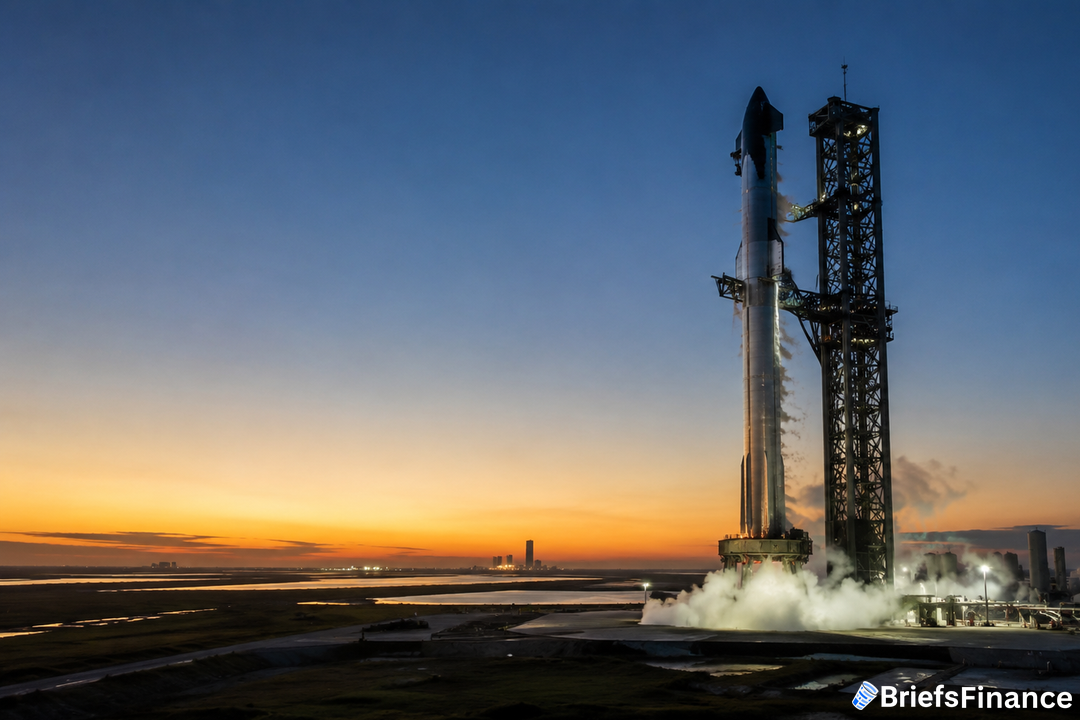
SpaceX carried out its 13th test flight of Starship, a vehicle roughly 400 feet tall, on July 24 from Starbase, Texas. About two minutes in, the Super Heavy booster separated and came down in the Gulf of Mexico. SpaceX said the landing wasn't perfect: the booster "attempted to relight its engines for the landing burn," but only a subset ignited before a "hard splashdown." SpaceX's IPO prospectus warned that failing to make Starship fully reusable and quickly relaunchable would mean higher launch costs, slower rollouts, delayed revenue, and larger capital needs. SpaceX also said it expects Starship to "commence payload delivery to orbit" in the latter part of the year.
What to Watch
After earnings from Alphabet, Meta, Microsoft, and Amazon, investors will scrutinize SpaceX's AI plans and capital spending. They are also likely to ask about Cursor, the AI coding company SpaceX has agreed to buy for $60 billion. The acquisition is scheduled to close in Q3, subject to regulators. CNBC's Jim Cramer advised waiting until insider lock-up periods start expiring before buying the stock.
Join Market Briefs, our free daily newsletter, for a quick daily rundown of the markets