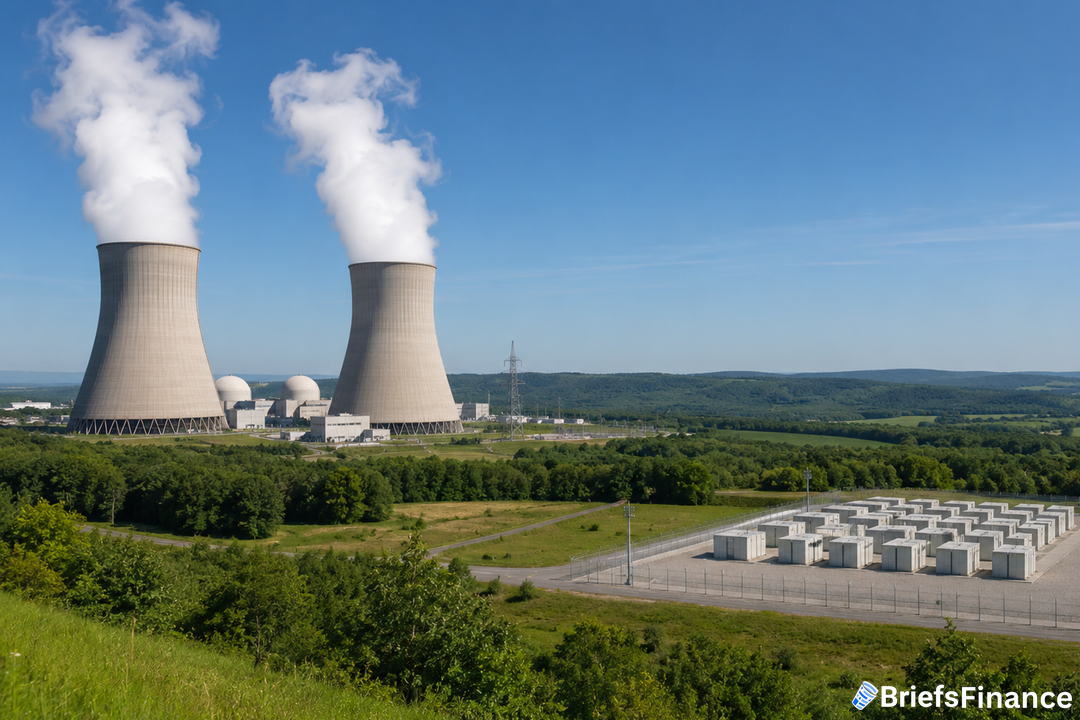
The Waste Problem That Won't Go Away
Nuclear power plants produce waste.
The problem is that there is no permanent home for any of it.
In 1987, Congress selected Yucca Mountain in Nevada as the country's permanent storage site for nuclear waste. Yet political resistance over many years has blocked that project. Since then, spent fuel has been kept at reactor sites in cooling pools and dry casks - a temporary fix that the government has long sought to replace.
Now the government is trying a different approach. Five states - Tennessee, Utah, Louisiana, Idaho, and Oklahoma - have offered to host nuclear waste on their own soil.
Ted Garrish, assistant secretary for nuclear energy at the Energy Department, called it "a new way of thinking about nuclear."
Get the market news that matters in a five-minute read with Market Briefs, our free daily newsletter
What's in It for the Host States
The idea is to make waste storage more appealing by bundling it with things states actually want: jobs, tax revenue, and a piece of the nuclear energy revival.
Energy Secretary Chris Wright said the campuses "will be massive generators of economic growth, create thousands of high-paying jobs, and be crucial to unleashing America's nuclear renaissance."
There is also a national push on the table.
The Catch: Laws and Limits
Here is where the plan gets tricky. A 1987 federal law dictates that commercial nuclear waste may be disposed of only at Yucca Mountain. To implement these state-level agreements, Congress must pass new legislation that overrides that restriction.
There is also the question of what to do with the waste once it arrives. The U.S. does not have any commercial-scale fuel reprocessing facilities currently operating, though several companies want to build them.
Edwin Lyman, a nuclear safety specialist at the Union of Concerned Scientists, said the plan is "an attempt to try and package the unpalatable task of trying to find a radioactive waste disposal site for all the country's spent fuel by packaging it with other activities that are more appealing." He argued that "there is not an alternative for safe disposal of spent nuclear fuel other than a mined geological repository."
The agreements are non-binding. As per the agreement, each state would establish a Nuclear Lifecycle Innovation Campus, encompassing waste storage along with uranium enrichment, reprocessing of spent fuel, and fuel production. Additionally, these campuses could accommodate advanced reactor rollouts, electricity generation, and data center operations.
Currently, the nation holds more than 95,000 metric tons of used reactor fuel spread across 30 states, and the Energy Department projects that figure will almost double over the next few decades. That growing stockpile gives added urgency to finding a long-term solution.
Join Market Briefs, our free daily newsletter, for a quick daily rundown of the markets