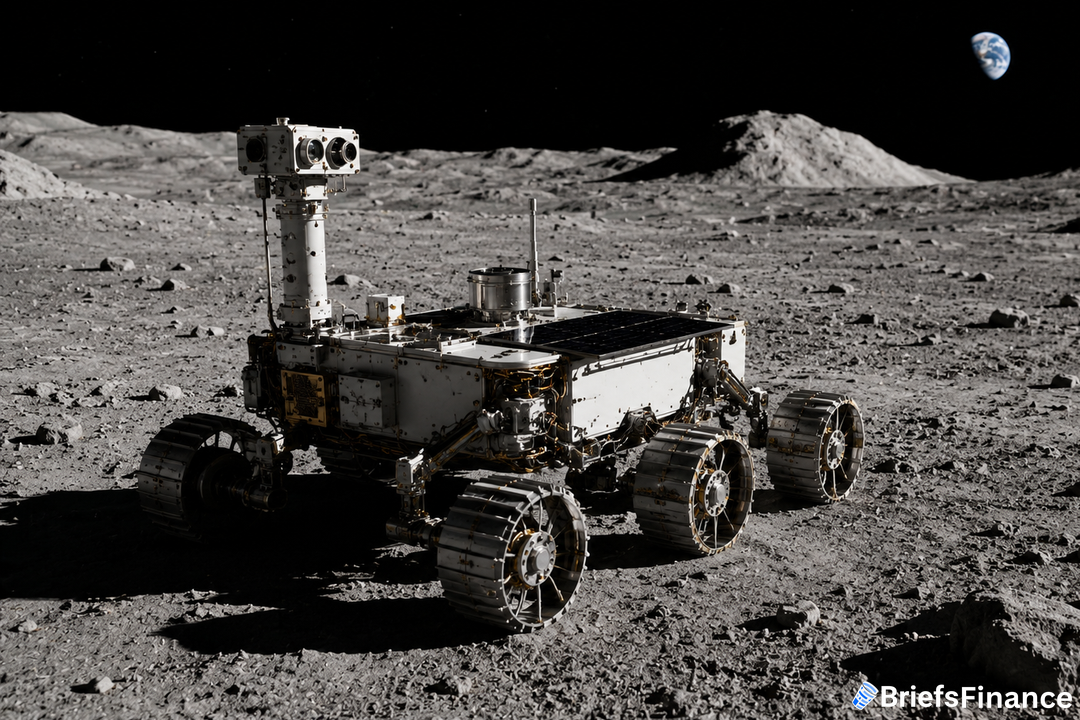
The moon is about to get a serious computer upgrade.
On July 23, 2026, Lunar Outpost - a Colorado-based space robotics company - revealed its next rover will be equipped with Nvidia's Jetson chips. The Jetson chip is a small, energy-efficient type of graphics processing unit for which Nvidia has become well known. While GPUs are mostly known for powering video games and AI data centers back on Earth, this one will be handling navigation and decision-making in an extreme environment.
This chip would likely be the first GPU to operate on the moon. The company is testing it against its existing flight computer, which has a longer history in space.
"We're taking the Nvidia Jetson and comparing it to our flight compute platform that has a little bit more spaceflight heritage," said Justin Cyrus, CEO of Lunar Outpost. "We're really pushing towards trying to adopt these more capable GPU-powered systems in these extreme environments."
The rover will travel aboard a lander from Intuitive Machines, a fellow lunar-focused firm. Also launching in that window is a Firefly Aerospace satellite - Firefly, which became the first private firm to achieve a safe lunar landing with a robot, will carry Nvidia's Jetson platform into lunar orbit.
Why the Moon Needs Smarter Robots
Five years ago, Lunar Outpost's rover software was what Cyrus calls "more deterministic." That meant it followed a strict set of rules. But space is messy, and you cannot predict every rock.
Get the market news that matters in a five-minute read with Market Briefs, our free daily newsletter
Now the company is blending that old-school approach with physical AI - artificial intelligence that can adapt to the real world. The rover can learn and adjust on the fly, which is a big deal when you are driving on a surface that has no roads and no GPS.
But the moon is brutal on electronics. Lunar night lasts about two weeks, and the cold can kill unshielded hardware.
"Your system has to survive lunar night and has to do so on very low power," Cyrus said. Nvidia's chip is designed to deliver a lot of computing punch without draining the battery.
The company runs its deterministic software and the new AI software side by side to figure out where the AI can handle tasks no robot has ever done before.
Nvidia's Jetson chip, designed for low power consumption while delivering high computational performance, is a critical enabler for robotic autonomy in such conditions.
What Comes Next
Two missions are lined up for Falcon 9 rockets before the end of 2026: Lunar Outpost's rover on an Intuitive Machines lander and Firefly's satellite. Both should reach the moon within months of each other.
Lunar Outpost is also building a much larger rover called Pegasus, designed to carry astronauts, targeted for a 2028 launch on a Blue Origin rocket. Blue Origin suffered an anomaly this summer, but Cyrus remains optimistic. "It does seem like they're making pretty darn good progress on the pad," he said. "Everything we've been told, we're on the same timeline for 2028."
Rather than developing everything in-house, NASA contracts private firms to construct spacecraft that transport scientific instruments to the lunar surface. Those sensors study the terrain and look for useful resources - water ice is a big one, because it could be turned into fuel and air for future astronauts.
The bottom line: The moon is becoming a place where private companies compete for government contracts, and where their technology gets stress-tested like nowhere on Earth.
Join Market Briefs, our free daily newsletter, for a quick daily rundown of the markets