Free NewsletterPro Login
S&P 500 6,287 +0.42%
DOW 44,521 -0.18%
NASDAQ 21,103 +0.71%
S&P 500 +12.4%
Briefs Finance Fund +24.8%
JOIN THE FUND →

World Cup: Brazil's Rooftop Solar Surge Meets 15% Demand Drop

Published Jun 29, 2026
[tts_player]
Share:
Summary:
  • Brazil's electricity consumption fell 15% below average during the 2022 World Cup matches, according to grid operator data.
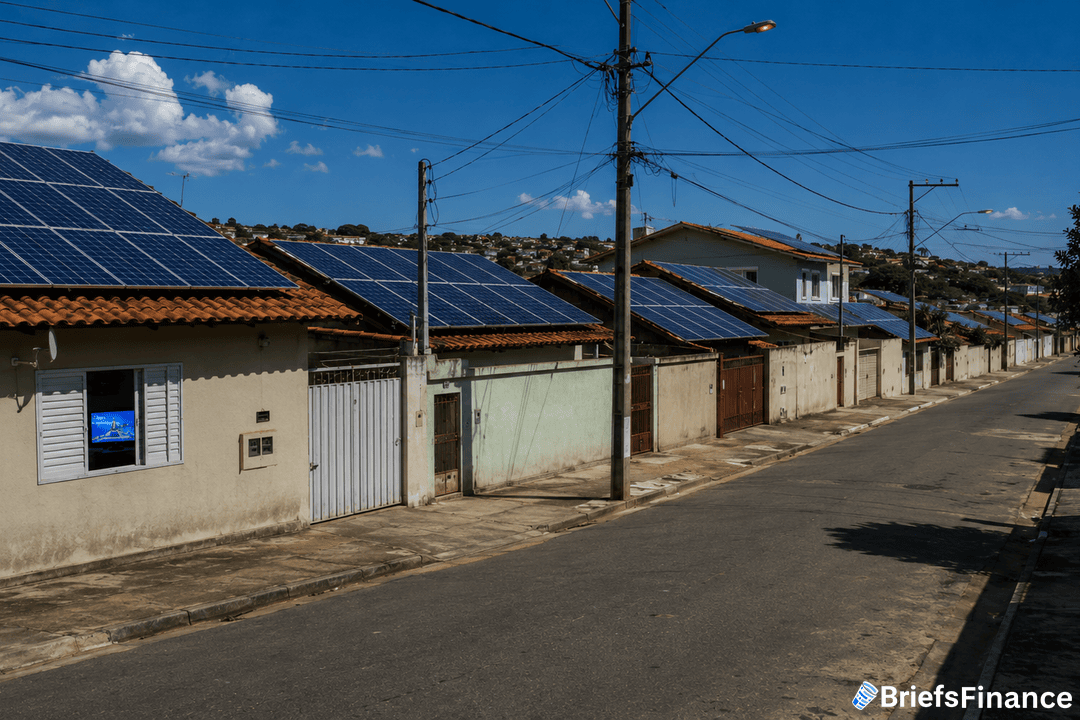
  • Rooftop solar panels now account for nearly 20% of the country's total installed generation capacity of 247.9 gigawatts.
  • Grid operators cut 20% of renewable generation in 2025, costing wind and solar operators an estimated 6.5 billion reais ($1.2 billion).

When a World Cup match starts, millions of Brazilians stop working and sit down to watch. Electricity demand drops sharply. But rooftop solar panels still generate power - and grid operators cannot control them. That creates a dangerous imbalance for Brazil's power grid.

The Grid's Control Problem

Brazil's grid operator, ONS, has to keep supply and demand equal at all times. Normally, it can dial down large power plants when demand falls. But about 4 million small-scale generation units - 90% of which are rooftop solar panels on homes and businesses - pump power into the system without any central control. The operator cannot order them to stop.

This becomes a big problem during events like World Cup matches. The only way ONS can rebalance the grid is to cut power from large renewable plants it can control. That is called curtailment.

"During periods of low electricity demand combined with high generation, such as on Sundays and public holidays, it creates operational challenges," Brazil's electricity regulator Aneel said.

Get your free investing masterclass bonus when you join Market Briefs, our free daily newsletter

Who Pays the Price

The pain from curtailment does not fall evenly. Large industrial energy users, represented by the association ABRACE, are the ones who signed long-term contracts for wind and solar power years ago. Now those projects are being forced to shut down at times.

"The parties suffering most now from curtailment are the very industrial companies that contracted these projects years ago with government subsidies," said Victor Iocca, who serves as director of electrical energy at ABRACE.

On the other side, the rooftop solar industry says it is not the problem. The Brazilian distributed generation association ABGD points out that its roughly 21 million customers supply power when it is most needed. According to Christino Áureo, who serves as the director of government and institutional relations at ABGD, "We need to provide a solution for the power system so that this expansion can eventually reach a balance."

But the uncertainty is already scaring off new investment. Atlas Renewable Energy, a wind and solar developer, suspended $1 billion in new projects earlier this month, citing a lack of clarity on curtailment solutions.

What's Next for the Grid

Authorities at Brazil's energy ministry and the regulator Aneel are discussing fixes. In May, Energy Minister Alexandre Silveira said that further work is required on the "technical and legal framework that can provide certainty to the proposed solutions."

One idea is battery storage. Another option is expanding electricity exports to neighboring countries.

The distributed generation association argues batteries are the most effective fix. "It's very clear to me that the solution involves batteries," said Áureo.

Subscribe to Market Briefs, our free daily newsletter, and claim your bonus investing masterclass

Disclosure

Recent News

1 2 3 28

Get Market Briefs delivered to your inbox every morning for free!

No fluff. No noise. No politics. Just finance news you can read in 5 minutes.

Blogs

June 29, 2026
Portfolio Diversification: Why Putting All Your Eggs in One Basket Destroys Wealth
  • Real diversification means spreading investments across all 11 economic sectors plus bonds, alternatives, and cash so no single bet can sink the portfolio.
  • Different sectors perform at different times, so a diversified portfolio captures upswings while smoothing the brutal drawdowns that wipe out concentrated bets.
  • Total market index funds offer the simplest path to diversification, and annual rebalancing is what keeps the structure working over time.
Read More
June 29, 2026
Non Taxable Income: What It Is and Why It Matters
  • Non taxable income is money you receive that you don't owe income tax on.
  • The tax code treats workers, investors, and business owners very differently, and investors often come out ahead.
  • Learning how income is taxed is a quiet superpower for keeping more of what you earn.
Read More
June 29, 2026
Semiconductor Stocks: A Simple Guide for Investors
  • Semiconductor stocks are companies that design and make computer chips, the brains inside nearly every modern device.
  • The AI boom has turned chips into one of the market's most important and most watched groups.
  • They offer big growth potential, but come with high valuations and a notoriously cyclical history.
Read More
June 25, 2026
How Stocks Work: A Simple Guide for Beginners
  • A stock is a slice of ownership in a company - buy one, and you own a piece of the business.
  • You make money two ways: the share price rising over time, and dividends paid to shareholders.
  • The simplest path for most beginners is buying into the whole market through a low-cost index fund.
Read More
June 25, 2026
Stop Loss vs Stop Limit: What's the Difference?
  • A stop loss order sells your stock once it hits a trigger price, prioritizing getting you out.
  • A stop limit order only sells within a price range you set, prioritizing price over a guaranteed exit.
  • The trade-off: a stop loss almost always executes; a stop limit might not if the price moves too fast.
Read More
June 25, 2026
Energy Stocks: A Simple Guide for Investors
  • Energy stocks are companies that produce and supply the power the world runs on, from oil and gas to newer sources.
  • They make up one of the 11 sectors of the market and tend to move with energy prices and big-picture shifts.
  • Like any sector, the key is diversification and understanding the forces driving demand.
Read More
June 18, 2026
What Is a Stop Loss Order? A Simple Guide
  • A stop loss order automatically sells a stock once it falls to a price you set.
  • It's a tool to cap losses or lock in gains without watching the market all day.
  • It works best for active strategies, and can backfire if used carelessly on long-term holdings.
Read More
June 18, 2026
Best S&P 500 Index Fund: How to Choose One
  • The best S&P 500 index fund for most investors is simply the cheapest, most established one that tracks the index well.
  • Funds like VOO, IVV, and SPY all hold the same 500 companies, so the biggest difference is the fee.
  • Pick one, automate your buys, and let time do the heavy lifting.
Read More
June 17, 2026
What Are Penny Stocks? Risks and Rewards Explained
  • Penny stocks are very low-priced shares of very small companies, often trading for just a few dollars or less.
  • They promise huge gains but carry huge risks: low liquidity, high failure rates, and wild price swings.
  • Most investors are better served by quality companies and funds than by chasing cheap shares.
Read More
June 17, 2026
Best Stocks for Beginners With Little Money
  • The best stocks for beginners with little money usually aren't individual stocks at all - they're low-cost index funds.
  • You can start with $100 or less and use small, regular investments to build wealth over time.
  • Focus on diversification and consistency, not on picking the next big winner.
Read More
1 2 3 24
Share via
Copy link










