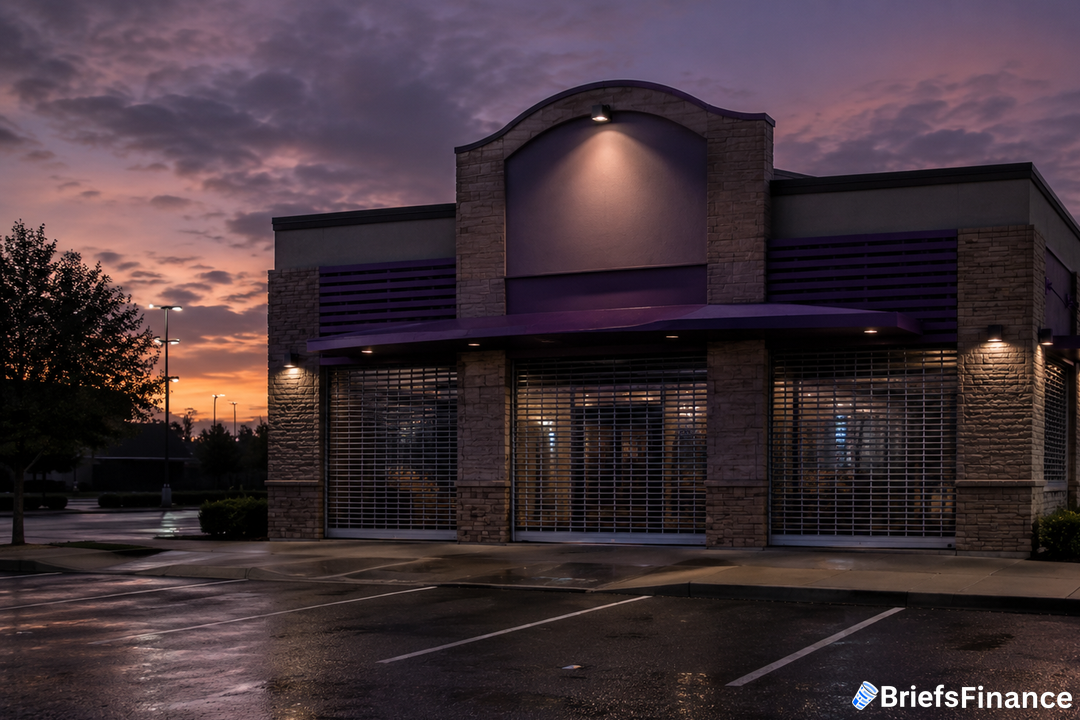
What Happened at Taco Bell
A parasite called Cyclospora found its way into iceberg lettuce served at Taco Bell locations. The lettuce came from a supplier named Taylor Farms, which also supplied onions linked to a McDonald's E. coli outbreak back in 2024.
The Food and Drug Administration first tied the outbreak to Taco Bell's lettuce, and the company quickly pulled affected produce from its restaurants on July 17.
Taco Bell's CEO Sean Tresvant published an open letter to customers on July 22. "We aren't entitled to your loyalty. We earn it one meal at a time," he wrote. On the same day the letter went out, the chain offered Enchiritos and nacho fries at a $1 price point, and later discounted its Mexican Pizza to $1 on Tuesday as a customer-retention effort.
Robert F. Kennedy Jr., the Health and Human Services Secretary, told reporters that the outbreak is "under control."
Why Investors Are Watching Closely
Yum Brands owns Taco Bell, KFC, and the smaller Habit Burger & Grill chain. The company is about to report its quarterly earnings, and Wall Street expects it to post profit of $1.58 per share on $2.2 billion in revenue. Analysts also forecast same-store sales at Taco Bell grew 7% in the second quarter.
Get the market news that matters in a five-minute read with Market Briefs, our free daily newsletter
Yum Brands is now worth about $42 billion.
The real question is what happens next. An analyst at RBC Capital Markets, Logan Reich, wrote in a note on July 21 that the outbreak likely had "minimal impact on Taco Bell's Q2 results." But he also warned that "debate around impact on Q3 and beyond is the key driver of the stock recently."
Between June 30 and that note's publication, seven different analysts lowered their full-year earnings estimates for Yum Brands. That is a lot of people on Wall Street getting more cautious.
When a restaurant chain loses that many customers overnight, the revenue hit usually shows up a few weeks later - not in the quarter that already ended.
What This Means for Your Portfolio
The big question is whether Taco Bell bounces back fast or struggles for months. Past outbreaks give investors two very different pictures.
According to a research note from M Science, McDonald's sales bounced back within a matter of weeks once the CDC announced the outbreak was contained and news coverage faded, and by Q2 2025 the chain had fully recovered - boosted by the introduction of its Minecraft Movie Meal.
Chipotle had it much worse. Over the span of 2015 to 2018, Chipotle faced connections to five distinct foodborne illness incidents. Customers stayed away for years, and the stock took a long time to recover.
Taco Bell is trying to follow the McDonald's playbook. They got the bad lettuce out of stores fast, the CEO apologized publicly, and they are pushing discounts to get people back in the door. It helped that a former reality TV personality, Lo Bosworth, posted "I still luv u Taco Bell" on the company's Instagram - free positive buzz never hurts.
For investors, the risk is that the outbreak drags through the third and fourth quarters. If Taco Bell keeps losing customers, Yum Brands' overall earnings could miss expectations later this year. If the apology and discounts work, the stock might recover the 5% it lost and then some.
Either way, this is a reminder that a single supply chain problem can hit a company's bottom line hard - and fast. Watch how many customers come back over the next few months. That number will tell you more than any earnings report.
Join Market Briefs, our free daily newsletter, for a quick daily rundown of the markets