Free NewsletterPro Login
S&P 500 6,287 +0.42%
DOW 44,521 -0.18%
NASDAQ 21,103 +0.71%
S&P 500 +12.4%
Briefs Finance Fund +24.8%
JOIN THE FUND →

Trump's Tariff Retreat Sparks Global Market Rally and "TACO" Trade Talk

A stylized illustration of a cylindrical cup with blue arrows and lines indicating a swirling or rotational motion inside the cup.
Published Jan 22, 2026
[tts_player]
Share:
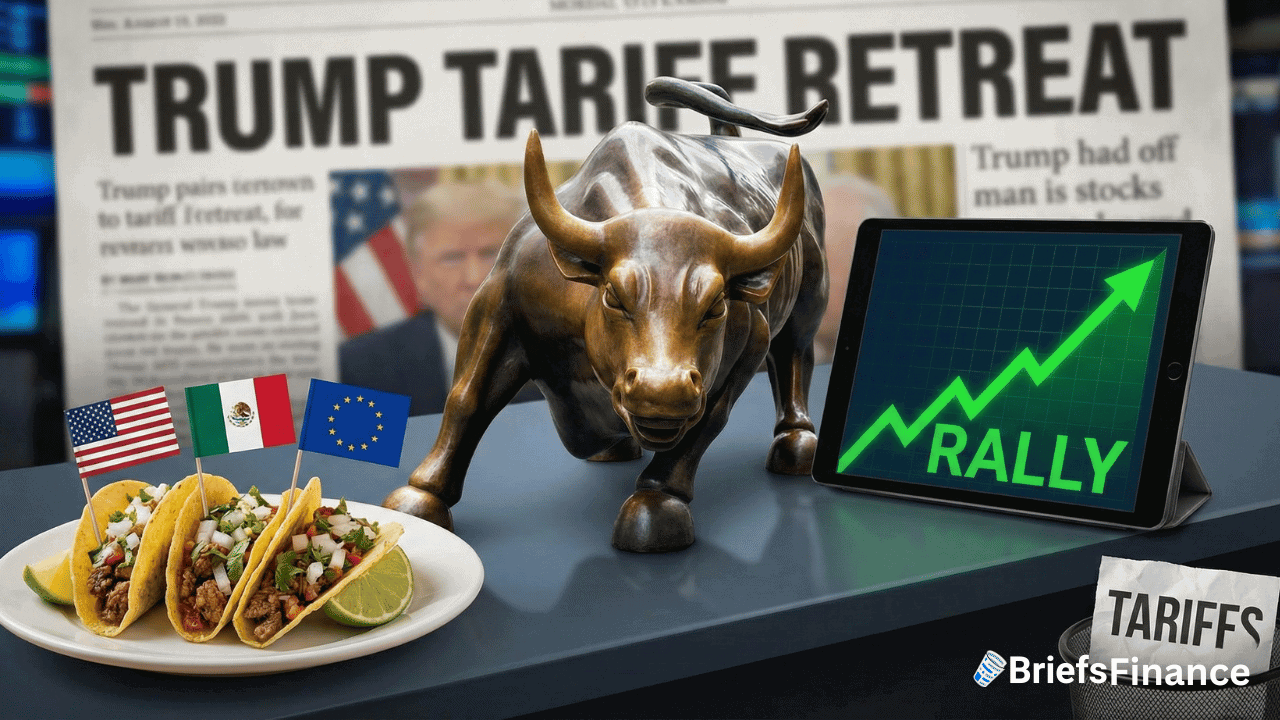
A bull statue, tacos with US, Mexico, and EU flags, a "RALLY" chart on a tablet, and a "Trump Tariff Retreat" headline highlight the Global Market Rally fueled by renewed hopes for smoother TACO Trade between nations.
Summary:

  • On January 21, 2026, Trump retreated from proposed 10% tariffs on eight European countries, set to rise to 25% on June 1.
  • The announcement led to a global market rally, with major U.S. stock averages rising sharply on January 22.
  • The term 'TACO,' meaning 'Trump Always Chickens Out,' has resurfaced among investors following Trump's tariff retreat.

Trump's Announcement and Market Reaction

On January 21, 2026, U.S. President Donald Trump announced he would walk back the proposed 10% tariffs on eight European countries.

These tariffs were scheduled to increase to 25% on June 1. This announcement caused a surge in global markets, with major U.S. stock averages jumping significantly. Futures indicated that gains would continue on January 22, 2026.

The TACO Trade Resurfaces

The recent developments have revived discussions among investors about the "TACO" trade, which stands for "Trump Always Chickens Out."

This term reflects skepticism regarding Trump's trade policies, as he has a history of threatening tariffs only to back down later. Market watcher Russ Mould noted that Trump's behavior has led to a pattern where investors become cautious but optimistic when he retreats from aggressive stances.

Market Sentiment and Analyst Views

Alan Siow, co-head of emerging market corporate debt at Ninety One, commented that while the TACO mindset has influenced recent market rallies, it remains uncertain whether this will lead to permanent changes in market behavior.

He pointed out that the rhetoric from global leaders at the World Economic Forum in Davos indicates a potential shift in policy that could affect business and investment plans.

Despite the positive market response to Trump's conciliatory tone, analysts urge caution. Toni Meadows from BRI Wealth Management advised investors to wait for additional details about the Greenland deal and how Europe might respond.

He noted that while markets are recovering, they remain sensitive to Trump's future announcements.

Implications for Investors

The positive market response indicates a shift in sentiment, but analysts warn that future reactions to White House policies may still be volatile.

As traders digest the implications of the U.S. earnings season, they will closely monitor Trump's next moves and the potential impact on global markets. Meadows emphasized the importance of understanding that market reactions might only be temporary and that the broader implications of Trump's trade policies will unfold in time.

What to Watch Next

Investors should keep an eye on the developments surrounding Trump's Greenland deal and any subsequent announcements regarding tariffs.

The market's reaction to these events could influence the TACO trade's impact on global financial trends. As always, staying informed and prepared for shifts in policy will be critical for navigating the current market landscape.

Disclosure

Recent News

1 2 3 28

Get Market Briefs delivered to your inbox every morning for free!

No fluff. No noise. No politics. Just finance news you can read in 5 minutes.

Blogs

June 25, 2026
How Stocks Work: A Simple Guide for Beginners
  • A stock is a slice of ownership in a company - buy one, and you own a piece of the business.
  • You make money two ways: the share price rising over time, and dividends paid to shareholders.
  • The simplest path for most beginners is buying into the whole market through a low-cost index fund.
Read More
June 25, 2026
Stop Loss vs Stop Limit: What's the Difference?
  • A stop loss order sells your stock once it hits a trigger price, prioritizing getting you out.
  • A stop limit order only sells within a price range you set, prioritizing price over a guaranteed exit.
  • The trade-off: a stop loss almost always executes; a stop limit might not if the price moves too fast.
Read More
June 25, 2026
Energy Stocks: A Simple Guide for Investors
  • Energy stocks are companies that produce and supply the power the world runs on, from oil and gas to newer sources.
  • They make up one of the 11 sectors of the market and tend to move with energy prices and big-picture shifts.
  • Like any sector, the key is diversification and understanding the forces driving demand.
Read More
June 18, 2026
What Is a Stop Loss Order? A Simple Guide
  • A stop loss order automatically sells a stock once it falls to a price you set.
  • It's a tool to cap losses or lock in gains without watching the market all day.
  • It works best for active strategies, and can backfire if used carelessly on long-term holdings.
Read More
June 18, 2026
Best S&P 500 Index Fund: How to Choose One
  • The best S&P 500 index fund for most investors is simply the cheapest, most established one that tracks the index well.
  • Funds like VOO, IVV, and SPY all hold the same 500 companies, so the biggest difference is the fee.
  • Pick one, automate your buys, and let time do the heavy lifting.
Read More
June 17, 2026
What Are Penny Stocks? Risks and Rewards Explained
  • Penny stocks are very low-priced shares of very small companies, often trading for just a few dollars or less.
  • They promise huge gains but carry huge risks: low liquidity, high failure rates, and wild price swings.
  • Most investors are better served by quality companies and funds than by chasing cheap shares.
Read More
June 17, 2026
Best Stocks for Beginners With Little Money
  • The best stocks for beginners with little money usually aren't individual stocks at all - they're low-cost index funds.
  • You can start with $100 or less and use small, regular investments to build wealth over time.
  • Focus on diversification and consistency, not on picking the next big winner.
Read More
June 16, 2026
Tech Stocks: A Simple Guide for New Investors
  • Tech stocks are companies in the information technology and related sectors, from software to chips to the internet giants.
  • They've driven much of the market's growth, but they can be volatile and richly valued.
  • The smart approach is to understand what you own and not let one sector run your whole portfolio.
Read More
June 16, 2026
What Is a Joint Stock Company? A Simple Guide
  • A joint stock company is a business owned by many people, each holding shares of stock that represent a slice of ownership.
  • It's the basic idea behind every public company you can buy on the stock market today.
  • Owning a share makes you a part-owner, entitled to a piece of the profits and growth.
Read More
June 16, 2026
Capital Gains Tax in California: A Simple Guide
  • Capital gains tax is what you owe when you sell an investment for more than you paid for it.
  • How long you held it matters: long-term gains are taxed more gently than short-term gains at the federal level.
  • Smart investors lower the bill with tools like tax-loss harvesting and holding for the long run.
Read More
1 2 3 23
Share via
Copy link









