Free NewsletterPro Login

Trump's Tariff Retreat Sparks Global Market Rally and "TACO" Trade Talk

A stylized illustration of a cylindrical cup with blue arrows and lines indicating a swirling or rotational motion inside the cup.
Published Jan 22, 2026
Share:
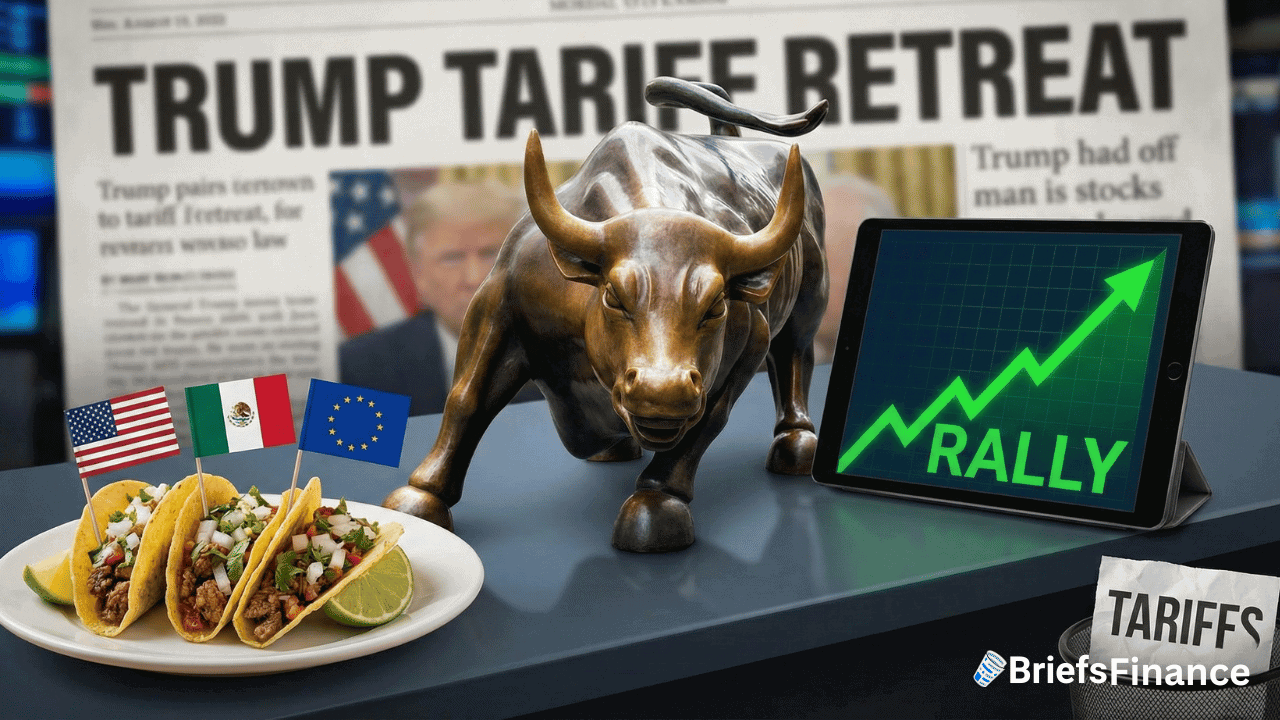
A bull statue, tacos with US, Mexico, and EU flags, a "RALLY" chart on a tablet, and a "Trump Tariff Retreat" headline highlight the Global Market Rally fueled by renewed hopes for smoother TACO Trade between nations.
Summary:

  • On January 21, 2026, Trump retreated from proposed 10% tariffs on eight European countries, set to rise to 25% on June 1.
  • The announcement led to a global market rally, with major U.S. stock averages rising sharply on January 22.
  • The term 'TACO,' meaning 'Trump Always Chickens Out,' has resurfaced among investors following Trump's tariff retreat.

Trump's Announcement and Market Reaction

On January 21, 2026, U.S. President Donald Trump announced he would walk back the proposed 10% tariffs on eight European countries.

These tariffs were scheduled to increase to 25% on June 1. This announcement caused a surge in global markets, with major U.S. stock averages jumping significantly. Futures indicated that gains would continue on January 22, 2026.

The TACO Trade Resurfaces

The recent developments have revived discussions among investors about the "TACO" trade, which stands for "Trump Always Chickens Out."

This term reflects skepticism regarding Trump's trade policies, as he has a history of threatening tariffs only to back down later. Market watcher Russ Mould noted that Trump's behavior has led to a pattern where investors become cautious but optimistic when he retreats from aggressive stances.

Market Sentiment and Analyst Views

Alan Siow, co-head of emerging market corporate debt at Ninety One, commented that while the TACO mindset has influenced recent market rallies, it remains uncertain whether this will lead to permanent changes in market behavior.

He pointed out that the rhetoric from global leaders at the World Economic Forum in Davos indicates a potential shift in policy that could affect business and investment plans.

Despite the positive market response to Trump's conciliatory tone, analysts urge caution. Toni Meadows from BRI Wealth Management advised investors to wait for additional details about the Greenland deal and how Europe might respond.

He noted that while markets are recovering, they remain sensitive to Trump's future announcements.

Implications for Investors

The positive market response indicates a shift in sentiment, but analysts warn that future reactions to White House policies may still be volatile.

As traders digest the implications of the U.S. earnings season, they will closely monitor Trump's next moves and the potential impact on global markets. Meadows emphasized the importance of understanding that market reactions might only be temporary and that the broader implications of Trump's trade policies will unfold in time.

What to Watch Next

Investors should keep an eye on the developments surrounding Trump's Greenland deal and any subsequent announcements regarding tariffs.

The market's reaction to these events could influence the TACO trade's impact on global financial trends. As always, staying informed and prepared for shifts in policy will be critical for navigating the current market landscape.

Disclosure

Get Market Briefs delivered to your inbox every morning for free!

No fluff. No noise. No politics. Just finance news you can read in 5 minutes.

Blogs

May 30, 2026
Financial Literacy Books That Actually Build Wealth
  • The best financial literacy books don't just teach budgeting, they shift how you think about money.
  • Two classics stand out: The Intelligent Investor for valuing investments, and Rich Dad Poor Dad for the owner's mindset.
  • Reading is only step one. The real wealth comes from acting on what you learn.
Read More
May 30, 2026
What Is a Roth Conversion? A Simple Guide
  • A Roth conversion moves money from a traditional retirement account into a Roth account.
  • You pay taxes on the money now, in exchange for tax-free growth and withdrawals later.
  • It can pay off if you expect higher taxes or more income in the future, but the timing and tax hit matter a lot.
Read More
May 30, 2026
Trailing Stop Loss: How to Protect Your Gains
  • A trailing stop loss is an order that automatically sells a stock if it falls a set percentage from its recent high.
  • As the stock rises, the sell point rises with it, locking in gains while capping losses.
  • It's most useful for active strategies like momentum investing, not for long-term buy-and-hold.
Read More
May 30, 2026
5 Types of Wealth: Why Money Is Only One of Them
  • Real wealth is more than a bank balance. It spans your finances, health, mind, purpose, and freedom.
  • Money is powerful, but it amplifies the life you already have rather than fixing a broken one.
  • True financial wealth means your cash flow covers your expenses, so your money works while you live.
Read More
May 30, 2026
How to Invest in Private Equity: A Beginner's Guide
  • Private equity means investing in companies that aren't listed on the stock market.
  • Traditional private equity is built for experienced, high-net-worth investors with large amounts to invest.
  • New rules have opened more accessible paths, like startup crowdfunding and real estate deals, often starting around $100.
Read More
May 30, 2026
What Is a Call Option? A Simple Guide With Examples
  • A call option gives you the right to buy a stock at a set price by a set date.
  • Investors buy calls when they expect a stock to rise, using less money than buying the shares outright.
  • The most you can lose buying a call is the premium, but time works against you, so it's an advanced tool.
Read More
May 30, 2026
EBITDA Formula: How to Calculate It Step by Step
  • EBITDA stands for Earnings Before Interest, Taxes, Depreciation, and Amortization, a measure of a company's core profit.
  • The formula adds those four items back to net income to show what the underlying business earns.
  • Investors use EBITDA to compare companies and to judge how many times earnings a stock is selling for.
Read More
May 30, 2026
What Is a Stock Option? A Plain-English Guide
  • A stock option is a contract giving you the right, but not the obligation, to buy or sell a stock at a set price by a set date.
  • There are two types: calls (the right to buy) and puts (the right to sell).
  • Options are powerful but risky, so they suit investors who already have the basics down.
Read More
May 30, 2026
Put Option: What It Is and How It Works
  • A put option gives you the right to sell a stock at a set price by a set date.
  • Investors use puts to bet a stock will fall, or as insurance to protect shares they own.
  • The most you can lose buying a put is the premium you paid, which makes it a defined-risk tool.
Read More
May 30, 2026
Operating Margin: What It Is and How to Calculate It
  • Operating margin shows how much profit a company keeps from its core business after paying its running costs.
  • The formula is operating income divided by revenue, shown as a percent.
  • A strong, steady operating margin signals a well-run business that controls its costs.
Read More
1 2 3 22
Share via
Copy link









