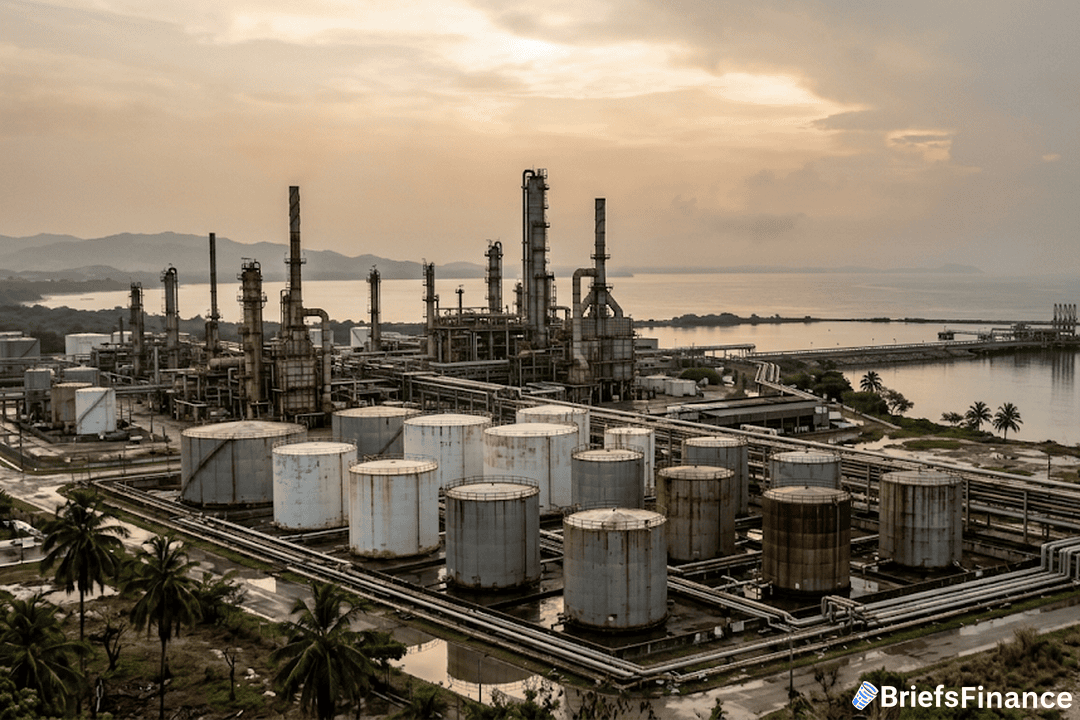
What the Treasury Did
Some of the asphalt on American roads starts in Venezuela. That connection is now tangled up with a Florida billionaire, a British Virgin Islands company, and a U.S. enforcement action.
On Friday, the Treasury blocked assets tied to an overseas company that Sargeant is connected to, and which works in Venezuelan oil production. Several people familiar with the move, who asked not to be named, described it as sanctions.
In plain terms, the government is leaving him a way out.
The penalties fell on Bluewave Properties Ltd., a company registered in the British Virgin Islands, after the Treasury's Office of Foreign Assets Control, a unit that enforces sanctions, found it violated a 2018 order. The order aimed to freeze property belonging to people or groups that backed Venezuela's previous government.
Bluewave owns a minority share of North American Blue Energy Partners, often called NABEP. NABEP is the second-largest private oil producer in Venezuela, after Chevron.
That odd situation matters because of what NABEP produces.
The Billionaire Behind the Oil
Sargeant is a former U.S. Marine pilot and a Florida oil businessman. For years, he served as a go-between for Washington and Caracas at a time when the two governments barely trusted each other, and that role gave him real influence in both capitals.
Get the free Always Be Buying eBook and learn the simple system for building wealth on any income
That influence did not last. As the Trump administration lined up behind a new U.S.-backed president in Caracas, Sargeant drew White House disapproval.
He moved easily between two very different places: Trump's golf club in Palm Beach, Florida, and Venezuela's presidential palace. He often met with former President Nicolás Maduro, who is now held by the U.S., and with officials including Acting President Delcy Rodríguez.
His access had a purpose. He relayed messages between the two governments and helped win the release of U.S. hostages held in Venezuela in 2025.
Along the way, he built commercial arrangements in Venezuela at a time when most oil companies avoided the country because of political danger and U.S. sanctions. An undated photo shows Sargeant and Miami businessman Hugo Perera meeting with PDVSA president Manuel Quevedo in Caracas to talk about drilling agreements with the Maduro government.
That combination of political access and business deals eventually drew attention. After the Wall Street Journal wrote about his influence, Trump posted in February that Sargeant "has no authority, in any way, shape, or form, to act on behalf of the United States of America, nor does anyone else that is not approved by the State Department."
A Trump administration official, speaking on condition of anonymity, described U.S. policy toward Venezuela in three stages: stabilization, recovery, and transition. The official added that Washington will keep supporting responsible, transparent investment in Venezuela that helps people in both countries.
Sargeant would not comment, and the Treasury did not respond to a request for comment.
What It Means for Your Money
The move against Sargeant is not only a Washington story. It reaches into physical goods, starting with the asphalt on American roads.
If Sargeant sells his stake, the next owner will control a meaningful share of Venezuela's private oil production. That matters for road-building costs, energy markets, and anyone who owns stocks connected to oil.
For investors, the episode shows something useful. Oil is always a business, but it is also always a political story, and governments can shift the rules, the players, and the access quickly.
Events like this rarely stay inside one company. They can move oil supply expectations, commodity prices, and the stocks tied to them.
For your portfolio, the useful question is not whether Sargeant wins or loses. It is how much of the oil market still depends on connections and permission from governments.
Download the free Always Be Buying eBook and start putting your money to work today