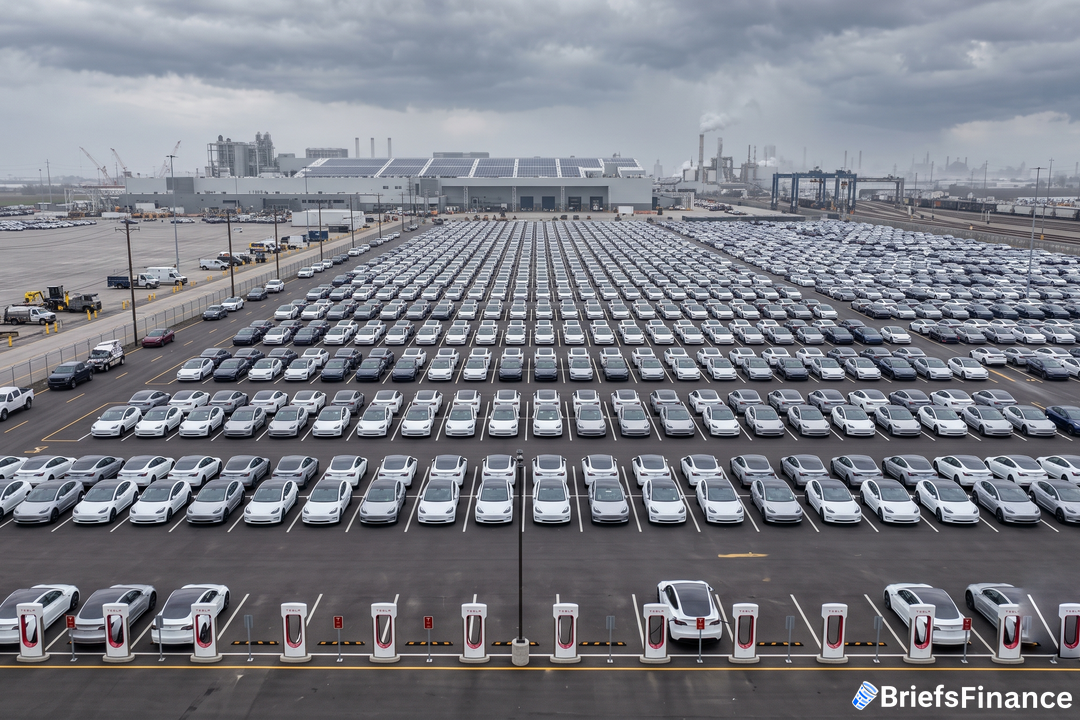
Tesla sold more cars than anyone predicted. But investors still hit the sell button.
Shares dropped 8% anyway.
A Beat That Didn't Pay Off
The delivery numbers were a clear win. Tesla produced 451,758 vehicles in the quarter.
What Drove the Surge
Tesla's strong quarter came from several moves. The company introduced lower-cost versions of the Model 3 and Model Y. Those two models made up 467,762 of all deliveries - 97% of the total.
Get your free investing masterclass bonus when you join Market Briefs, our free daily newsletter
Tesla also broadened the availability of its advanced driver-assistance technology, called Full Self-Driving (Supervised), to certain European countries. Higher gasoline costs triggered by the conflict in Iran drove additional European consumers to switch to electric vehicles. Tesla has been working to bounce back after two straight years of falling vehicle sales. Those drops were partly caused by public pushback against CEO Elon Musk and the expiration of a federal tax incentive for EVs in the United States.
Competition and Challenges
Tesla faces many rivals. Chinese automakers such as BYD, Nio, and Xiaomi are growing quickly. Hyundai Motor Group and Volkswagen also compete for EV buyers. The U.S. market has its own challenges. Dan Hearsch, managing director at AlixPartners, said: "We have a huge country, and people live far away from each other compared to Europe where the charging infrastructure is better and people don't have to drive quite so far."
Tesla's energy storage business is also expanding. The company deployed 13.5 GWh of Megapacks in Q2 2026, beating the 13.3 GWh analyst estimate. That was up from 9.6 GWh a year earlier.
SpaceX, Elon Musk's rocket company, bought $269 million worth of Tesla Megapacks in April 2026. SpaceX also spent $131 million purchasing Tesla Cybertrucks in 2025. Musk's SpaceX, which owns xAI, has deployed the Megapacks to cut power expenses for xAI's computing facilities located in and near Memphis, Tennessee.
The market's negative reaction despite a solid quarterly performance suggests that investors remain focused on longer-term headwinds. While the delivery numbers exceeded expectations, analysts worry about rising competition from BYD and others, the loss of the U.S. federal tax credit, and the impact of Musk's controversial leadership on consumer sentiment. Additionally, Tesla's heavy reliance on the Model 3 and Model Y - which accounted for 97% of deliveries - highlights the need for diversification into new models and markets.
The energy storage business, though growing, still represents a small fraction of overall revenue. These factors likely contributed to the stock's decline even after a strong quarter.
Subscribe to Market Briefs, our free daily newsletter, and claim your bonus investing masterclass