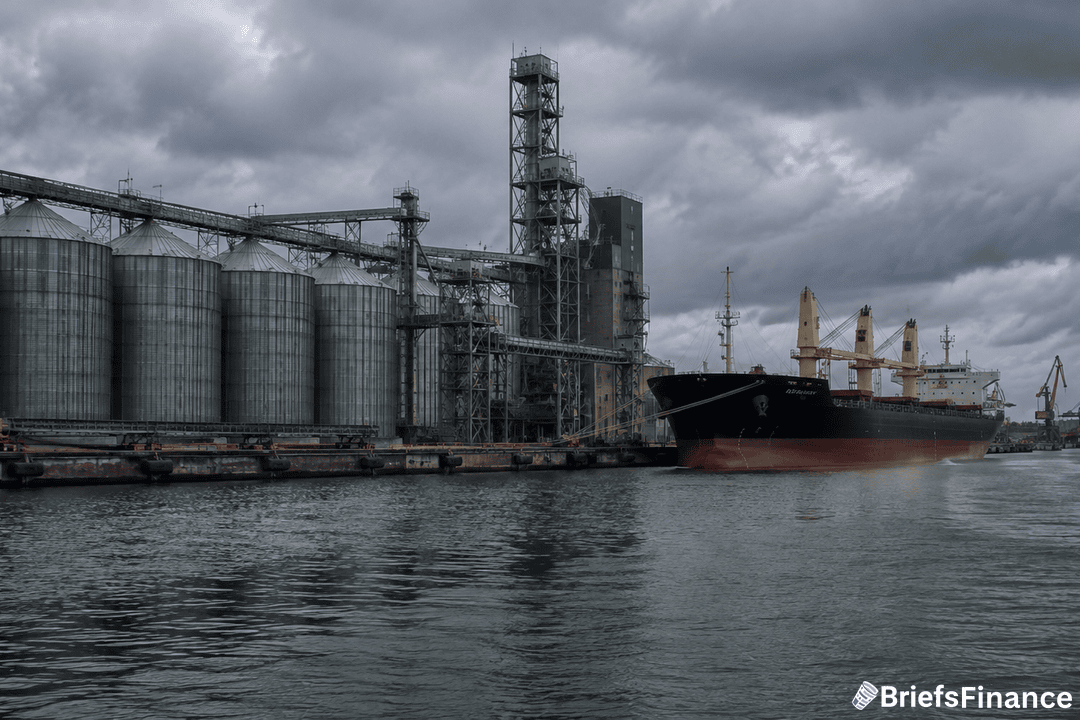
One Port Carried the Grain Business
Ukraine is one of the world's leading grain shippers, and farming is its biggest export earner. Last year, the farm sector brought in more than half of all the money Ukraine made from selling goods overseas.
That makes the new forecast a hard reset. Wheat exports are expected to land at 8.3 million tons, 53% below the earlier estimate.
The reason is not the harvest; it is the attacks. Russian strikes have cut off Odesa. The Danube River is an alternative, but record-low water levels from drought have limited how much grain can move that way.
The New Harvest Is Filling Up Everything
The problem does not stop at the docks. With exports blocked, the new harvest is piling up on farms, and that is dragging down grain prices inside Ukraine.
The country has about 59 million tons of grain-storage capacity. At the current pace, that space may be used up by early November.
Get the free Always Be Buying eBook and learn the simple system for building wealth on any income
That leaves a shortfall of about 11 million tons before autumn ends. That is a serious gap, and it explains why farmers are feeling the pinch.
Backup Routes and Money Are Moving
Kyiv is trying to keep the grain flowing. President Volodymyr Zelenskyy said the government has approved loan help for farmers that lowers the cost of borrowing, and more measures are planned to add storage and alternative export routes.
Kyiv has also requested grant aid of €220 million, about $253 million, from the European Commission to help small and medium-sized farmers cover their loan interest. Ukraine and Romania reached an agreement to increase grain flows through Romania's Constanta port, while the state-owned railway firm Ukrzaliznytsia is seeking additional transit routes.
All of that helps, but it cannot fully replace the port. The backup routes are smaller, slower, and more expensive than Odesa.
Outside forecasters see the same kind of drop. The U.S. Department of Agriculture (USDA) predicts a sharp decline in Ukrainian grain shipments, with an official wheat-export estimate of 14.5 million tons.
For corn, the Foreign Agricultural Service projects 14 million tons, 39% lower than the official USDA corn estimate.
What It Means for Your Portfolio
For investors, this is not just a story about one country's export numbers. Ukraine is a major grain supplier, and when a big supplier loses its main shipping route, food prices can start moving around a lot more.
You may see that first in grocery bills. It can also show up in the stocks and funds tied to farming, food shipping, or emerging markets.
The wider lesson is that supply chains are only as strong as their busiest doorway. Odesa was that doorway, and losing it has consequences that outlast the attacks.
The next few months will show how much grain can be rerouted and at what price. That answer will ripple into the cost of food and into your portfolio.
Download the free Always Be Buying eBook and start putting your money to work today