Free NewsletterPro Login
S&P 500 6,287 +0.42%
DOW 44,521 -0.18%
NASDAQ 21,103 +0.71%

Warning: Undefined variable $funds in /var/www/briefs.co/htdocs/wp-content/plugins/oxygen/component-framework/components/classes/code-block.class.php(133) : eval()'d code on line 491

Warning: foreach() argument must be of type array|object, null given in /var/www/briefs.co/htdocs/wp-content/plugins/oxygen/component-framework/components/classes/code-block.class.php(133) : eval()'d code on line 491
/* the link was here */

Solar Shares Jump as New U.S. Levies Target Polysilicon

Published Aug 7, 2026
[tts_player]
Share:
Summary:
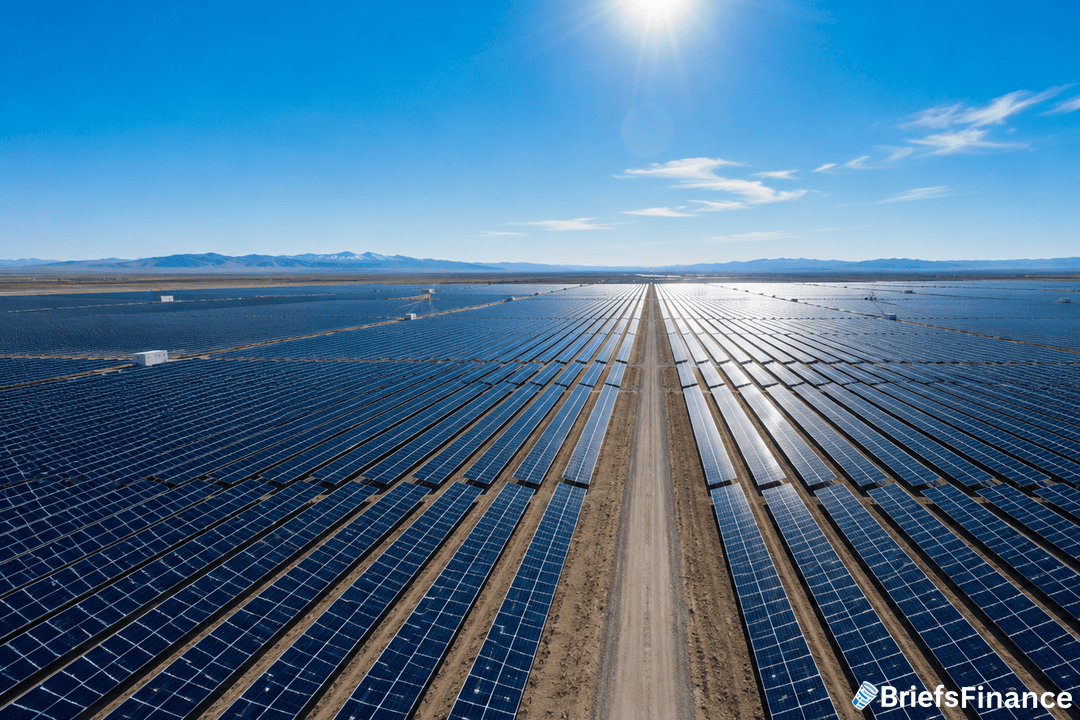
  • Shares of U.S. solar companies jumped Friday after President Donald Trump imposed new tariffs on imported goods made with polysilicon.
  • The order applies a 15% tariff to polysilicon-based products and sets price floors for certain related imports.
  • First Solar rose 6%, SolarEdge Technologies gained about 1%, and the Invesco Solar ETF was up more than 2%.

New Tariffs Hit the Building Block of Solar Panels

Solar panels and semiconductors both depend on a material called polysilicon. It is the raw ingredient that makes them work.

Polysilicon is not a household word. But it is exactly the kind of quiet, essential material that trade fights are made of.

President Donald Trump is turning that ingredient into the latest front in his trade war. On Thursday, he signed an executive order that adds new tariffs on imported goods made with polysilicon.

Investors clearly saw the order as good news for the industry.

In simpler terms, it puts a floor under prices so foreign goods cannot undercut American factories.

The order uses Section 232 of the U.S. Trade Expansion Act of 1962. That law lets the president restrict imports when they pose a threat to national security.

Trump said the goal is to stop foreign countries from weakening American producers. The order spells out the problem in his own words.

"For decades, America has allowed foreign countries to weaken United States producers in the polysilicon sector, eroding our economic and national security. Today, I am taking action to put a stop to these practices and revitalize the United States polysilicon sector," he said in the order.

Get the free Always Be Buying eBook and learn the simple system for building wealth on any income

Commerce Secretary Howard Lutnick provided the advice and information behind the order, Trump said. The new duties are set to stay in place through Aug 7 2026.

Why Polysilicon Is at the Center of a Bigger Fight

Polysilicon matters far beyond rooftops and solar farms. Because it feeds into semiconductors, it also touches the artificial intelligence boom.

That connection makes this a story about AI and energy, not just a niche trade case. The order is meant to shield American supply chains for semiconductors and solar power from Chinese competition, and to counter China in the race over AI and energy.

The White House is framing the move as a national security issue. The 1962 law behind the order was built for exactly that kind of argument.

This makes the tariffs the newest chapter in the U.S.-China contest over chips, energy and AI. Polysilicon now sits right in the middle of all three.

Both countries see clean energy and AI as industries of the future. Control of the materials that feed those industries is part of the contest.

The action is part of a broader U.S. push to reduce reliance on Chinese supply chains for critical materials. Because polysilicon sits at the intersection of solar power and semiconductors, Washington sees it as central to the AI and clean-energy race.

What the Rally Means for Investors

Wall Street read the order as a win for U.S. solar names.

The reason is easy to follow. Tariffs raise the cost of imported polysilicon, which makes domestically produced panels more competitive.

But the math gets more complicated further down the chain. Solar installers and developers buy panels, and if panels get more expensive, the cost savings they pass along to customers could shrink.

For your portfolio, the key question is which part of the solar business you are exposed to. Pure U.S. manufacturers are getting a clear boost right now, while companies that depend on cheap imported parts may face a tougher quarter or two.

For fund investors, the move is a reminder that policy can move an entire sector in a single day. A trade headline can reprice a whole basket of stocks before lunch.

For most investors, the lesson is broader. Trade policy has become a market mover, and the U.S.-China contest now touches chips, energy and AI all at once.

The details still matter. How those price floors are enforced and whether the industry adapts will determine if this rally has legs or fades.

Download the free Always Be Buying eBook and start putting your money to work today
Disclosure

Recent News

1 2 3 51

Get Market Briefs delivered to your inbox every morning for free!

No fluff. No noise. No politics. Just finance news you can read in 5 minutes.

Blogs

June 29, 2026
Portfolio Diversification: Why Putting All Your Eggs in One Basket Destroys Wealth
  • Real diversification means spreading investments across all 11 economic sectors plus bonds, alternatives, and cash so no single bet can sink the portfolio.
  • Different sectors perform at different times, so a diversified portfolio captures upswings while smoothing the brutal drawdowns that wipe out concentrated bets.
  • Total market index funds offer the simplest path to diversification, and annual rebalancing is what keeps the structure working over time.
Read More
June 29, 2026
Non Taxable Income: What It Is and Why It Matters
  • Non taxable income is money you receive that you don't owe income tax on.
  • The tax code treats workers, investors, and business owners very differently, and investors often come out ahead.
  • Learning how income is taxed is a quiet superpower for keeping more of what you earn.
Read More
June 29, 2026
Semiconductor Stocks: A Simple Guide for Investors
  • Semiconductor stocks are companies that design and make computer chips, the brains inside nearly every modern device.
  • The AI boom has turned chips into one of the market's most important and most watched groups.
  • They offer big growth potential, but come with high valuations and a notoriously cyclical history.
Read More
June 25, 2026
How Stocks Work: A Simple Guide for Beginners
  • A stock is a slice of ownership in a company - buy one, and you own a piece of the business.
  • You make money two ways: the share price rising over time, and dividends paid to shareholders.
  • The simplest path for most beginners is buying into the whole market through a low-cost index fund.
Read More
June 25, 2026
Stop Loss vs Stop Limit: What's the Difference?
  • A stop loss order sells your stock once it hits a trigger price, prioritizing getting you out.
  • A stop limit order only sells within a price range you set, prioritizing price over a guaranteed exit.
  • The trade-off: a stop loss almost always executes; a stop limit might not if the price moves too fast.
Read More
June 25, 2026
Energy Stocks: A Simple Guide for Investors
  • Energy stocks are companies that produce and supply the power the world runs on, from oil and gas to newer sources.
  • They make up one of the 11 sectors of the market and tend to move with energy prices and big-picture shifts.
  • Like any sector, the key is diversification and understanding the forces driving demand.
Read More
June 18, 2026
What Is a Stop Loss Order? A Simple Guide
  • A stop loss order automatically sells a stock once it falls to a price you set.
  • It's a tool to cap losses or lock in gains without watching the market all day.
  • It works best for active strategies, and can backfire if used carelessly on long-term holdings.
Read More
June 18, 2026
Best S&P 500 Index Fund: How to Choose One
  • The best S&P 500 index fund for most investors is simply the cheapest, most established one that tracks the index well.
  • Funds like VOO, IVV, and SPY all hold the same 500 companies, so the biggest difference is the fee.
  • Pick one, automate your buys, and let time do the heavy lifting.
Read More
June 17, 2026
What Are Penny Stocks? Risks and Rewards Explained
  • Penny stocks are very low-priced shares of very small companies, often trading for just a few dollars or less.
  • They promise huge gains but carry huge risks: low liquidity, high failure rates, and wild price swings.
  • Most investors are better served by quality companies and funds than by chasing cheap shares.
Read More
June 17, 2026
Best Stocks for Beginners With Little Money
  • The best stocks for beginners with little money usually aren't individual stocks at all - they're low-cost index funds.
  • You can start with $100 or less and use small, regular investments to build wealth over time.
  • Focus on diversification and consistency, not on picking the next big winner.
Read More
1 2 3 24
Share via
Copy link











